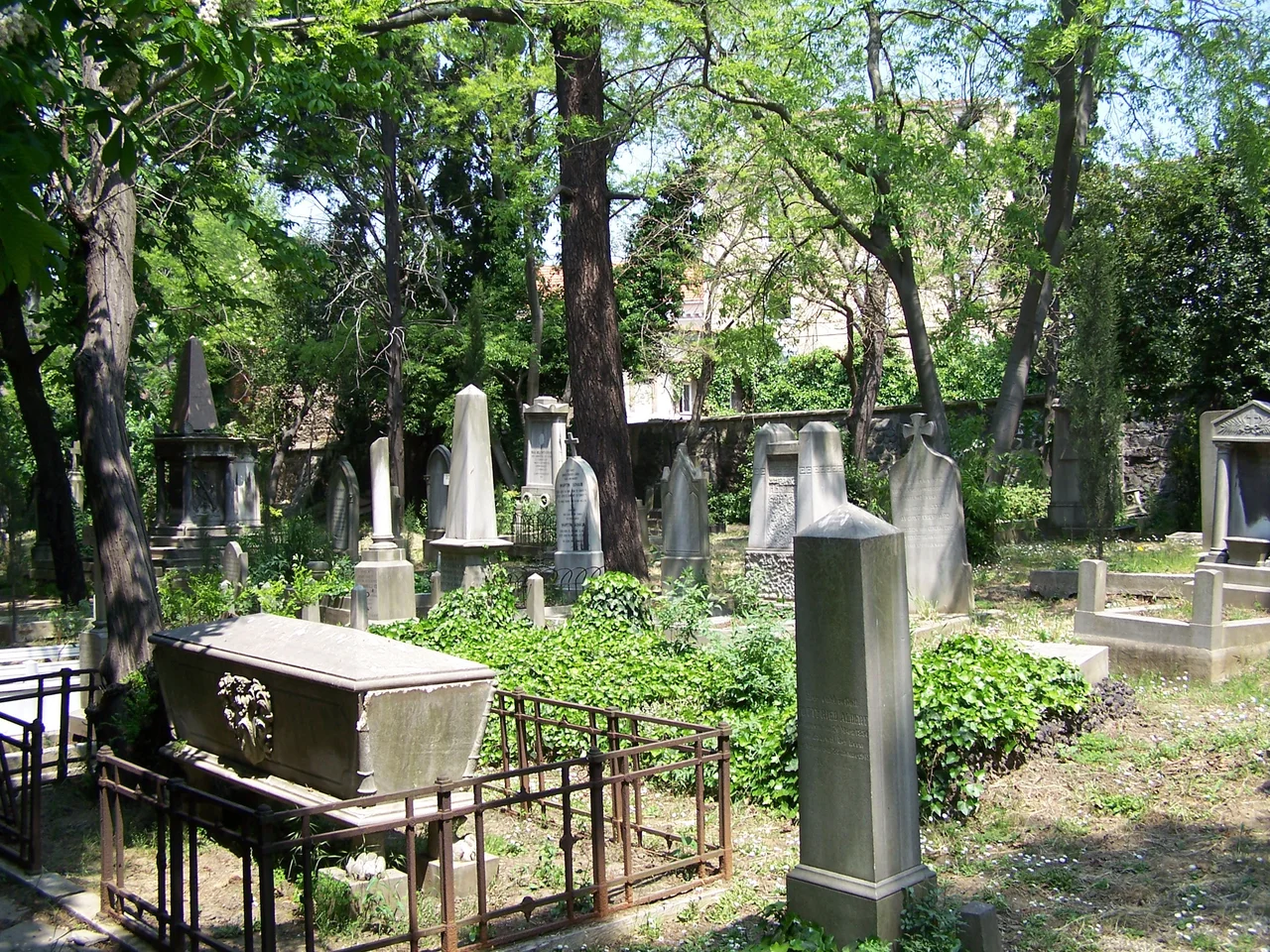

Feriköy Protestant Cemetery
In February 1842, an American missionary named William Goodell recorded in his memoirs a task no parent should ever face: moving the body of his nine-year-old son. Constantine Washington Goodell had died of typhoid the year before and been buried in the old Graveyard of the Franks in Pera. Now developers were encroaching, and his grave had to be moved. Goodell wrote with heartbreaking restraint — the coffin was scarcely damp, everything was sweet and still — before laying the boy in a new grave a few rods distant. It would not be the last time. By 1863, even that grave had been disturbed, and Constantine's remains were transferred again, this time to a newly opened cemetery in Feriköy. There he has rested ever since, in the company of thousands of other lives woven into Istanbul's cosmopolitan past.
A Gift from the Sultan
The Feriköy Protestant Cemetery — its official Latin name Evangelicorum Commune Coemeterium — exists because a sultan decided it should. In 1857, Sultan Abdülmecid I ordered the Ottoman government to donate the land to the leading Protestant powers of the era: the United Kingdom, Prussia, the United States, the Netherlands, Sweden, Norway, Denmark, the Federated Cities of the Hanseatic League, and the Grand Duchy of Oldenburg. It was a remarkable act of Ottoman pluralism, granting foreign Protestant communities a permanent home for their dead on the city's northern fringe, roughly three kilometers north of Taksim Square. The first burial took place in November 1858; the cemetery opened officially in early 1859. Today it is governed by a rotating board drawn from the consulates general of Germany, the United Kingdom, the United States, the Netherlands, Sweden, Hungary, and Switzerland. About 5,000 people have been interred here across nearly two centuries.
The Great Field of the Dead
The cemetery was built to receive the displaced. Between 1840 and 1910, the area running north from Taksim toward Şişli transformed from open countryside into densely inhabited residential neighborhoods. Early maps show that land consumed by the non-Muslim burial grounds of the Grand Champs des Morts — Pera's Great Field of the Dead, a world-renowned necropolis whose design influenced cemetery reformers across Europe. As the city expanded and Istanbul developed along Western models, the Grand Champs des Morts was closed and eventually erased. The Frankish section fell first. Graves were relocated, then relocated again. The land became Taksim Garden, completed in 1869. What Feriköy preserves, along its east and south walls, are the rescued fragments of that earlier world: stones propped against the masonry, transferred from the Graveyard of the Franks, representing the last tangible links to a burial culture that the city otherwise swallowed whole. Monument Row, along the eastern wall, concentrates the most significant of these rescued markers.
A Divided Ground
The cemetery's internal geography tells a story about Ottoman legal categories. A separate section in the southwest corner was set aside for Armenian Protestants, physically walled off from the main cemetery where foreign nationals were buried. The separation reflected official Ottoman classification: Armenians were Ottoman subjects, not foreign nationals, and the imperial millet system kept different communities in distinct administrative spaces even in death. Within that smaller Armenian section, the graves are more linguistically diverse than the wall might suggest — epitaphs in Armenian, Greek, Arabic, and other languages mark the resting places of Greeks, Arabs, Assyrians, and Turkish Protestants, including some who converted from Islam. There is also one Commonwealth war grave: a British Army Intelligence Corps officer who died in 1945, the lone marker of the Second World War in this otherwise nineteenth-century landscape.
The Lives Between the Stones
Walk the cemetery's paths and you pass through a compressed biography of Istanbul's foreign community. Elias Riggs (1810–1901) spent decades as a missionary and linguist, working among the Armenian community. Franz Carl Bomonti (1857–1903), a Swiss brewer, helped launch Turkey's modern beer industry — his name survives in a neighborhood of the city. Per Wilhelm Berggren (1835–1920), a Swedish photographer, documented Ottoman Istanbul in images that historians still rely on. Paul Lange (1857–1919), the last musician of the Ottoman court, led choirs and orchestras in the city for nearly four decades. Josephine Powell (1919–2007) traveled and photographed across the Islamic world and built a major collection of carpets and kilims. John Freely (1926–2017) and Hilary Sumner-Boyd co-authored Strolling through Istanbul, still considered the finest English-language guide to the city. These are not statistics. They are people who arrived from far away, built lives in an extraordinary city, and stayed.
Stewardship and Survival
Cemeteries like Feriköy require active tending to survive urban pressure. In 2018, the Feriköy Protestant Cemetery Initiative formed — a civil society effort focused on preservation, historical research, and keeping the site open as both a burial ground and an urban green space. By 2021, the governing board recognized the Initiative as its official partner. The cemetery holds membership in the Association of Significant Cemeteries in Europe. That designation matters: it connects Feriköy to a network of burial grounds across the continent recognized for their historical and cultural value, ensuring the site remains visible to scholars, visitors, and policymakers. Behind the walls, the garden is genuinely quiet — a rarity in Istanbul — and the old trees shade stones in a dozen languages. It is a place where the city's layered past sits very close to the surface.
From the Air
The Feriköy Protestant Cemetery sits at approximately 41.054°N, 28.984°E in Istanbul's Şişli district, about 3 km north of Taksim Square. From flight altitude, look for the dense urban grid of Şişli giving way to a small walled green enclosure — the cemetery's mature trees mark it distinctly against the surrounding rooftops. The nearest major airport is Istanbul Airport (LTFM), roughly 35 km to the northwest. Recommended viewing altitude is 2,000–4,000 feet for the Şişli neighborhood context; the Bosphorus strait is visible 2–3 km to the east, and Taksim Square's open space is identifiable to the south.
Nearby Stories
- Kocaeli Peninsula 7.6 km away
- Second Battle of Çatalca 11 km away
- Istanbul's Rural Outskirts 14 km away
- MV Struma 20 km away
- HMAS AE2 36 km away
- Bursa 66 km away
- Sangarius Bridge 71 km away
- Januarius MacGahan 101 km away