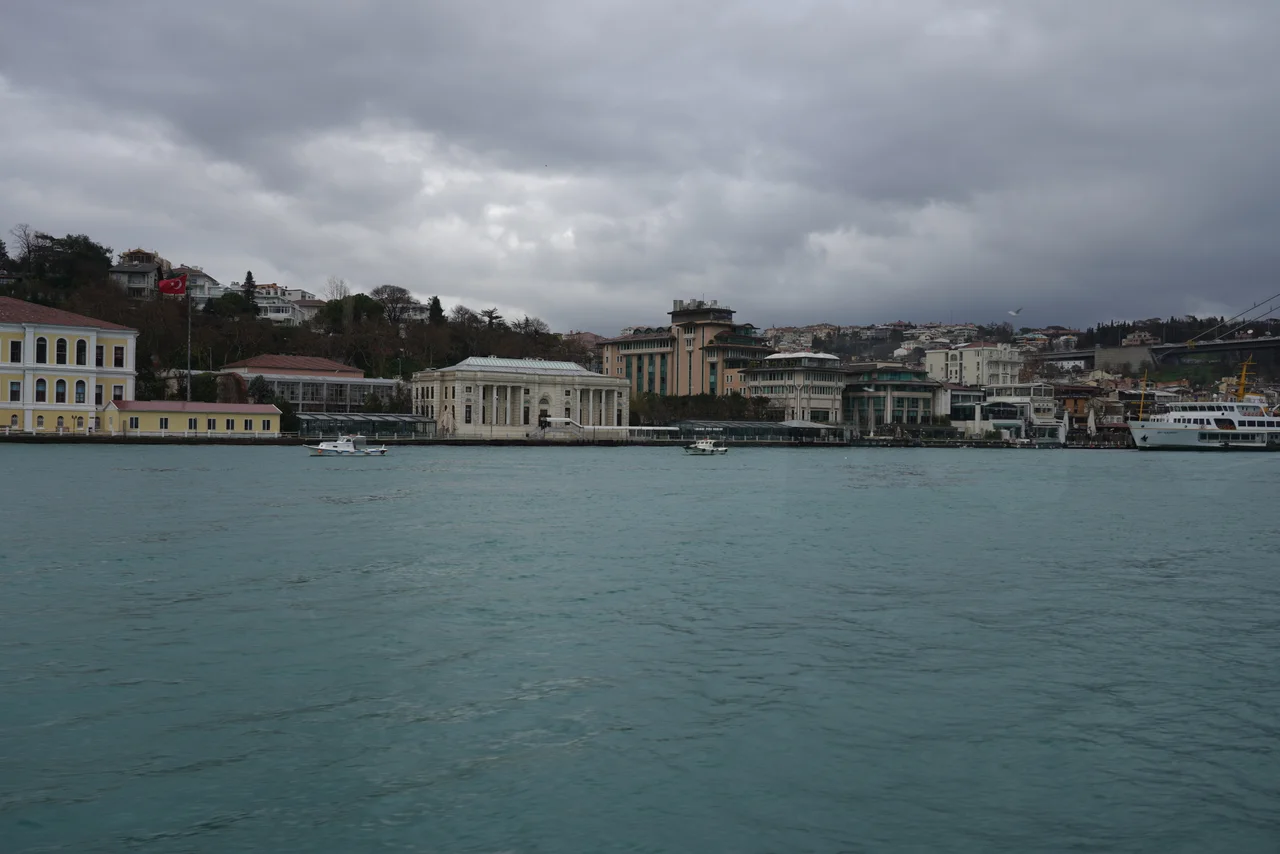

Feriye Palace
The word feriye means secondary, or auxiliary — a modest name for a set of buildings with an immodest past. Stretched along the European shore of the Bosphorus between the grand Dolmabahçe and Çırağan palaces, the Feriye Palace complex was commissioned in 1871 by Sultan Abdülaziz to house the extended family of the imperial court: princes, retainers, and the concubine ward that every Ottoman palace required. It was, in the hierarchy of the Bosphorus waterfront, a supporting cast. History made it something else. In May 1876, Abdülaziz himself would be brought to Feriye — not as a sultan but as a deposed one — and within days he was dead. The building that bore the name 'secondary' became, in that moment, a primary address in the contested history of an empire's decline.
Designed for the Margins of Power
Sarkis Balyan, the Armenian architect who shaped much of Istanbul's imperial waterfront in the nineteenth century, designed the Feriye complex for Sultan Abdülaziz in 1871. It was built to supplement the two great palaces already commanding the Bosphorus shore — Dolmabahçe to the south and Çırağan immediately adjacent. The new complex consisted of three main waterfront buildings, a ward for concubines, a small two-story structure, and outbuildings arranged behind the main façades. The name the palace received — feriye, from the Ottoman Turkish for 'secondary' — accurately described its intended function: accommodation for the court's extended household, the relatives and dependents who surrounded the sultan without commanding his direct attention. Architecturally, Balyan built in the Ottoman baroque style that had become the signature of the late imperial waterfront, elegant without being as grand as the primary palaces flanking it.
May 1876: A Deposition and a Death
On May 30, 1876, Sultan Abdülaziz was removed from power by his ministers in a constitutional coup. He was taken to Topkapı Palace — the old dynastic seat — and when he requested transfer to Beylerbeyi Palace, the request was denied; he was sent to Feriye instead, arriving as a private man rather than a sovereign. Days later, he was found with his wrists cut. The official finding was suicide. That verdict has never gone unchallenged. Contemporary accounts and later investigations raised the possibility that he was killed — that what looked like self-inflicted wounds were in fact inflicted by others. The physical evidence was ambiguous, and the political context made foul play plausible: Abdülaziz had powerful enemies, and a dead ex-sultan created fewer complications than a living one. No definitive conclusion has been established by historical scholarship, and the question remains open. What is certain is that he died at Feriye in June 1876, within days of his deposition, and that the palace thereafter carried the weight of that contested end.
The Court's Last Decades
After the death of Abdülaziz, Feriye continued to house members of the Ottoman imperial household through the empire's final half-century. The arrangement ended on March 3, 1924, when the parliament of the newly established Republic of Turkey abolished the Ottoman Caliphate. The last caliph, Abdülmecid II, was exiled along with remaining court members. The buildings stood vacant afterward, the furnishings and residents gone, the waterfront rooms silent. That interlude of emptiness did not last long. Practical uses displaced the ceremonial past with a speed that characterized the new republic's approach to imperial architecture across Istanbul.
Schools, Fire, and Survival
By 1927, the Maritime College had moved into part of the Feriye complex. The 1928–29 academic year brought Kabataş High School to another section of the buildings. In 1967, when Galatasaray High School began mixed-gender education, part of Feriye housed its girls' section. When the Maritime College evolved into Istanbul Technical University's School of Maritime in 1981 and relocated to Tuzla, its Feriye buildings passed to Ziya Kalkavan Maritime Vocational High School. Galatasaray's portion was transferred to the newly established Galatasaray University in 1992, which uses it today for its faculties of Law, Economics, and Communications. In 1995, a neglected northeastern section was restored by the Kabataş Education Foundation and reopened as Feriye Lokantası, a restaurant overlooking the Bosphorus. Then, on January 22, 2013, fire severely damaged the main building used by Galatasaray University. The Ministry of Culture committed to restoration; the palace — secondary in name, improbably central in history — was to continue its education work.
The Bosphorus Shore It Commands
Feriye's situation on the Bosphorus is, by any measure, extraordinary. The complex sits on the European shore of the strait at the point where the waterway narrows and the Asian coastline draws close. Ferries cross here. The current runs fast and changes with the tides. In the nineteenth century, the sultans chose this stretch of shore for their grandest residences precisely because the Bosphorus at this point is theatrical — the strait as a stage, the palace as a declaration. Abdülaziz commissioned Feriye as a practical addition to the imperial waterfront. What it became was something harder to categorize: a palace where one of the Ottoman Empire's most contested deaths occurred, a building that passed through maritime education and fine dining, a structure that survived fire and found new purpose. The Bosphorus still runs past it, fast and indifferent, as it always has.
From the Air
Feriye Palace sits at approximately 41.046°N, 29.020°E on the European shore of the Bosphorus strait in the Beşiktaş district of Istanbul. From the air, look for the Bosphorus waterfront just north of Dolmabahçe Palace — the cluster of historic buildings along the European shoreline between the strait and the dense urban grid includes the Feriye complex. The nearest major airport is Istanbul Airport (LTFM), approximately 30 km to the northwest. At 1,500–3,000 feet, the Bosphorus strait, the First Bosphorus Bridge (15 July Martyrs Bridge) to the north, and the sweep of the Asian shore are all visible. The palace's waterfront position is clearest in a low pass from the northwest.
Nearby Stories
- Kocaeli Peninsula 7.6 km away
- Second Battle of Çatalca 11 km away
- Istanbul's Rural Outskirts 14 km away
- MV Struma 20 km away
- HMAS AE2 36 km away
- Bursa 66 km away
- Sangarius Bridge 71 km away
- Januarius MacGahan 101 km away