.jpg)
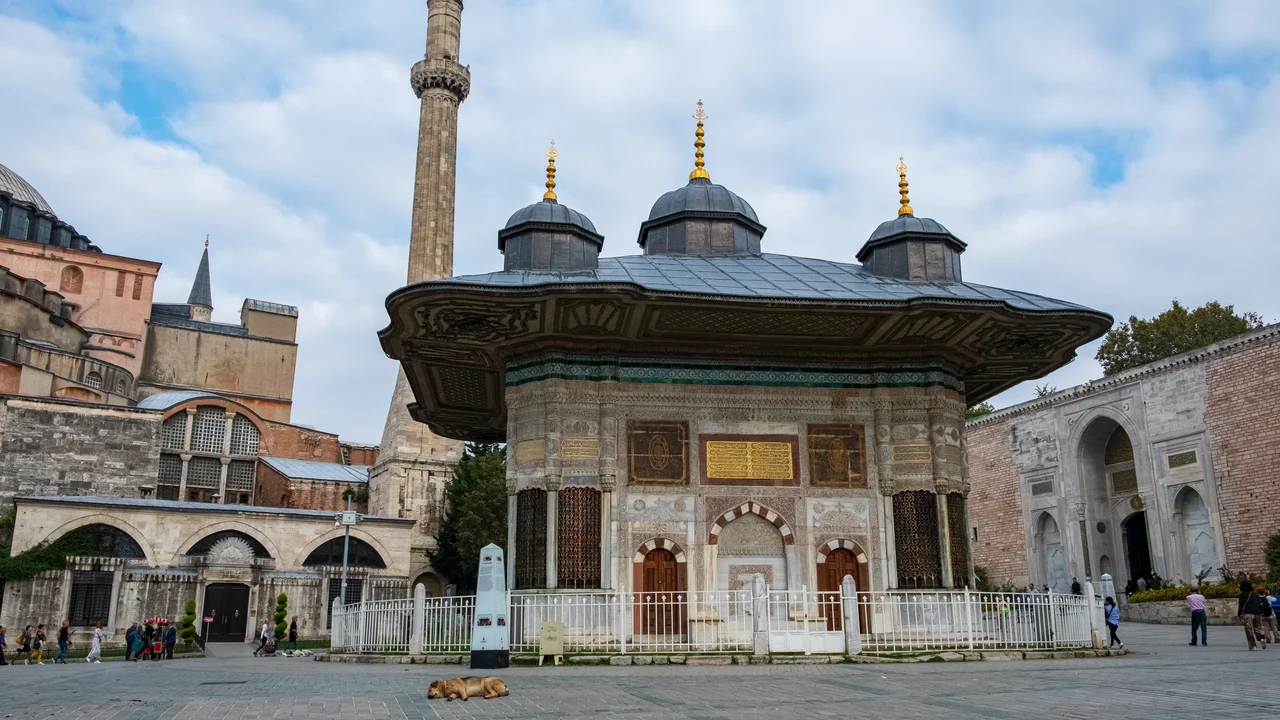
Fountain of Ahmed III
Every city has a building that makes you stop and look twice. In Istanbul, outside the Imperial Gate of Topkapı Palace, it is a fountain — not a grand fountain in the European plaza tradition, but a compact, multi-sided kiosk of carved stone, floral niches, and calligraphic poetry that seems almost impossibly ornate for something whose primary purpose was to give away free water. Sultan Ahmed III built it in 1728, at the beginning of the brief, elegant period the Ottomans called the Lale Devri — the Tulip Era — when the empire briefly turned from military expansion toward pleasure, poetry, and the beautification of Constantinople. The fountain outside Topkapı's gate was its opening statement.
The Tulip Era and Its Tastes
The Tulip Era lasted barely a decade, from roughly 1718 to 1730, before it collapsed under the weight of military setbacks and popular resentment of its perceived extravagance. But while it lasted, it produced a style of Ottoman architecture unlike anything that came before: lighter, more decorative, more openly in conversation with European Baroque and Rococo influences filtering in through diplomatic and commercial contacts. Ahmed III was a patron of this turn. He loved tulips — he reportedly maintained elaborate tulip gardens across the city — and he loved the idea of public display as a form of cultural patronage. The fountain outside his palace gate was both an act of piety, providing clean water to travelers and passersby at no cost, and an advertisement for the refined sensibility of his reign.
Five Domes and Four Faces
The fountain is a square structure capped with five small domes — one at each corner and one at the center — which give it a silhouette that reads almost like a miniature palace rather than a utilitarian water source. Each of the four façades is carved with mihrab-shaped niches decorated in shallow relief with foliate and floral designs, each niche containing a drinking fountain called a çeşme. At each corner, a triple-grilled sebil once allowed attendants stationed inside to pass cups of water or sherbet free of charge to anyone who approached through the grille. The water supply came from an octagonal pool inside the kiosk, with circulation space for the attendants who managed the distribution. Above the niches and drinking fountains on every face, large calligraphic plates framed in blue and red tiles carry the stanzas of a fourteen-line poem in praise of water and its donor.
The Poem That Wraps Around It
The calligraphic inscription was composed by Seyyid Hüseyin Vehbi bin Ahmed, who served as the chief judge of Aleppo and Kayseri. His fourteen-line poem is distributed across the fountain's faces and is meant to be read clockwise, beginning at the northern sebil. It praises water in the classical Ottoman literary tradition — water as divine gift, water as the substance of life, water as something a great sultan gives freely to his people. The final stanza, on the northwest face, was composed as a chronogram by Ahmed III himself: a line of poetry in which the numerical values of the Arabic letters, when summed, yield the year of the fountain's construction. The emperor did not merely commission a beautiful object. He signed it with verse.
A Social Gathering Place
During the Ottoman period, public fountains like this one were more than water sources. They were social infrastructure — stopping points on pedestrian routes through the city, places where people naturally paused, exchanged news, and rested. The location outside Topkapı's Imperial Gate put this fountain at one of the busiest intersections in Constantinople: the point where the palace opened onto the city, where officials arrived and departed, where petitioners waited, and where the great road toward Hagia Sophia began. That the sultan chose to place a fountain here rather than simply a decorative monument says something about how he understood the relationship between ruler and city. The gift of water, freely given, was a form of political theater — generous, public, impossible to miss.
An Enduring Presence
The fountain has stood for nearly three centuries, and it remains one of the most photographed structures in Istanbul — a fact that would probably not surprise Ahmed III, who understood the persuasive power of a beautiful object placed where everyone will see it. The Tulip Era ended badly: Ahmed III was deposed in 1730 following a Janissary revolt, in part sparked by resentment of the era's perceived decadence. But the fountain outlasted the politics. It was included on Turkish banknotes in the twentieth century. It sits today in the morning shadow of Topkapı's great tower, surrounded by tourists positioning cameras, and it does exactly what it was designed to do: make people stop.
From the Air
The Fountain of Ahmed III sits at approximately 41.008°N, 28.981°E, in the Fatih district at the edge of the Topkapı Palace complex on Istanbul's historic peninsula. From the air, Topkapı Palace's distinctive layered rooflines and tower are the dominant landmarks; the fountain stands just outside the main gate on the square to the southwest. At 2,000 feet on a clear day, the full extent of the walled palace compound is visible from end to end, with Hagia Sophia's dome rising 500 meters to the west. The nearest major airport is Istanbul Airport (LTFM), approximately 38 kilometers to the northwest. The Golden Horn and Bosphorus together define the peninsula from the air, making orientation straightforward.
Nearby Stories
- Kocaeli Peninsula 7.6 km away
- Second Battle of Çatalca 11 km away
- Istanbul's Rural Outskirts 14 km away
- MV Struma 20 km away
- HMAS AE2 36 km away
- Bursa 66 km away
- Sangarius Bridge 71 km away
- Januarius MacGahan 101 km away