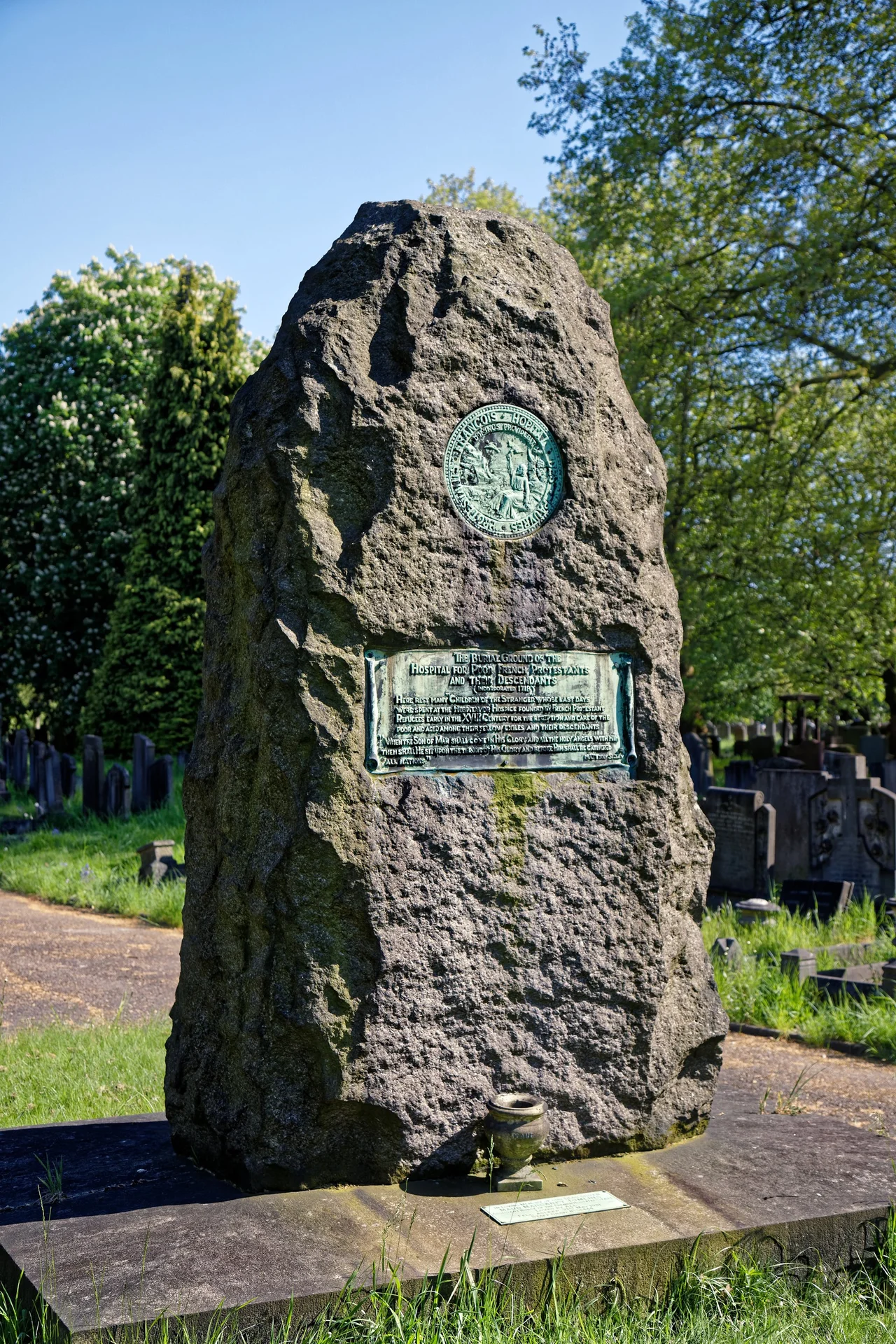
_monument_at_City_of_London_Cemetery.jpg)
French Hospital (La Providence)
Jacques de Gastigny had been Master of the Hounds to King William III - a Huguenot in exile from Catholic France, finding a place in the household of a Dutch-born Protestant king who had taken the English throne. When he died in 1708, his will left £1,000 to improve the pest-house to the north of Old Street in the parish of St Giles without Cripplegate. The money was to furnish beds and linen and clothing "and other necessities of the said poor ffrench Protestants who shall be in the said place". The Huguenots who had fled France for their faith in the previous decades, and who were dying in poverty in London, would at least die warm and fed. From this bequest grew an institution that has continued to care for Huguenot descendants for more than three hundred years.
Why They Came
The Huguenots were French Protestants, members of the Reformed tradition that had grown in France from the 1530s onwards. For most of a century they lived under uneasy legal protection - the Edict of Nantes, granted by Henri IV in 1598, allowed them limited rights of worship and assembly. In October 1685, Louis XIV revoked the Edict. The state's tolerance of Protestantism ended overnight. Huguenot churches were demolished, Huguenot schools closed, Huguenot pastors expelled or imprisoned. Conversion to Catholicism was demanded under threat of property confiscation, military quartering in private homes, the galleys for men and convents for women. Around 200,000 Huguenots fled the country - to the Netherlands, to England, to the German states, to the American colonies, eventually to the Cape of Good Hope. They were refugees in the precise modern sense of the term: people who had lost everything for their faith and now needed somewhere to start again. England received between 40,000 and 50,000 of them. London received the largest concentration, particularly in Spitalfields and Soho, where they brought silk weaving and watchmaking and goldsmithing skills that transformed entire neighbourhoods. They also brought poverty - the kind that arrives when you have abandoned your house, your business, and most of your possessions to keep your faith. They needed somewhere to grow old. They needed somewhere to die with dignity. La Providence answered both.
Golden Acre
Philippe Ménard, Gastigny's executor, organised an appeal to supplement the original bequest. The appeal was so successful that the trustees decided to build a new hospital entirely, rather than simply extending the existing Cripplegate pest-house. The French Hospital was incorporated under the Great Seal on 24 July 1718 - one of the earliest charitable foundations in England dedicated to the welfare of needy immigrants, and one of the first in Britain to provide sympathetic care for the mentally ill. The corporation chose as its seal the image of Elijah being fed by the ravens, from 1 Kings 17:6, with the motto Dominus providebit - "The Lord will provide". Affectionately, from the 1720s onwards, the hospital was known as La Providence. The inventory of contents from 1742 survives. By the early 19th century the buildings in Finsbury were in urgent need of restoration, and the number of inmates had fallen. The decision was made to find a new London location.
A Château in Hackney
The architect Robert Lewis Roumieu - himself the son of a Huguenot family - designed the new building in Victoria Park, Hackney. It opened in 1865. The Builder magazine described it as modelled on the Château de Chambord, which is generous but not exactly wrong: turrets, dormers, an extravagantly French silhouette dropped into the East End. Roumieu waived his fee for the drawings and served for a while as the hospital's treasurer. The building housed sixty residents in conditions that for the period were state of the art, with proper heating and ventilation and infirmary facilities. It also began to function as a repository of Huguenot heritage - records, portraits, plate, the objects descendants brought when they entered the hospital and the things bequeathed to it. The hospital became a kind of national archive of the diaspora it had been founded to serve. In 1941 the inmates were evacuated because of the Blitz and the building was requisitioned as a day nursery for women doing war work. After the war the directors decided that postwar Britain's growing state health and welfare apparatus made a hospital model impractical, and that La Providence's future lay as an almshouse. Roumieu's building was sold and became St Victoire School for Girls, then part of Cardinal Pole Catholic School, and since 2014 has housed the Mossbourne Victoria Park Academy.
Compton's Lea and Theobald Square
A Victorian house in ten acres at Compton's Lea, near Horsham in West Sussex, was bought in 1947 and served as the hospital's home for the next decade. The arrangement was never quite right - occupancy was too low and the hospital ran at a loss, sustained only by income from other property the corporation owned. The breakthrough came in 1956, when the directors approved the conversion of a square of small houses off Rochester High Street, in Kent, into almshouses for elderly Huguenot descendants. Theobald Square was renovated between 1957 and 1959. The first nineteen flats opened in September 1959, in the cathedral city of Rochester, formally renamed La Providence. The buildings were mid-19th century, now Grade II listed - solid Kentish brick around a quiet square, the doctor's house at 105 High Street renumbered as 41 La Providence. The hospital's stated duty, three centuries after Gastigny's will, is still to provide care "for those among us who are in distress".
A Diaspora Remembered
The list of distinguished Huguenot descendants associated with the hospital reads like a parallel social history of England. Henri de Massue de Ruvigny, Earl of Galway, the French Protestant general who fought for William III in Ireland, was a governor. John Ligonier, 1st Earl Ligonier, born Jean-Louis de Ligonier in Castres in 1680, who rose to become Commander-in-Chief of the British Forces, was a governor. The diplomatist John Robethon. The surgeon Paul Buissière. The lawyer Sir Samuel Romilly, who fought to reform Britain's draconian criminal code in the early 19th century. The archaeologist Sir Austen Henry Layard, who excavated Nineveh. Successive Earls of Radnor were governors from the 18th century until 2015. On 13 May 2015 the Huguenot Museum opened in Rochester, displaying the collections of the French Hospital - the silverware, the portraits, the silk samples, the documents that the diaspora carried with it across three centuries. The motto on the corporation's seal is still Dominus providebit. The Huguenot families who came in 1685 with what they could carry are still here, in some sense, in the families whose names appear in the hospital's records. They came as refugees and stayed to become English. The hospital they built is one of the things they made of that becoming.
From the Air
La Providence is at 51.39°N, 0.51°E on Rochester High Street in the cathedral city of Rochester, Kent. The almshouses form a quiet square just off the High Street, recognisable from the air as a small enclosed courtyard of Victorian brick buildings in the historic city centre. Rochester Cathedral and Rochester Castle are immediately adjacent, both highly visible landmarks. Rochester Airport (EGTO) is 2 miles south; London Southend (EGMC) is 11 miles northeast. Best viewed from 1,500-3,000 feet over the Medway valley.
Nearby Stories
- Waltham Abbey Royal Gunpowder Mills 1.6 km away
- Bethlem Royal Hospital 4.4 km away
- Sissinghurst Castle Garden 5.6 km away
- Chelmsford 6.5 km away
- Herne Bay Pier 6.7 km away
- Operation Stack 7.1 km away
- St Osyth's Priory 13 km away
- Plymouth Brethren 24 km away