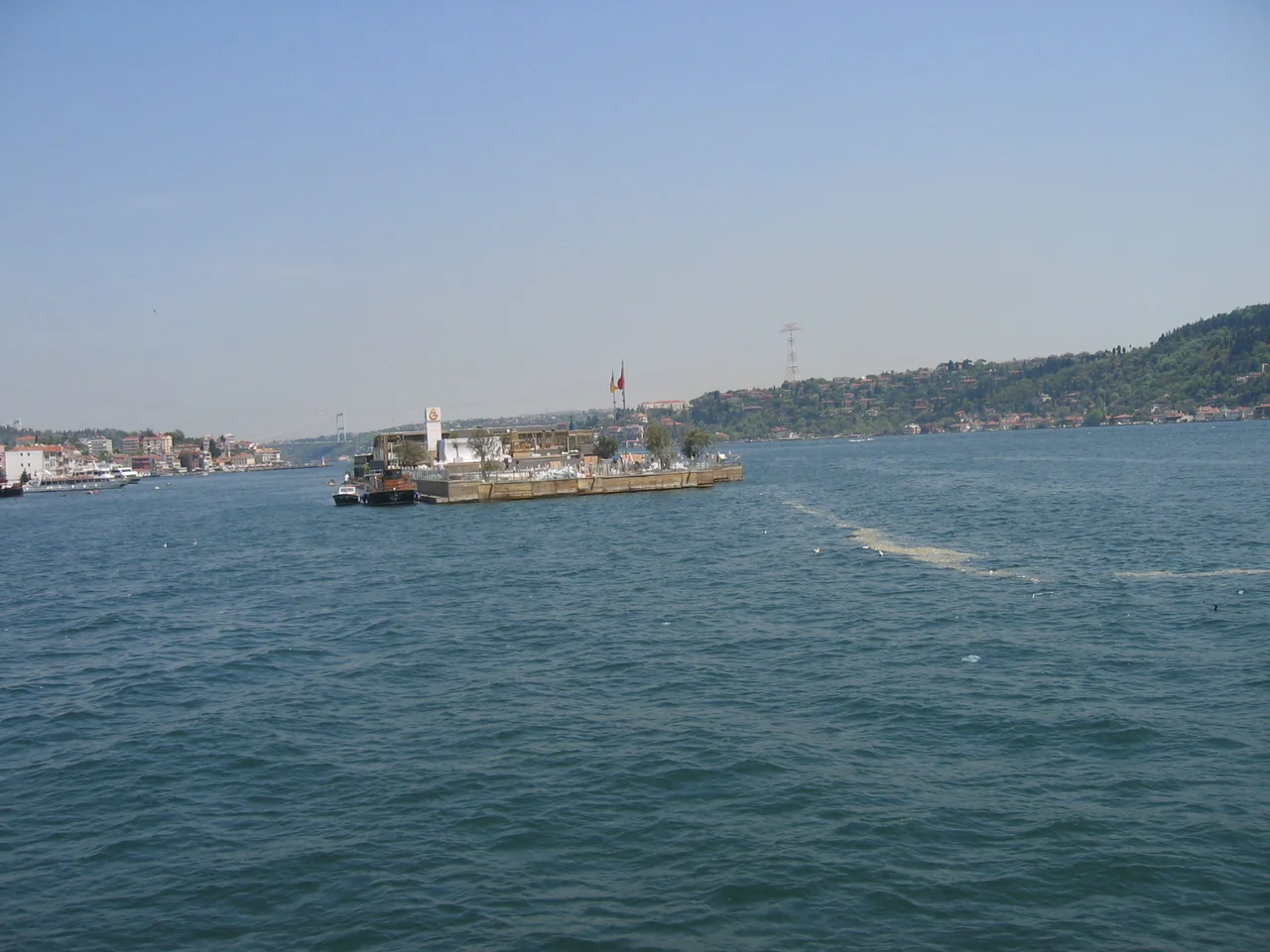

Galatasaray Islet
One hundred and sixty-five meters from the European shore of the Bosphorus, roughly halfway between the first Bosphorus Bridge and the Dolmabahçe Palace, sits a small island that most people sailing past have never heard of. It is barely large enough to be called an island — technically it is an islet — but its history is larger than its size would suggest. In 1872, an Ottoman sultan granted it to his court architect. Two years later, one of the nineteenth century's greatest marine painters sat here and made pictures the sultan would hang in his palace. Today it belongs, at least in part, to Galatasaray, the Istanbul sports club whose football team is one of the most celebrated in Turkey, and access is restricted to members and their guests. The Bosphorus is full of surprises.
A Gift from a Sultan
In 1872, Sultan Abdülaziz — who reigned from 1861 to 1876 — granted the islet to Sarkis Balyan, his court architect. Sarkis was a member of the Balyan family, an Ottoman-Armenian dynasty of architects who had served the imperial court for generations and whose buildings — including several palaces along the Bosphorus — shaped Istanbul's nineteenth-century waterfront. Sarkis Balyan (1835–1899) built a three-story house on the islet as his personal residence, claiming a spot of land in the middle of one of the world's great straits as his own private domain. It was the kind of gift that a powerful patron gave to a valued craftsman, a recognition of status rendered in geography. The islet was 165 meters from the shore, close enough to reach by rowboat, remote enough to feel like a different world.
Aivazovsky on the Bosphorus
In 1874, Ivan Aivazovsky visited Istanbul. It was one of several visits the Russian-Armenian painter made to the city over the course of his career. Aivazovsky (1817–1900) was among the most celebrated marine painters of the nineteenth century, famous across Europe and Russia for his luminous depictions of the sea — its storms, its calms, its relationship with light. He stayed at Sarkis Balyan's mansion on the islet during this visit and made a number of paintings there, commissioned by Sultan Abdülaziz for the Dolmabahçe Palace. The commission put Aivazovsky's work directly into the imperial collection. Painting from an island in the middle of the Bosphorus, looking out at a strait that has carried ships since antiquity, toward a skyline of minarets and domes and the European hills beyond — it is not a difficult subject to see why a painter would want to work here.
From Private Estate to Sports Club
The islet passed out of the Balyan family in the following decades. By the twentieth century it had come into the possession of Galatasaray Sports Club, the multisport organization founded in 1905 that operates one of Turkey's most prominent football clubs alongside basketball, water polo, and other sports programs. The transition from architect's residence to sports club property was not unusual in Istanbul, where private estates along the Bosphorus and its islands have changed hands repeatedly across Ottoman and Republican periods. Galatasaray used the islet as a recreational and entertainment facility, and from autumn 2002 through July 2007 it underwent substantial construction that transformed it into a more comprehensive entertainment and recreation center serving the club's members and, to some degree, the broader Istanbul community.
Fire on the Water
Renovation finished in 2007, but the same year brought disaster. On 4 October 2007, a fire broke out in a kitchen chimney on the islet and burned through two restaurants, damaging four other premises in the complex. The islet's compactness, which makes it charming, also makes it vulnerable: there is limited room for fire separation, and access by emergency services from the shore requires crossing 165 meters of water. The fire was controlled before it destroyed the entire complex, and the damaged facilities were subsequently repaired. It was a reminder that small islands in the middle of moving water have particular vulnerabilities, regardless of how much money has been invested in making them comfortable.
A Closed Island on an Open Strait
Today, the Galatasaray Islet is accessible only to members of the sports club and their guests, reached by a free ferry service from the Kuruçeşme neighborhood on the European shore. The Bosphorus around it is among the busiest commercial waterways in the world, carrying tankers from the Black Sea through to the Mediterranean. Passenger ferries crisscross between the European and Asian shores. The first Bosphorus Bridge — officially the 15 July Martyrs Bridge — spans the strait a short distance to the north, its enormous cables visible from the islet's shore. Against all of that scale and traffic and visibility, the islet remains curiously private: a small, tree-covered piece of land in the middle of everything, belonging to a football club, carrying the memory of a painter who came here to look at the sea.
From the Air
Galatasaray Islet sits at approximately 41.060°N, 29.040°E in the Bosphorus strait, just north of the first Bosphorus Bridge (15 July Martyrs Bridge), off the Kuruçeşme neighborhood on the European shore. From the air, the islet is clearly visible as a small, wooded landmass in the strait, directly beneath the bridge's northern approach. At 2,000 feet, the bridge span provides an unmistakable reference point, and the islet lies just south of it in the narrow strait between the European hills to the west and the Asian shore to the east. The Dolmabahçe Palace's distinctive white facades are visible further south along the European waterfront. The nearest major airport is Istanbul Airport (LTFM), approximately 25 kilometers to the northwest. Approaches over the Bosphorus at low altitude offer clear sightlines along the strait on clear days.
Nearby Stories
- Kocaeli Peninsula 7.6 km away
- Second Battle of Çatalca 11 km away
- Istanbul's Rural Outskirts 14 km away
- MV Struma 20 km away
- HMAS AE2 36 km away
- Bursa 66 km away
- Sangarius Bridge 71 km away
- Januarius MacGahan 101 km away