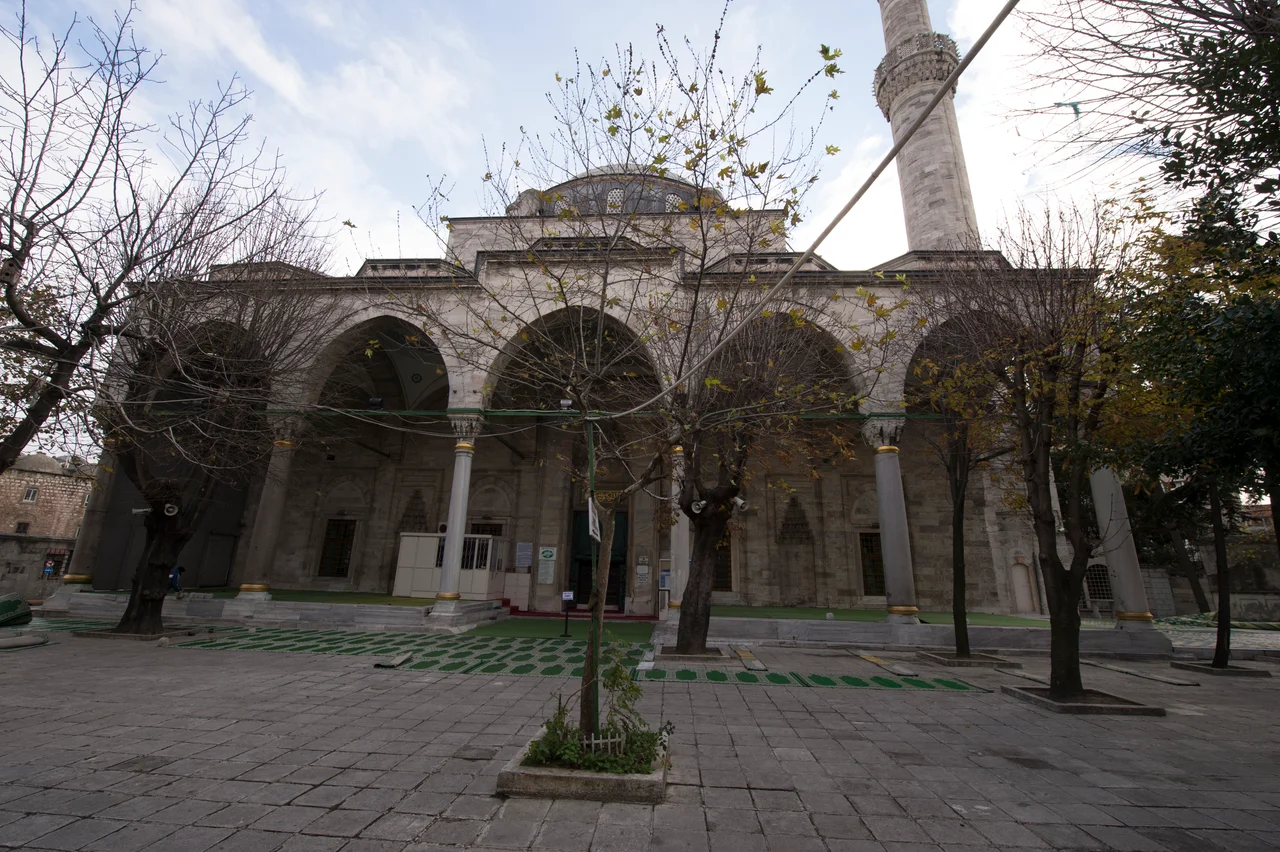

Gazi Atik Ali Pasha Mosque
Just steps from the Column of Constantine — where the Byzantine and Ottoman worlds overlap in a single weathered shaft of stone — the Gazi Atik Ali Pasha Mosque has stood since 1497 with a quietness that belies its age. In a city where monumental mosques crowd the skyline, this one makes no grand gesture. Its single minaret, its simple prayer hall, its position at the edge of one of history's busiest thoroughfares: all of it speaks of an older Istanbul, before the age of architectural spectacle.
The Man Who Built It
The mosque's patron was Hadım Atik Ali Pasha, a man who would go on to serve as Grand Vizier of the Ottoman Empire under Sultan Bayezid II. Construction began in 1496 and was completed the following year — a remarkably swift timeline that reflected both the Pasha's means and his desire to leave a mark near the city's political and commercial heart. The title "Hadım" in his name, meaning eunuch, was common among a particular class of Ottoman administrators who rose through palace service rather than military lineage. Atik Ali Pasha was one of the most powerful men in the empire, and this modest mosque on the Divan Yolu was his enduring contribution to the city's sacred landscape.
The mosque belongs to the reign of Bayezid II, a sultan remembered for consolidating the Ottoman state and for a disposition more contemplative than his conquering father Mehmed II. The architecture of his era tends toward the restrained, and the Atik Ali Pasha Mosque fits that sensibility perfectly.
A Crossroads of Empire
The Divan Yolu — literally the "Road to the Council" — was the spine of Ottoman Istanbul, the processional avenue that ran from the Topkapı Palace gate through the heart of the city toward the ancient Roman Milion. Walking it today, you move through roughly sixteen centuries of continuous urban life. The Atik Ali Pasha Mosque sits near the Çemberlitaş stop, close to the Column of Constantine (the Çemberlitaş itself), which has stood since 330 CE when Constantine dedicated the city he renamed after himself.
The Grand Bazaar entrance is nearby. So is the Nuruosmaniye Mosque, a baroque masterpiece built two and a half centuries after the Atik Ali Pasha. Between these monuments — ancient, early Ottoman, late Ottoman — the mosque occupies the middle term, the quiet hinge between two great architectural eras.
Five Centuries on the Street
What survives of the original 1497 structure is modest in size but remarkable in durability. The mosque has endured earthquakes, fires, and the wholesale transformation of its surroundings across five centuries. The bazaar district has changed around it countless times — hans (caravanserais) have been built, demolished, and rebuilt; the street layout has shifted; the commercial noise has changed from the shouts of cloth merchants to the hum of tourist traffic. Through all of it, the small mosque has remained open for prayer.
Its interior is characteristic of early Ottoman mosque design: a single domed prayer hall without the soaring galleries and secondary domes of later imperial commissions. There is an intimate scale here, more in keeping with a neighbourhood mosque than an imperial monument. And in a city dominated by imperial monuments, that intimacy is its own kind of distinction.
What Remains
Unlike some of Istanbul's earliest Ottoman mosques, which were converted Byzantine churches and carry the marks of that transformation, the Atik Ali Pasha Mosque was purpose-built from the start. It belongs to the first generation of mosques constructed after the 1453 conquest — a period when Ottoman architects were developing their own vocabulary, drawing on Byzantine domes and Seljuk traditions and Persian influences, finding the synthesis that would culminate in Sinan's great works of the following century.
Visitors who take the time to step inside find a space that rewards attention. The stonework, the proportions, the light through small windows — these are the elements of a mature architectural tradition still finding its way. Coming here before the Grand Bazaar opens, before the tour groups fill the Divan Yolu, is to experience something of what the city's older rhythms might have felt like: the call to prayer, the mosque's cool interior, the ancient column visible through the doorway.
From the Air
The Gazi Atik Ali Pasha Mosque sits at 41.009°N, 28.971°E in the Çemberlitaş neighbourhood of Fatih, on the historic peninsula of Istanbul's European side. From the air, the city's historic peninsula is unmistakable — the Hagia Sophia and Blue Mosque dominate the skyline to the southeast, while the Grand Bazaar's distinctive roofline lies to the west. The mosque is nestled in the dense fabric between these landmarks, near the Column of Constantine. The nearest major airport is LTFM (Istanbul Airport) to the northwest, approximately 40 km away. A viewing altitude of 2,000–3,000 feet gives the best perspective on the historic peninsula's dense layering of monuments.
Nearby Stories
- Kocaeli Peninsula 7.6 km away
- Second Battle of Çatalca 11 km away
- Istanbul's Rural Outskirts 14 km away
- MV Struma 20 km away
- HMAS AE2 36 km away
- Bursa 66 km away
- Sangarius Bridge 71 km away
- Januarius MacGahan 101 km away