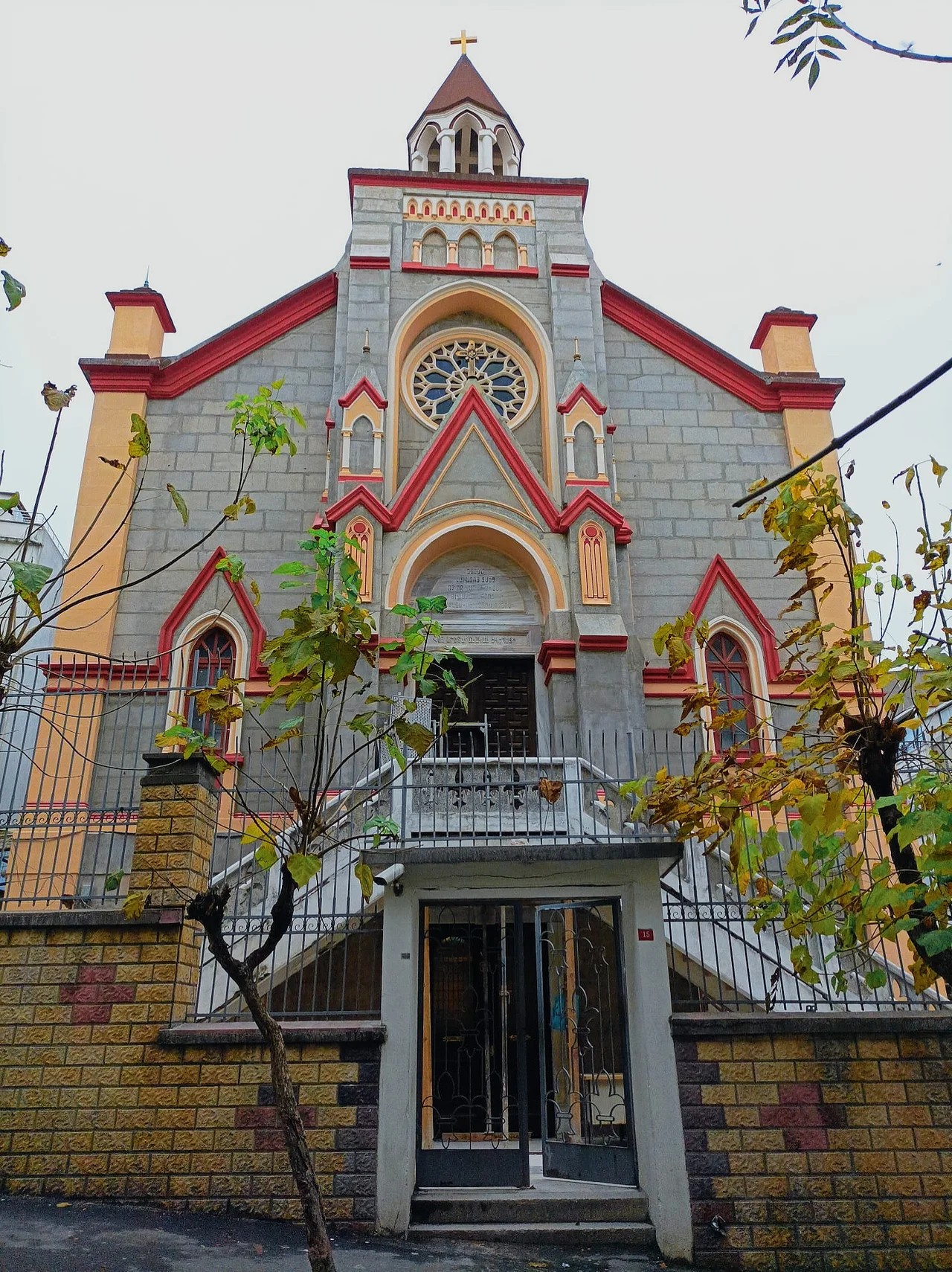

Gedikpaşa Surp Hovhannes Church
The Armenian name above the door — Սուրբ Յովհաննէս, Surp Hovhannes, Saint John — has belonged to this corner of Gedikpaşa since 1827. The church has burned twice, been restored four times, and outlasted empires. The community that built it is smaller now than it was, shaped by migrations and tragedies and the pressures that minority life in a modern nation-state brings. But on Sundays, the bells still ring in the Fatih district, and the Apostolic liturgy is still sung in Armenian.
Built, Burned, Rebuilt
The Surp Hovhannes Church was constructed in 1827, a period when Istanbul's Armenian community maintained a substantial and visible presence in the city's religious and commercial life. The Gedikpaşa neighbourhood, on the old side of Istanbul south of the Grand Bazaar, had long been home to Armenian residents and institutions.
In 1849 the original structure burned. Fire was an ever-present danger in 19th-century Istanbul, a city of wooden buildings crowded along narrow streets, and churches were no exception. Reconstruction took time, and the restored church was eventually reopened for worship — but it was not until 1876 that the full restoration was completed, made possible by an edict of Sultan Abdülaziz. The church reopened its doors for worship in 1895.
Another fire struck in 1972, this time damaging the building heavily. A restoration in 1986 brought the church back to full use, reopened by Armenian Patriarch of Istanbul Shenork I Kaloustian. A final major restoration followed in 2006, when Patriarch Mesrob II presided over the reopening. Four restorations across nearly two centuries speak to how much this building has mattered to the people who keep it.
A School That Opened and Closed
Beside the church, in 1835, the Surp Mesrobyan School opened — named for Saint Mesrob, the fifth-century monk who created the Armenian alphabet. For nearly 150 years it educated children from the neighbourhood's Armenian families. Then, in 1982, the school closed. The official reason was lack of students, and that is accurate as far as it goes: by the late 20th century, Istanbul's Armenian population had declined sharply from its 19th-century peak, scattered by the disasters and displacements of the early 20th century and by later waves of emigration. A school that once filled its classrooms fell silent.
The building still stands next to the church, its presence a document of what the neighbourhood once was — a hub of Armenian educational and communal life — and what demographic change across a century can do to the institutions that communities build.
Camp Armen and the Wider Community
The church is the trustee of Camp Armen, an Armenian orphanage located in the Tuzla district of Istanbul, on the Asian shore. Camp Armen has its own layered history — founded to shelter Armenian children, it became a symbol of community survival and of the legal and property struggles that minority institutions in Turkey have faced. The connection between the Surp Hovhannes Church and Camp Armen is a reminder that the church's role was never only liturgical: it was also an anchor for a community navigating difficult terrain.
The Armenian Apostolic faith, the oldest form of Christianity in the world still practised as a national church, has deep roots in Istanbul going back to Byzantine times. The Gedikpaşa congregation is part of the Armenian Patriarchate of Constantinople, an institution that has maintained continuous presence in the city for centuries and that remains one of the spiritual centres of the global Armenian diaspora.
Surviving in Gedikpaşa
The Gedikpaşa neighbourhood today is a dense, busy part of the Fatih district — workshops and small commercial enterprises fill the streets around the church, and the sound of the city is constant. The church sits among this activity as it always has, its stone facade unremarkable from the street, its interior cool and dim and fragrant with incense on service days.
For the Armenians of Istanbul — a community estimated at around 60,000 to 70,000 people in the city — churches like Surp Hovhannes are not merely historical sites. They are the living places of a living community: spaces for baptisms, memorials, holy days, and the ongoing practice of a faith that has survived everything this city has been through. The building has burned and been rebuilt. The community has diminished and endured. Both remain.
From the Air
The Gedikpaşa Surp Hovhannes Church stands at 41.006°N, 28.967°E in the Fatih district of Istanbul's historic peninsula. From the air, the area is southwest of the Grand Bazaar and northeast of the Sea of Marmara shore. The historic peninsula's skyline is defined by the Hagia Sophia and Blue Mosque to the east; the church is nestled in the dense residential fabric to their west. The nearest major airport is LTFM (Istanbul Airport) approximately 40 km to the northwest. A viewing altitude of 2,000–3,000 feet is ideal for appreciating the historic peninsula's urban texture and the proximity of this site to Istanbul's ancient core.
Nearby Stories
- Kocaeli Peninsula 7.6 km away
- Second Battle of Çatalca 11 km away
- Istanbul's Rural Outskirts 14 km away
- MV Struma 20 km away
- HMAS AE2 36 km away
- Bursa 66 km away
- Sangarius Bridge 71 km away
- Januarius MacGahan 101 km away