
German Fountain
The gift arrived in pieces. Crated in Germany, loaded onto ships, and sailed to Istanbul, the components of an octagonal neo-Byzantine fountain were assembled in the northern end of the ancient Hippodrome in 1900. When the gilded dome caught the light of Sultanahmet Square for the first time, it told a story — but not the simple one of imperial friendship it was meant to convey. Behind the eight porphyry columns and the golden mosaics glittering inside the bronze dome lay a web of railway ambitions, oil intelligence, and diplomatic wariness that neither side openly acknowledged.
A Kaiser Comes Calling
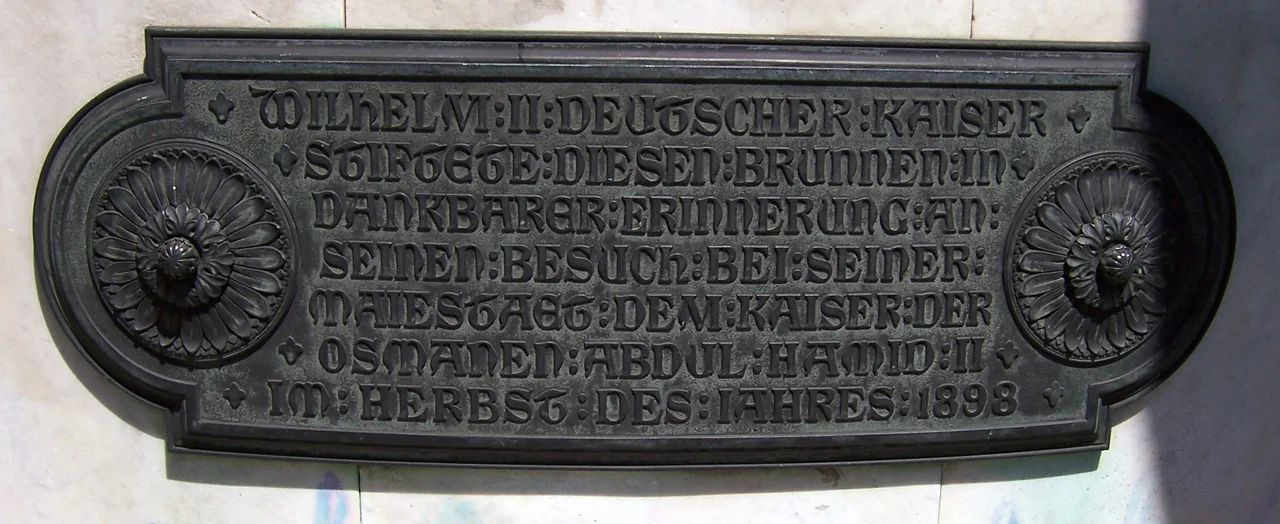
Kaiser Wilhelm II visited the Ottoman Empire three times in his reign — in 1889, 1898, and 1917. His second visit, beginning in Istanbul on October 18, 1898, during the rule of Sultan Abdülhamid II, was the grandest. Wilhelm arrived with an entourage that included men described as archaeologists. His primary purpose was to gain Ottoman approval for the Berlin-Baghdad Railway, a line that would run from Berlin to the Persian Gulf and potentially connect onward to British India through Persia. The railway promised a short overland route from Europe to Asia — one that could carry German exports, troops, and artillery. The Ottoman Empire, stretched thin financially, could not fund such a project on its own, and Abdülhamid II expressed gratitude for Germany's offer. But he was not without suspicion. The German Government constructed this fountain as a commemorative gift for the 1898 imperial visit — a graceful public token of the two empires' relationship.
What the Sultan's Spies Found
Beneath the pleasantries of state visits, intelligence was moving in both directions. Abdülhamid II's secret service took a hard look at the archaeologists in the Kaiser's retinue and concluded they were in fact geologists — men with professional interest in what lay beneath Ottoman soil rather than atop it. Their suspicions proved well-founded. The Ottoman secret service later uncovered a German report noting that the oilfields around Mosul in northern Mesopotamia were richer than those in the Caucasus. The Berlin-Baghdad Railway, if built, would pass directly through that region. What Wilhelm offered as a route for commerce and solidarity, Abdülhamid II privately read as a surveying expedition with diplomatic cover. The fountain went up in the Hippodrome regardless. Alliances required their symbols.
Delayed by One Deadline, Tied to Another
The fountain's inauguration was originally planned for September 1, 1900 — the 25th anniversary of Abdülhamid II's ascension to the throne. Construction ran behind schedule. Rather than a rushed opening at one ruler's milestone, the fountain was inaugurated on January 27, 1901: Kaiser Wilhelm II's birthday. The delay gave the gift a different resonance — less Ottoman occasion, more German celebration. According to the Ottoman inscription carved into the structure, construction had begun in Hejira year 1319, corresponding to 1898–1899. The fountain stands today as it stood then: an octagonal dome supported by eight porphyry columns, the dome's interior covered in golden mosaics, the central reservoir set on a mosaic-tiled platform. The Hippodrome around it has seen Byzantine chariot races, janissary rebellions, and centuries of transformation, but this small and ornate structure has remained remarkably unchanged.
A Ground Older Than the Fountain Knows
The spot where the fountain stands carries layers of history that no single monument can contain. Historians have debated whether the site once held the Kathisma — the imperial viewing lodge of the Great Palace of Constantinople — or the Carceres Gates, the starting stalls for the Hippodrome's chariot races. If the Carceres Gates hypothesis is correct, the same ground once held the Quadriga of Lysippos, the famous bronze four-horse sculpture later looted by Crusaders and installed above the entrance of St. Mark's Basilica in Venice. The German Fountain sits, in other words, on ground that has hosted some of the ancient world's most celebrated objects. The Kaiser's gift, however beautiful, is among the newer arrivals.
Standing in Sultanahmet Today
The fountain sits across from the Mausoleum of Sultan Ahmed I, at the northern end of what visitors now call Sultanahmet Square. The Blue Mosque and Hagia Sophia are close neighbors. Tourists photograph the golden mosaic ceiling through the open arches; the dome's interior catches midday light and returns it as warm amber. The fountain is a working water feature and a quiet architectural anomaly — neo-Byzantine in style, German in manufacture, Ottoman in placement. It does not announce itself loudly. But for those who know what brought it here, it speaks of an age when railroads, oil, and imperial ambition were negotiated not only in conference rooms but also in the form of beautifully made things placed in ancient public squares.
From the Air
The German Fountain sits at 41.0071°N, 28.9767°E in the Sultanahmet district of Istanbul's Historic Peninsula. Approaching from the northwest at 3,000–5,000 feet, the Blue Mosque's six minarets and Hagia Sophia's distinctive dome are unmistakable landmarks just to the south. The fountain itself is too small to spot from altitude, but the elongated rectangle of the ancient Hippodrome — now Sultanahmet Square — is visible between those two monuments. Nearest major airport: LTFM (Istanbul Airport) on the European side, approximately 35 km northwest. Clear days offer views across the Bosphorus to the Asian shore. Land breezes from the Sea of Marmara typically give good visibility over the historic peninsula in morning hours.
Nearby Stories
- Kocaeli Peninsula 7.6 km away
- Second Battle of Çatalca 11 km away
- Istanbul's Rural Outskirts 14 km away
- MV Struma 20 km away
- HMAS AE2 36 km away
- Bursa 66 km away
- Sangarius Bridge 71 km away
- Januarius MacGahan 101 km away