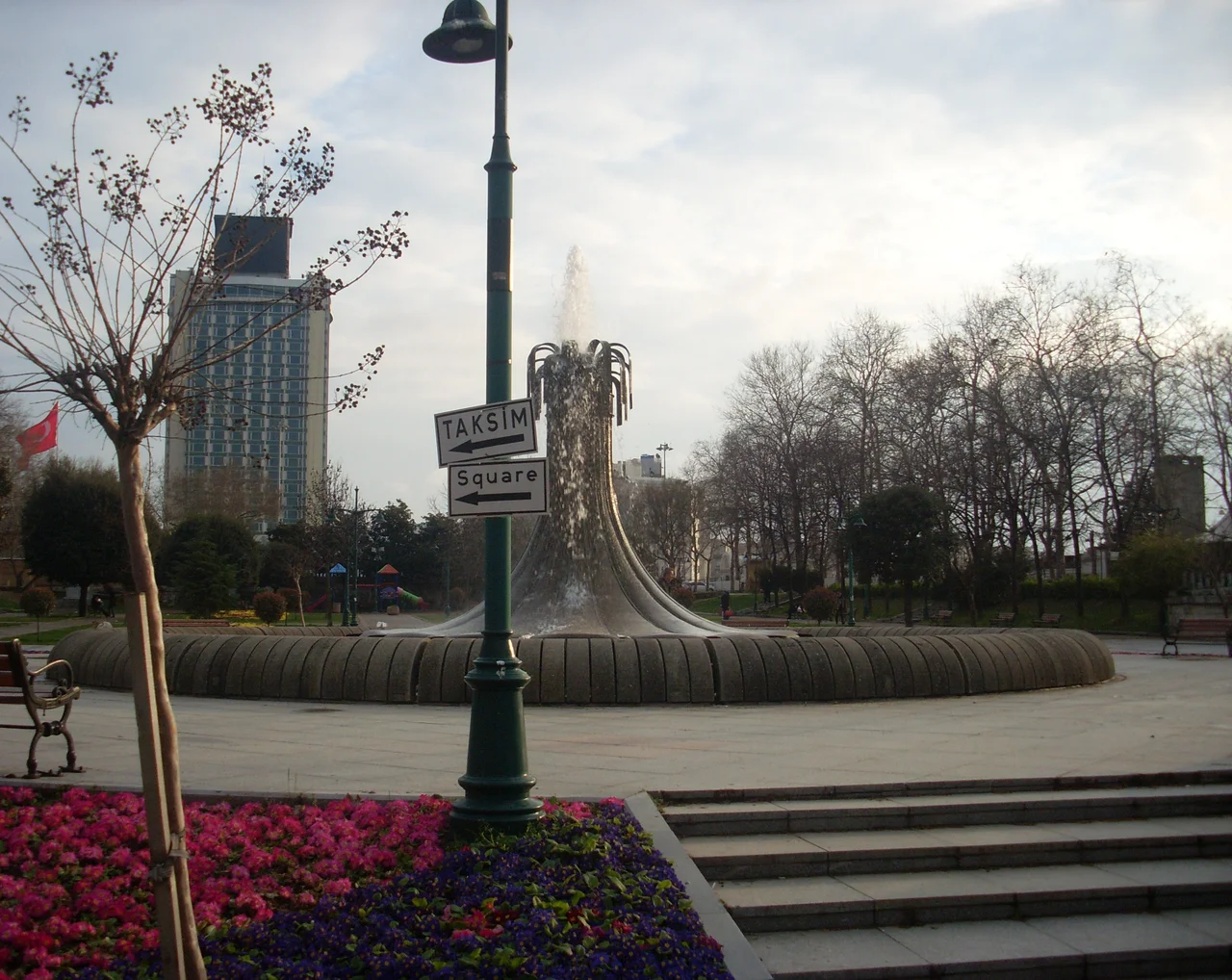

Gezi Park
Gezi Park does not look like the kind of place that changes history. It occupies a modest wedge of green beside Taksim Square in Istanbul's Beyoğlu district — trees, benches, dolphin-shaped water fountains, a map of the park dating to 1943. But in the spring of 2013, when authorities announced plans to demolish it and replace it with a reconstruction of the old Ottoman Halil Pasha Artillery Barracks, something unexpected happened. People sat down in the park and refused to leave. What followed — over weeks that stretched from late May into June and beyond — became one of the most discussed and disputed episodes in modern Turkish public life.
A Patch of Ground with a Long Memory
The land beneath Gezi Park has worn many identities. The Halil Pasha Artillery Barracks stood here from the 19th century into the early 20th. In 1921, the barracks' internal courtyard was converted into the Taksim Stadium. It was on that ground — before the park existed — that the Turkish national football team played its first official international match: Turkey versus Romania, October 26, 1923, ending in a 2–2 draw. Later the stadium was demolished, and the park was created; by 1943 it was established as a protected area. A large Armenian cemetery had also once occupied land in this broader neighborhood, a reminder that the area's history extends across cultures and centuries. The park that became a flashpoint in 2013 was, in other words, already layered with prior lives.
The Spark: May 2013
In late May 2013, a small group of environmentalists began occupying Gezi Park to protest demolition plans. On May 31, according to contemporaneous news reports, police moved in with tear gas and pressurized water to clear the demonstrators. The response was not dispersal — it was expansion. Crowds grew rapidly, and the occupation spread from the park to Taksim Square itself. The protests drew an unusually diverse coalition, as described by the Taksim Solidarity Platform (Taksim Dayanışma Platformu), the umbrella body that came closest to representing the demonstrators: rich and poor, LGBT individuals and religious conservatives, Turks and Kurds, Sunni and Alevi. Their demands were varied and sometimes contradictory, reaching beyond the fate of Gezi Park to include freedom of assembly, freedom of expression, and concerns about the government's direction on secularism and economic policy. Anti-capitalist Muslims marched alongside secular protesters. The park had become, in the words of observers, less a location than a symbol.
The Cost in Human Terms
The protests continued through June 2013 and left a toll that numbers alone cannot fully carry. The demonstrations ultimately claimed at least eight civilian lives and one police officer's life, most in 2013, with the final death coming in March 2014. Among those who died: Mehmet Ayvalıtaş, 20 years old; Abdullah Cömert, 22; Ethem Sarısülük, 26; İrfan Tuna, 47; Selim Önder, 88; Ali İsmail Korkmaz, 19; and Ahmet Atakan, 22. A police officer, Mustafa Sarı, 27, died after falling from a bridge while in pursuit of demonstrators. Berkin Elvan, who was 14 when he was struck in the head by a tear-gas canister near his home in June 2013, died on 11 March 2014 after 269 days in a coma — and became one of the most enduring symbols of the protests. More than 8,500 people were reported injured over the course of the unrest; twelve lost an eye, according to reports, after being struck by tear gas grenades. Police use of force — including the deployment of tear gas inside enclosed buildings — drew widespread criticism from human rights organizations and international observers. Each person who died carried a life, a family, a story that does not reduce to a statistic.
The Language of Protest
The 2013 protests generated their own culture and vocabulary. After a government official described the demonstrators as 'çapulcu' — roughly, 'looters' or 'marauders' — the protesters adopted the word themselves, reclaiming it as a badge of civic identity. The English hybrid 'chapulling' or 'Çapuling' entered informal use, describing the act of standing up for rights. Protesters who called themselves the Çapulcu built a visual culture of humor, irony, and creativity that was documented by the Istanbul arts platform InEnArt in a project called Urban Voices. The Koç Holding conglomerate drew attention when it provided shelter to demonstrators in one of its hotels near Taksim; the company was subsequently subject to a tax investigation, a sequence of events that drew commentary in Turkey and internationally. On the first anniversary of the protests, May 31, 2014, police again used tear gas and water cannons against demonstrators in Istanbul, Ankara, and other cities.
The Park Today
Gezi Park remains a park. The reconstruction of the barracks was not carried out during the period covered by these events; the park's legal and political status continued to be contested in subsequent years through the courts and Turkish political life. The trees still stand. The dolphin fountains still run. Visitors to Taksim find it easy to walk through the park without sensing anything of what happened — it is a quiet, leafy space beside one of Istanbul's busiest intersections. But for many people who lived through 2013, the name Gezi carries a weight that outdoor furniture and flower beds cannot entirely disguise. It is a small park with an outsized place in memory.
From the Air
Gezi Park sits at 41.0383°N, 28.9869°E, adjacent to Taksim Square on Istanbul's European side, in the Beyoğlu district north of the Golden Horn. Approaching from the north or west at 3,000–4,000 feet, Taksim Square is identifiable by the open plaza and the Atatürk Cultural Center on its eastern edge. The park occupies the northwest corner of the square. Nearest major airport: LTFM (Istanbul Airport) approximately 25 km northwest. Visibility from altitude is generally good on clear days; the Bosphorus and the Asian shore are visible to the east. The area lies in the heart of the modern city, distinct from the historic peninsula to the south.
Nearby Stories
- Kocaeli Peninsula 7.6 km away
- Second Battle of Çatalca 11 km away
- Istanbul's Rural Outskirts 14 km away
- MV Struma 20 km away
- HMAS AE2 36 km away
- Bursa 66 km away
- Sangarius Bridge 71 km away
- Januarius MacGahan 101 km away