
Gillingham bus disaster
On the evening of 4 December 1951, fifty-two boys aged between nine and thirteen were marching down Dock Road in Gillingham, Kent, on their way to a boxing tournament at the Royal Naval Barracks. They were Royal Marines Volunteer Cadets - the rear platoon hadn't even received their uniforms yet. The boys in front wore the Marines' standard-issue dark blue battledress and berets, with white belts and white lanyards on their shoulders. The column was about fifteen yards long, marching three abreast on the left side of the road, showing no lights. There was no requirement to show lights. The street lamp by the municipal swimming pool had failed. Just before six o'clock the bus came up behind them in the dark, and a great deal of what makes British road safety law as it is today was decided in the next few seconds.
The Boys
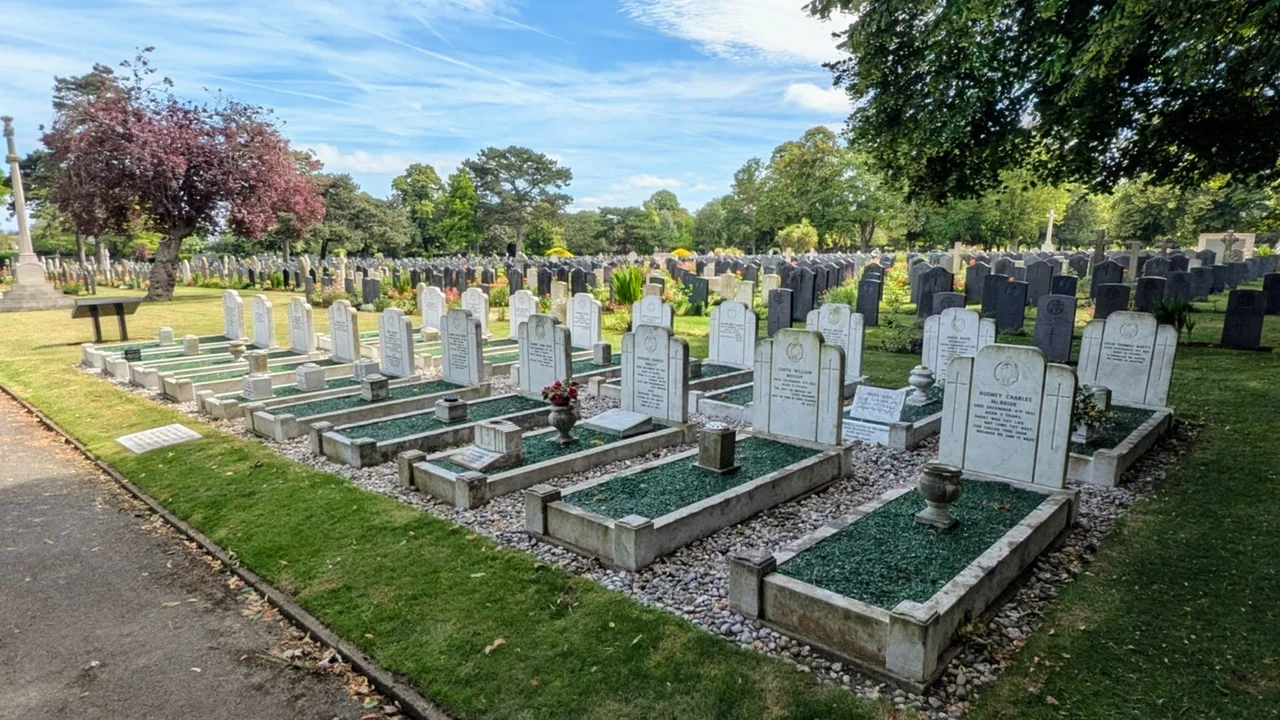
Their names matter. The dead were aged from about nine to thirteen - children. The military funeral for twenty of them was held at Rochester Cathedral on 12 December 1951, conducted by the Bishop of Rochester. Three Catholic boys were buried separately at the Church of Our Lady, Gillingham, by the Bishop of Southwark. Thousands of local people stood outside the cathedral and lined the route of the funeral procession to Gillingham Cemetery. Royal Marines guarded the coffins and acted as pallbearers. The Second Sea Lord attended. The Commandant-General Royal Marines attended. The Parliamentary and Financial Secretary of the Admiralty attended. The parents received £10,000 in total compensation from the bus company, which accepted liability under the tort of negligence - an amount that even in 1951 was inadequate measure of what had been taken from them. Most of the families lived in the Medway Towns, in the small terraced streets where men worked at Chatham Dockyard and their sons grew up wanting to be Royal Marines. Twenty-four of those sons never came home that night.
Dock Road, 5:58 pm
The company had left Melville Barracks at about 5:40 pm under the command of cadet non-commissioned officers - boys themselves, just slightly older - with one adult present: Lieutenant Clarence Murrayfield Carter, the contingent adjutant and a regular Royal Marines officer. Carter was moving up and down the flanks of the column. As they passed the municipal swimming pool, in the particular darkness caused by the broken street lamp, Carter saw the bus coming up behind them. He told the boys to move closer to the kerb. He assumed, reasonably, that the bus would steer around them. The bus driver, John William George Samson, was 57 years old. He had worked for the Chatham & District Traction Company for forty years, twenty-five of them as a driver, and he knew this route intimately. He had his sidelights on but not his headlights - perfectly legal at the time, and considered normal practice. Other drivers that night were using headlights on this same stretch, because it was particularly dark. Other drivers afterwards defended Samson's decision not to. Witnesses at the inquest estimated the bus's speed differently - Samson said one figure, Carter and another witness said much higher. None of the figures mattered to the children in front of the bus.
What Samson Felt
Samson told the inquest that he never saw the cadets at all. The first he knew of any impact was that the bus began to wobble "as though it had run over a lot of loose stones or something". It was also reported that he felt bumps and heard the high-pitched screams. He braked immediately. His conductress, Dorothy Dunster, called out "What's happened?" Carter, knocked over and dazed but uninjured, said the bus continued about fifty yards before it stopped; another witness said twenty-five. Samson got out. He saw what he had hit. Carter, racing to the front of the bus, found the driver pale-faced and repeating, over and over, "I didn't see them, I didn't see them." When the injured cadets began screaming with pain in the road behind, Samson fell to the ground and shouted "My God, what've I done?" Seventeen boys had died at the scene. Seven more died later in hospital, all but one on the same night. The boys who were uninjured were the ones who had been marching in the front ranks - the bus had taken the rear platoons, the new recruits without uniforms, the youngest of them all.
The Inquest
An inquest was held on 14 December 1951 at the Royal Naval Hospital in Gillingham, where many of the injured cadets were still being treated. The North-East Kent Coroner returned a verdict of accidental death. The coroner believed that Carter and the other witness, George Thomas Dixon, were probably mistaken about the speed of the bus, and accepted Samson's estimate. He did not believe that either Carter or Samson had been negligent in legal terms. Despite this, Samson was subsequently charged with dangerous driving and convicted at the Central Criminal Court. The jury recommended leniency, recognising that other factors had played a role. The judge banned Samson from driving for three years and fined him £20 - a small fine even in 1951. He avoided imprisonment because, the judge said, the mental punishment Samson was now living with would far exceed anything the law could apply. There was a particular detail that haunted the official reports: several injured cadets were trapped beneath the bus, and could not be extricated because nobody could lift the bus high enough without putting additional weight on the survivors below.
What Changed
The Ministry enquiry that followed produced specific recommendations that became British practice. From 1951 onwards, all three services were required to show a red light at the rear of any column of marching personnel on a road at night. Street lighting in the Medway Towns was improved. The enquiry recommended that all UK buses should be fitted with a single kerb spotlight, illuminating the area immediately to the left of the driver where a child or pedestrian might be in the dark gap below the headlight beam. The recommendation was accepted. It became standard practice on British buses for decades. John Samson never drove again. He continued living in the local area but became a broken man, keeping mostly to himself, never speaking publicly about what had happened. The bus involved - a Bristol double-decker registered as GKE 69 - remained in service for two more years before being scrapped in 1953. Other drivers were said to be glad to see it gone. Until the 1975 Dibbles Bridge coach crash killed 33 people in Yorkshire, the Gillingham bus disaster was the worst road traffic accident in British history by death toll. Every year, on the Sunday closest to the anniversary, the Chatham Royal Marine Cadet Unit still parades at Gillingham Cemetery, where the boys are buried. In the film Shadowlands, Anthony Hopkins as C. S. Lewis lectures on theodicy and points to the Gillingham bus disaster as an example of the kind of terrible event that God seems to allow - using the children of Dock Road, three decades on, as the witnesses to a problem in moral philosophy. They had not signed up for any of this. They had been marching to a boxing match.
From the Air
Dock Road in Gillingham, where the disaster happened, runs along the edge of the former Chatham Royal Naval Dockyard at approximately 51.40°N, 0.53°E. The site is in the Medway Towns conurbation, immediately south of the River Medway. Gillingham Cemetery, where the cadets are buried, is a short distance inland. Rochester Airport (EGTO) is 3 miles southwest; London Southend (EGMC) is 14 miles north across the Thames Estuary. Best viewed from 1,500-3,000 feet over the Medway.
Nearby Stories
- Waltham Abbey Royal Gunpowder Mills 1.6 km away
- Bethlem Royal Hospital 4.4 km away
- Sissinghurst Castle Garden 5.6 km away
- Chelmsford 6.5 km away
- Herne Bay Pier 6.7 km away
- Operation Stack 7.1 km away
- St Osyth's Priory 13 km away
- Plymouth Brethren 24 km away