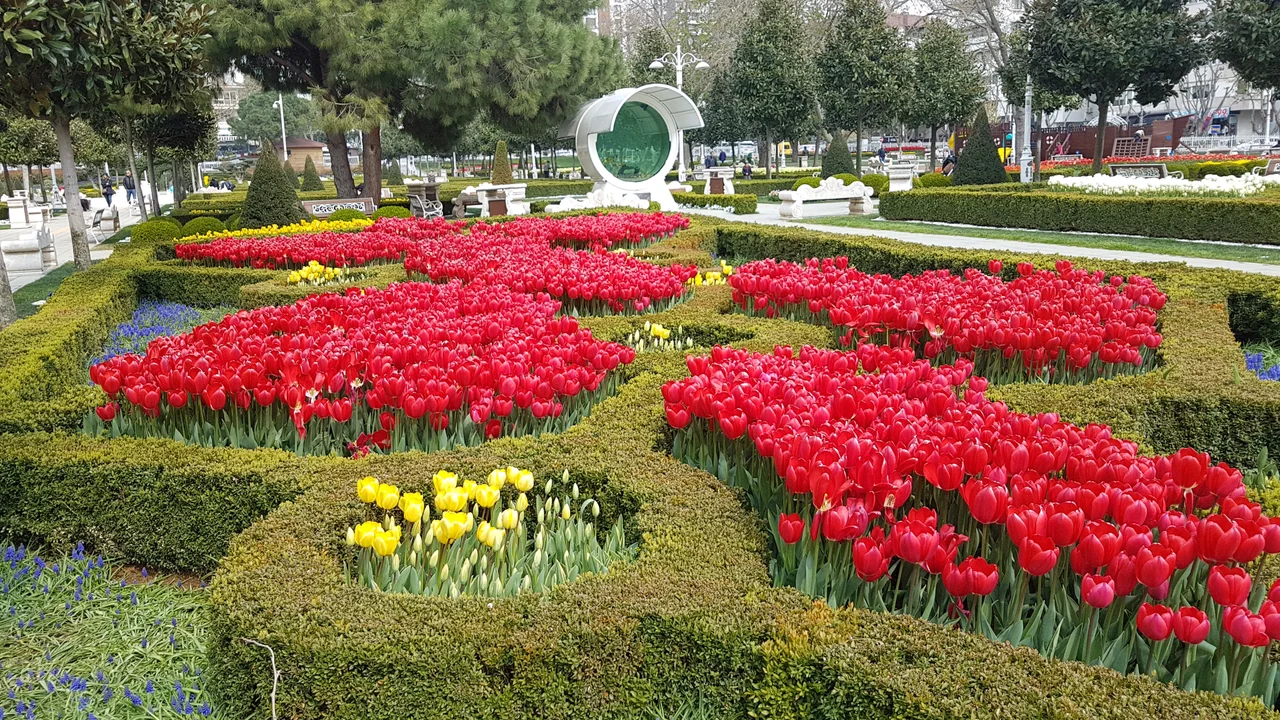

Göztepe Park
The Asian side of Istanbul moves at a different pace. Kadıköy's streets are quieter than the European shore's tourist circuits; Bağdat Avenue, one of the city's great promenading boulevards, runs in an unhurried line through the Göztepe neighborhood. And at the south end of that boulevard, the park opens up — 80,475 square meters of gardens, paths, playgrounds, and water that the people of Kadıköy have claimed as theirs since 1983. The park's full name is Göztepe 60. Yıl Parkı — Göztepe 60th Year Park — and the number tells you exactly when it was founded: the 60th anniversary of the Republic of Turkey.
Born on an Anniversary
Turkey proclaimed its republic on October 29, 1923. Sixty years later, in 1983, the Göztepe park was established in Kadıköy as part of the anniversary commemorations. The location made sense: Kadıköy is one of Istanbul's oldest continuously inhabited districts, with roots stretching back to the ancient Greek colony of Chalcedon. The park sits between Bağdat Avenue to the north — a boulevard famous for its cafes, boutiques, and plane trees — and Operatör Cemil Topuzlu Avenue to the south. After its initial opening, the park was renovated and reopened in 2013, gaining a natural self-cleaning pond of 1,200 square meters, tulip and rose gardens, and topiary sculptures shaped as whirling dervish figures — called semazens — formed from ligustrum hedges. The wooden play structures and aquariums with colorful fish followed. What was once a straightforward public park became something more deliberately curated.
A Museum for a Beloved Face
In March 2024, a museum opened inside the park dedicated to Kemal Sunal — and the significance of that choice says something about what Sunal meant to Turkey. Born in Istanbul on November 11, 1944, Sunal became the country's most beloved comedic actor over a career that produced 82 films. He was best known for the character Şaban, a bumbling, warm-hearted everyman whose misadventures in films like Hababam Sınıfı and Şabaniye made him a fixture in Turkish households for three decades. He won Best Actor at the Antalya Film Festival in 1977 and at the Ankara Film Festival in 1989; in 1998 he received a Lifetime Achievement Award at Antalya. On July 3, 2000, Sunal died of a heart attack at Atatürk Airport after boarding a plane bound for Trabzon, where he was to begin filming his next project. He was 55. The museum in Göztepe Park — the Kemal Sunal Museum — gathers his memory in the neighborhood that has long been one of Istanbul's most culturally engaged.
The Kadıköy Shore
To understand Göztepe Park, it helps to understand where it sits. Kadıköy is the Asian district that many Istanbullus who live on the European side describe, a little wistfully, as the better place to spend a Saturday. It has ferries to Eminönü, a busy market quarter, a reputation for independent bookshops and music venues, and the long spine of Bağdat Avenue running southward through the Göztepe quarter toward the Marmara coast. The park anchors the southern end of that social corridor. Families come for the children's playgrounds. Fitness enthusiasts use the exercise areas. Tulip season, in spring, turns the flower gardens into a destination. The water features — the natural pond, the aquariums — give the park a contemplative quality that the surrounding city often cannot offer.
Connected to the Wider City
Göztepe Park remains well-connected to Istanbul's public transit network by bus and nearby ferry terminals at Kadıköy. A future metro station, to be called 60. Yıl Parkı, is planned on the M12 line, which will link the park's neighborhood to Ataşehir and Ümraniye further inland on the Asian side. When that line opens, the park will have a station bearing its name — an unusual civic honor that reflects how central Göztepe 60. Yıl Parkı has become to this part of the city. For now, visitors arrive by bus, by bike along Bağdat Avenue, or on foot from the residential streets around Caddebostan. They come for the gardens and stay for the quiet. The Bosphorus is just a few kilometers north; the Sea of Marmara is closer still to the south. Göztepe Park sits between them, on a shore that has been settled for more than two thousand years.
From the Air
Göztepe Park sits at 40.9697°N, 29.0578°E on Istanbul's Asian shore, in the Kadıköy district of the Göztepe quarter. From the air at 3,000–5,000 feet, Kadıköy's waterfront along the Sea of Marmara is visible to the south, with the Bosphorus entrance visible to the north. The park's green area lies a few kilometers inland from the Marmara coast between Bağdat Avenue and the shoreline neighborhoods. Nearest major airport: LTFJ (Sabiha Gökçen International Airport), approximately 20 km southeast on the Asian side. From the east or southeast, the park is overflown during approaches to Sabiha Gökçen. Clear days reveal the European Istanbul skyline — Hagia Sophia, the Blue Mosque — across the water to the northwest.
Nearby Stories
- Kocaeli Peninsula 7.6 km away
- Second Battle of Çatalca 11 km away
- Istanbul's Rural Outskirts 14 km away
- MV Struma 20 km away
- HMAS AE2 36 km away
- Bursa 66 km away
- Sangarius Bridge 71 km away
- Januarius MacGahan 101 km away