.jpg)
Grand Bazaar, Istanbul
In 1591, thirty thousand gold coins went missing from the Cevahir Bedestan — the inner heart of Istanbul's Grand Bazaar. The theft shocked the city so thoroughly that the Bazaar closed entirely for two weeks. People were interrogated; pressure was applied. The money was eventually found hidden under a floor matting. The incident is remarkable less for the sum involved than for what it reveals about the Grand Bazaar's standing in Ottoman life: that its security was a civic matter, and its disruption was a disruption of the city itself. More than four centuries later, the Bazaar still employs 26,000 people and draws up to 400,000 visitors on a busy day. It has always been more than a market.
The Conquest and the First Stones
Sultan Mehmed II conquered Constantinople in 1453. Within two winters, he had begun building the Bazaar. The core structure — named the Cevâhir Bedestan, meaning Bedesten of Gems — was commissioned to trade textiles and jewels near the sultan's palace on the third hill of Istanbul. Construction finished in 1460/61, and the building was endowed to the waqf of the Hagia Sophia Mosque, tying the market's revenues to the city's great religious institution. A second covered building followed — the Sandal Bedestan, named for a thread the color of sandalwood woven in Bursa — and as trade expanded between the two structures, a growing network of streets and vaults was covered and incorporated into what became the Kapalıçarşı: the Covered Market. A Byzantine relief of a Comnenian eagle, still mounted above the East Gate of the old Bedestan, has led some scholars to argue that part of the structure predates the Ottoman conquest — though the architectural evidence suggests the building is predominantly 15th-century Ottoman work.
Fire, Rebuilding, and the Rules of Trade
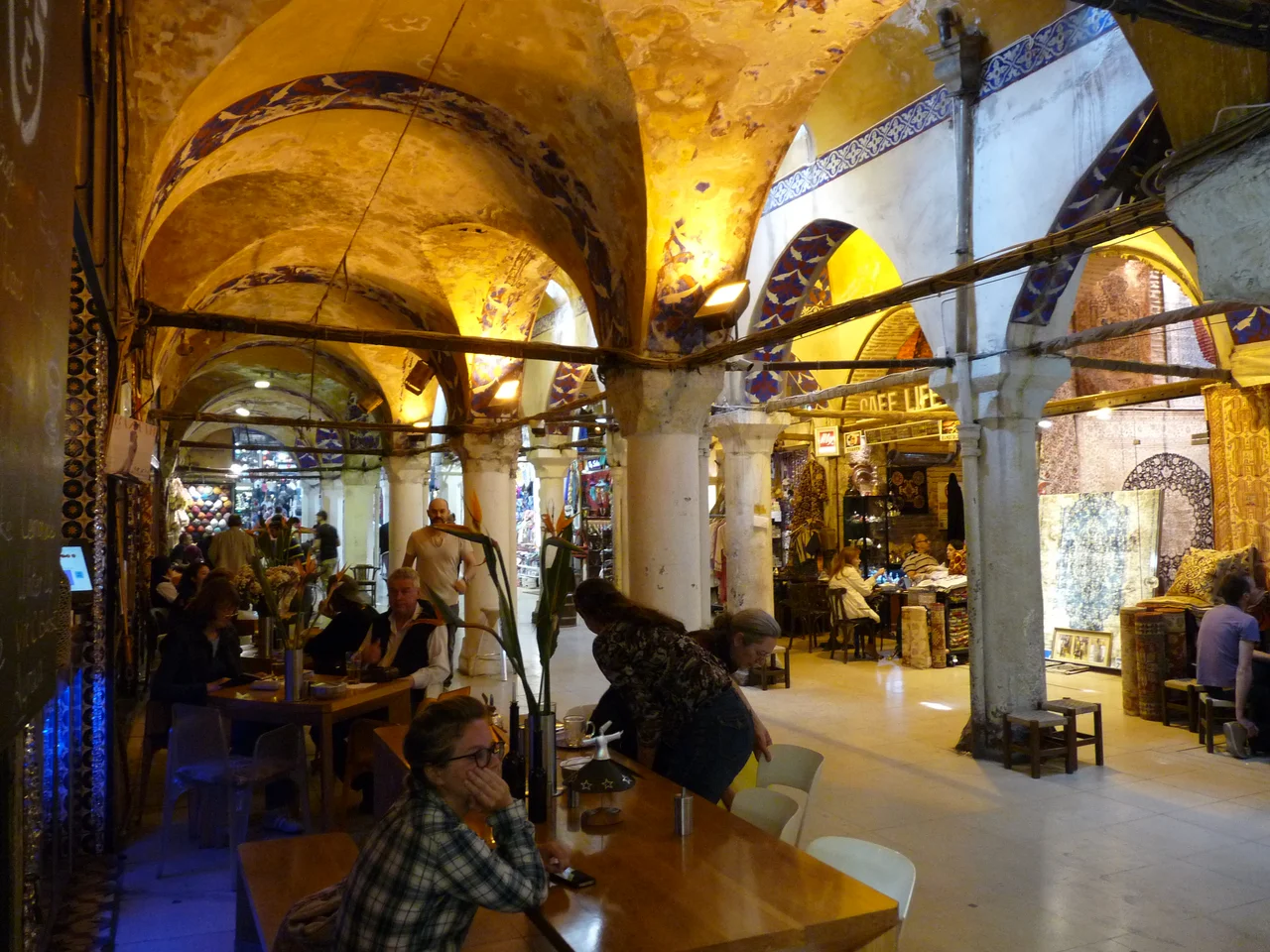
Wood burned. The Bazaar learned this repeatedly. Most of the original structures were built in timber, and fires swept through periodically over the centuries. After a particularly destructive fire in 1701, Grand Vizier Nevşehirli Damad Ibrahim Pasha oversaw the rebuilding of major sections in 1730–31. A law against fires, issued in 1696, had already begun the shift: parts of the market between the two bedestens were vaulted in stone and brick. After the fires, reconstruction followed no unified plan, which gave the western portions of the Bazaar their tangled, picturesque character — lanes crossing at odd angles, levels shifting unexpectedly, light arriving from windows placed just below the roofline. Smoking was strictly prohibited inside. Artificial lighting was not provided, both to reduce fire risk and because the valuable goods traded in the bedestens were best evaluated in natural light.
How Business Was Done
Until the 1894 earthquake prompted a major renovation, the Grand Bazaar operated on a principle entirely different from the Western shop. Merchants did not stand behind counters in enclosed spaces. They sat on wooden platforms called dolap — stalls roughly six units wide and three deep — in front of their shelves, along open lanes. Traders of the same goods were grouped together by guild rule: jewelers in one lane, armorers in another, spice merchants near the Bedestan, book dealers together. An 1890 survey counted 4,399 active shops, 2,195 rooms, a hamam, a mosque, 10 medreses, 19 fountains, a mausoleum, and 24 hans. The Inner Bedestan, with its dim illumination and iron gates, held the most precious goods; it opened only for part of each day. That architecture of concentration — everything valuable, everything organized, all of it secured behind walls and gates — made the Bazaar among the most secure commercial spaces in the world. Serious theft was almost unheard of. Almost.
The Social Life of an Enclosed City
The Grand Bazaar was not only an economic institution. During the Ottoman period, it was one of the very few public places where women could move with some freedom, which made it particularly interesting to European visitors who recorded their impressions. Théophile Gautier and Edmondo De Amicis both wrote about the Bazaar in the 19th century; for Western writers, it became a required stop and a required topic. There were no restaurants inside — the concept of dining out was alien to Ottoman commercial convention, and the Bazaar's administrators kept the space tightly controlled. The one formal night opening in the Bazaar's entire recorded history took place in 1867, when Sultan Abdülaziz returned from a visit to Egypt. The market was illuminated specially for the occasion, and the sultan rode through it on horseback as the crowd celebrated around him. It was a singular event in a space that otherwise ran on the strict rhythms of daylight and commerce.
The Bazaar Today
The Grand Bazaar stretches across 30,700 square meters in Istanbul's Fatih district, running roughly west to east between the Beyazit and Nuruosmaniye mosques. Its 61 covered streets still organize trade by product — gold jewelry along Kalpakçılar Caddesi, carpets along Sahaflar Caddesi, leather along Perdahçılar Caddesi — though the strict guild logic has softened into custom. In 2014, it ranked as the world's most-visited tourist attraction, with 91,250,000 annual visitors. The last major restoration was in 1980. Structural engineers worry about earthquake vulnerability: dealers who removed columns to gain floor space, and concrete poured over stolen lead on the roof, have created stresses in a building that was never designed for modern commercial densities. But walk into the Bazaar on a weekday morning, before the tour groups arrive, and the sound is still what it always was — vendors calling, fabric rustling, the faint echo of a thousand transactions inside a stone vault that has been doing this for more than five hundred years.
From the Air
The Grand Bazaar sits at 41.0106°N, 28.9679°E on Istanbul's historic European peninsula, in the Fatih district. From the air at 4,000–6,000 feet approaching from the west, the Bazaar's vast roof — a dense patchwork of domes and vaults — is visible between the Beyazit Mosque to the west and the Nuruosmaniye Mosque to the east, with the silhouette of Hagia Sophia's dome and the Blue Mosque's minarets just to the southeast. The Grand Bazaar is not immediately distinctive from altitude — it blends into the dense urban fabric — but its scale becomes apparent once you know what you're looking at: a city within the city. Nearest major airport: LTFM (Istanbul Airport), approximately 35 km northwest on the European side. Morning light from the east catches the historic peninsula's rooftops with particular clarity.
Nearby Stories
- Kocaeli Peninsula 7.6 km away
- Second Battle of Çatalca 11 km away
- Istanbul's Rural Outskirts 14 km away
- MV Struma 20 km away
- HMAS AE2 36 km away
- Bursa 66 km away
- Sangarius Bridge 71 km away
- Januarius MacGahan 101 km away