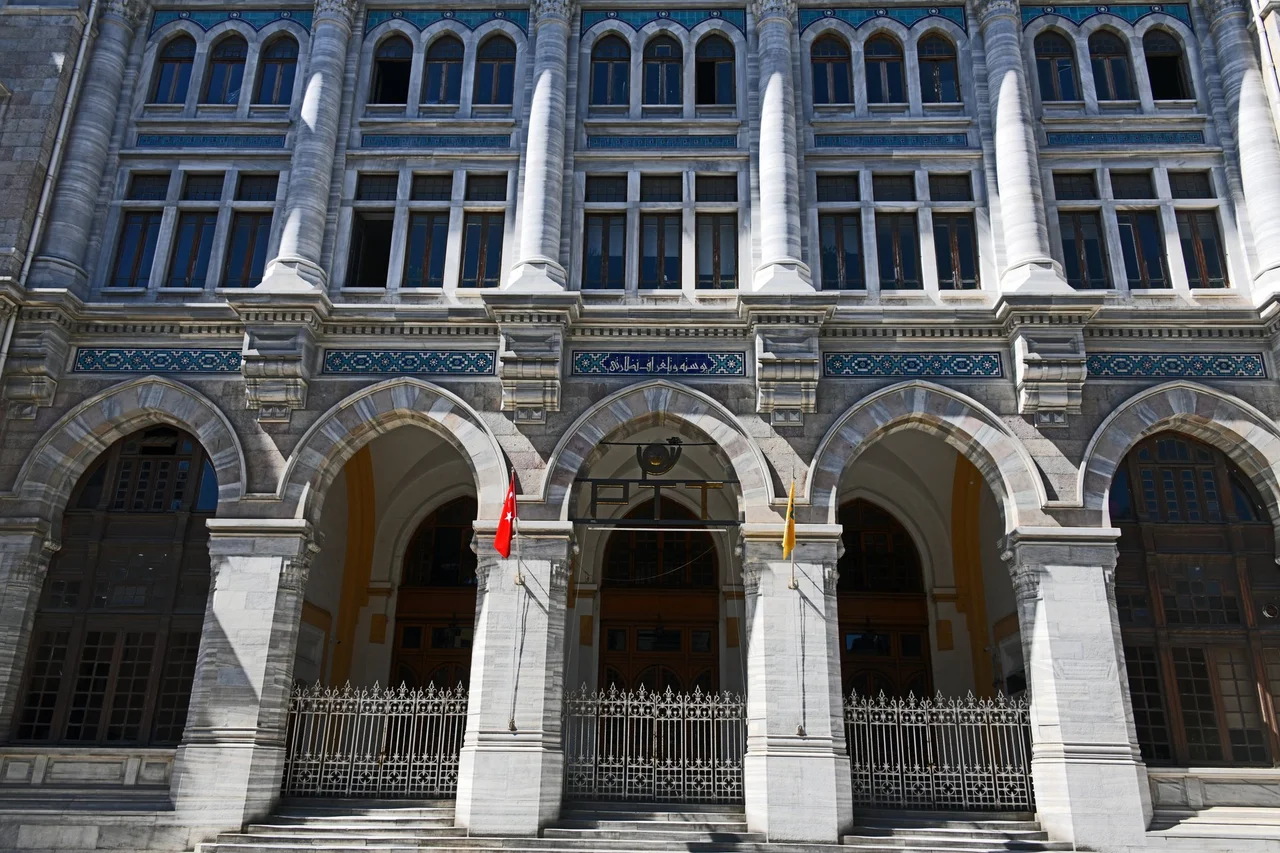

Grand Post Office
The inscription above the main entrance still reads, in Ottoman Turkish script, "Ministry of Post and Telegraph" — a reminder that this building was conceived as a statement of imperial ambition, not merely a place to send letters. When architect Vedat Tek completed the Istanbul Grand Post Office in 1909, he was doing something more than finishing a construction project. He was announcing the birth of a new architectural language, one that could be distinctly Turkish without abandoning the grandeur the Ottoman Empire demanded.
A New Tongue in Stone
Vedat Tek was born in 1873 into an Ottoman world that had spent decades copying European styles. By the early twentieth century, a counter-movement was stirring: why shouldn't the empire's own architectural heritage serve as the template for modernity? Tek became one of its earliest champions. The Grand Post Office was among the first major buildings to embody what historians later called the First Turkish National architectural style — a deliberate reaching back toward the classical Ottoman aesthetic of the sixteenth century, expressed through cut stone and marble, two-colored facades, tiled panels bearing Islamic geometric patterns, and muqarnas carved into pillar heads and corbels. The building's four stories are flanked by two corner turrets. Kufic calligraphic scripts frame the entryway. Every decorative choice was a declaration. This was not a European post office with a Turkish name; it was something genuinely new.
Inside the Hall of Light
Climb the exterior stairs — the entrance is elevated, giving even the act of entering a certain ceremony — and push through the doors into the atrium at the building's heart. Three stories of office balconies ring the rectangular hall on all sides, and above it all, a glass ceiling filters the light in amber and blue. The effect is somewhere between a cathedral nave and a covered marketplace. At 3,200 square meters of floor area, this is Turkey's largest post office, and the scale was always intentional. Post and telegraph were the internet of 1909: the nervous system of commerce, governance, and personal life across a vast empire stretching from the Balkans to Arabia. This building was sized to that ambition. The surrounding neighborhood reinforces the sense of a city in full operation: the Spice Bazaar is a short walk away, the New Mosque just beyond that, and the Sirkeci Railway Terminal — where Orient Express passengers once stepped off their trains — stands nearby.
Radio Waves and Republic
The Ottoman Empire that commissioned this building did not survive to see it turn thirty. After World War One, the empire collapsed and the Republic of Turkey emerged in its place. The Grand Post Office adapted. In the 1930s it was renamed first "New Post Office" and then, with a quiet grandiosity, simply "Grand Post Office." More strikingly, between 1927 and 1936 its upper floors temporarily housed Istanbul Radio — meaning that for nearly a decade, the building that had been built to transmit written messages became the broadcast point for voices reaching across a modernizing nation. The fact that both functions fit naturally within the same walls says something about the building's scale and flexibility.
Letters, History, and a Museum Within
In 2000, the Istanbul Postal Museum opened inside the building, occupying space that the main post office — still operating on the ground floor — no longer needed for clerks and counters. The museum traces the history of Ottoman and Turkish postal systems: the stamps, the sorting machinery, the uniforms, the routes that connected remote Anatolian towns to the imperial center. Wandering through it, you move between two time scales. Downstairs, people are buying stamps and filling out forms; upstairs, you are looking at the stamps their great-grandparents licked. The combination is very Istanbul: the past does not recede here so much as it continues to operate in parallel.
Sirkeci Seen from Above
From the air, the Grand Post Office reads as a solid, confident rectangular mass set between the waterfront and the old city's hills. Its two corner turrets are visible from a good approach angle, and the cut-stone facade catches the Bosphorus light differently depending on the hour. The building sits on the European shore of Istanbul, well within the historic peninsula that visitors come to for Hagia Sophia and the Grand Bazaar — but it is a short walk from those monuments rather than among them, which means it often rewards those willing to step slightly off the obvious path. Look for it on the Sirkeci side, tucked between the railway terminal and the waterfront, the tiled panels above the doorway still legible after more than a century of weather.
From the Air
The Grand Post Office sits at 41.0144°N, 28.9739°E on the European shore of Istanbul, in the Sirkeci district near the Golden Horn waterfront. From a low-altitude approach to LTFM (Istanbul Airport, ~35 km northwest), look for the historic peninsula's distinctive skyline — Hagia Sophia's dome and the Blue Mosque's minarets are the reference points, and Sirkeci lies just north of those landmarks near the waterfront. Recommended viewing altitude is 1,500–3,000 feet for the roofline context. The Golden Horn inlet and the Bosphorus strait are visible navigation anchors from most approach angles.
Nearby Stories
- Kocaeli Peninsula 7.6 km away
- Second Battle of Çatalca 11 km away
- Istanbul's Rural Outskirts 14 km away
- MV Struma 20 km away
- HMAS AE2 36 km away
- Bursa 66 km away
- Sangarius Bridge 71 km away
- Januarius MacGahan 101 km away