
Great Palace Mosaic Museum
Shoppers browsing the Arasta Bazaar near the Blue Mosque are walking, without knowing it, above one of the most spectacular floor decorations ever laid in the ancient world. Beneath the bazaar's stone paving, British archaeologists from the University of St Andrews spent years between 1935 and 1954 excavating a peristyle courtyard — an open colonnaded garden — whose entire 1,872-square-meter surface was covered in mosaic. The Great Palace Mosaic Museum preserves what they found: the pavement that once decorated a garden of the Byzantine emperors' Great Palace of Constantinople, filled with hunting scenes, animals, mythological figures, and the small dramas of everyday life.
The Palace Beneath the City
The Great Palace of Constantinople was the nerve center of the Byzantine Empire for nearly a thousand years, a sprawling complex of halls, churches, reception rooms, gardens, and hippodromes stretching from the Marmara shore uphill toward the Hippodrome. Almost nothing of it is visible today — the city that grew over it after 1453 erased the surface almost completely. But archaeology has been slowly recovering fragments. The peristyle courtyard whose mosaic floor is now displayed in the museum formed the southwestern corner of the palace complex. Scholars date the mosaics to somewhere between the reign of Emperor Justinian I (who ruled from 527 to 565) and the later reign of Heraclius, though the exact date remains disputed. What is not disputed is the quality: these mosaics represent the imperial workshops at full capacity.
A World in Tesserae
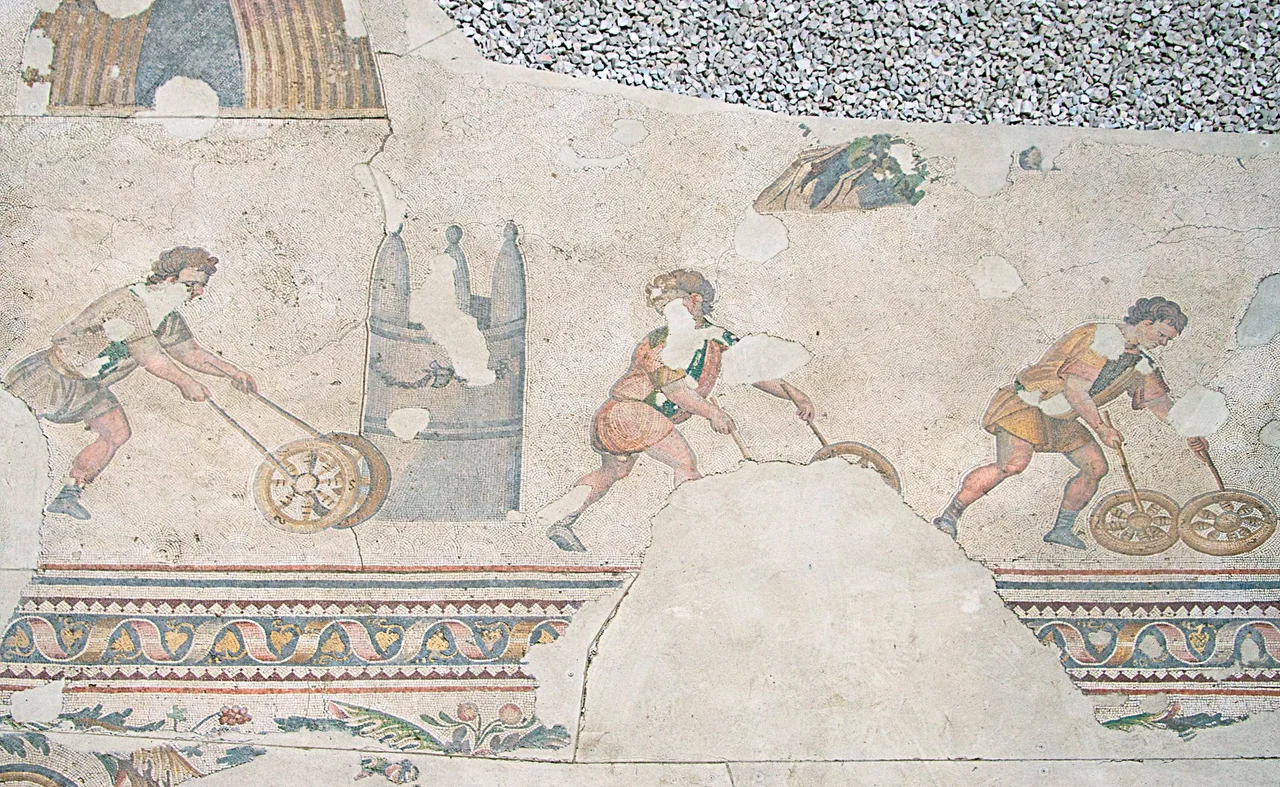
Walking through the museum is an exercise in adjusting expectations. These are not solemn religious images — no gold-ground saints, no hieratic Christ figures. The craftspeople who laid this floor were interested in the physical world: a boy chasing a dog, children playing with hoops in an arena, a woman carrying a pot, a shepherd milking a goat, a dromedary ridden by its handler. Combat scenes appear repeatedly — hunters pursuing lions, bears attacking lambs, griffins in mid-attack. A Dionysian procession unspools across one section, the elephant and the wine-jug carrier moving in opposite directions. The mosaic of the Good Shepherd — a man carrying a lost sheep on his shoulders, possibly also loaves of bread — occupies its own quiet corner, a pastoral note amid the action. Individually, each scene is virtuosic. Collectively, they paint a portrait of Byzantine courtly taste: cosmopolitan, confident, and delighted by the natural world.
Decades of Excavation and Preservation
The story of how this floor came to light is itself a long project. University of St Andrews archaeologists began digging in 1935, worked through 1938, then returned for a second campaign from 1951 to 1954. The Austrian Academy of Sciences, under the direction of Professor Werner Jobst, undertook further study and conservation work between 1983 and 1997, working with Turkey's Directorate General of Monuments and Museums. The challenge was enormous: an ancient mosaic floor exposed to centuries of overlying construction, then carefully lifted, restored, and re-presented within a purpose-built museum directly above the excavation site. The museum opened at street level above the Arasta Bazaar, close enough to Sultanahmet Square that visitors can see the Blue Mosque's minarets from the entrance. In July 2023 the museum closed again for restoration work; as of early 2024, a reopening date had not been announced.
What Survives, and What It Means
Byzantine mosaic floors are rare. Most were damaged by earthquakes, fires, or subsequent construction. The Great Palace collection survives because it lay buried and forgotten for centuries, protected by the very weight of the city above it. Its survival makes it one of the most significant archaeological finds of twentieth-century Istanbul — a window into a world that otherwise leaves almost no visual record at street level. The museum asks visitors to look down rather than up, which is itself an unusual act in a city of minarets and domes. Kneeling to examine the face of the boy with the dog, or the fur texture of a bear in mid-leap, you understand why the Byzantine court thought this floor worthy of the emperor's garden.
From the Air
The Great Palace Mosaic Museum sits at 41.0044°N, 28.9767°E, just southeast of Sultanahmet Square on Istanbul's historic peninsula. From a low-altitude pass over the European city flying toward LTFM (Istanbul Airport, ~35 km northwest), the Blue Mosque's six minarets and Hagia Sophia's single large dome mark the exact neighborhood. The museum is tucked immediately southeast of those landmarks. Recommended viewing altitude is 1,000–2,500 feet to distinguish the Arasta Bazaar area from the surrounding dense urban fabric. The Sea of Marmara is visible to the south.
Nearby Stories
- Kocaeli Peninsula 7.6 km away
- Second Battle of Çatalca 11 km away
- Istanbul's Rural Outskirts 14 km away
- MV Struma 20 km away
- HMAS AE2 36 km away
- Bursa 66 km away
- Sangarius Bridge 71 km away
- Januarius MacGahan 101 km away