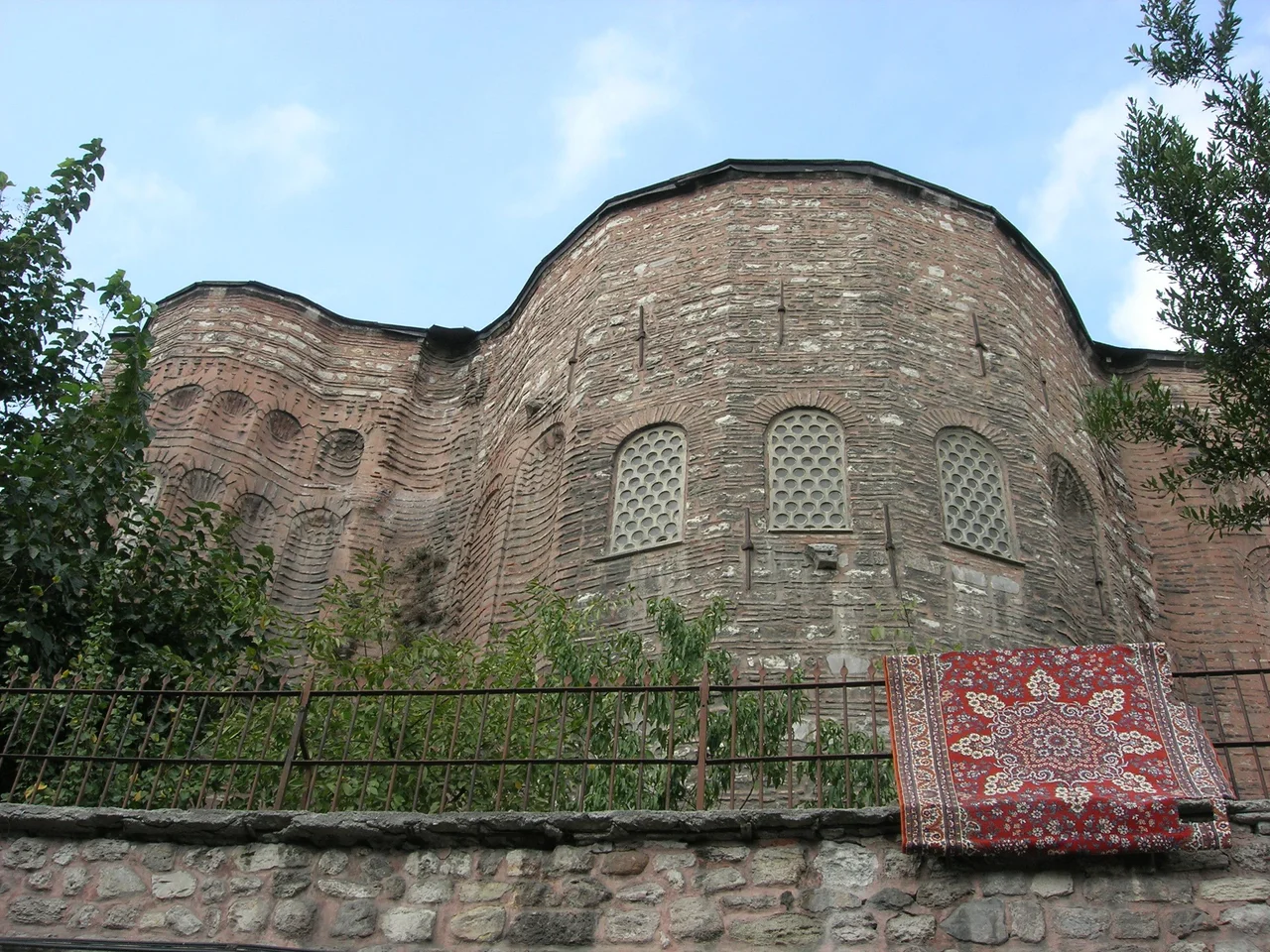

Gül Mosque
On the evening of May 28, 1453, Emperor Constantine XI walked with the Patriarch to a church adorned with garlands of roses — it was the eve of the saint's feast day — and prayed for what he must have known would be the last time. Then he left for the walls. By the next morning, Constantinople had fallen to the Ottoman army and the Byzantine Empire had ceased to exist. The church decorated with roses that night was almost certainly the building now known as the Gül Mosque, the Rose Mosque, standing at the end of a valley between Constantinople's fourth and fifth hills, overlooking the Golden Horn. It has held that name ever since, though whether it is because of the flowers that adorned it on that final Byzantine night, or because of a holy man named Gül Baba who was allegedly buried here in the following century, no one can say with certainty.
A Saint, a Miracle, and an Empire's Nerve
The story of the building begins before its walls were raised, with a nun named Theodosia. On January 19, 729, Emperor Leo III the Isaurian ordered the removal of a mosaic image of Christ from the Chalke Gate, the main entrance to the Great Palace of Constantinople. It was the opening act of the iconoclast controversy that would divide the Byzantine church and state for over a century. A group of women gathered to resist the order. Theodosia, a nun, caused the officer carrying out the removal to fall from his ladder. The officer died. Theodosia was captured and executed. After the iconoclast era ended, the church recognized her as a martyr and saint. Her relics were enshrined in a church in the Dexiokratiana quarter, and Hagia Theodosia became one of Constantinople's most venerated saints — sought out particularly by the sick. In 1306, a deaf-mute was miraculously cured in her church. After that, twice each week, processions carried the relics through the streets while crowds of the ill followed, hoping for healing.
The Problem of Knowing
Scholars have never fully agreed on what the building actually was before the Ottomans converted it. The identification with the church of Saint Theodosia dates back to the German preacher Stephan Gerlach, who visited between 1573 and 1578 and made the connection. But early twentieth-century scholar Jules Pargoire argued it was actually the church of Hagia Euphemia en tō Petriō, built by Emperor Basil I at the end of the ninth century — a monastery that housed his four daughters, all of whom were buried within it. Then in the 1960s, the German archaeologist Hartmut Schäfer studied the basement and proposed a still different identification, placing the construction between the late eleventh and early twelfth centuries and connecting it to the Monastery of Christos Euergetēs. Schäfer did not exclude the possibility that the building was later dedicated to Saint Theodosia. The uncertainty is itself part of what makes this building interesting: it is a structure whose identity has been genuinely disputed by serious scholars for centuries.
Rose and Mosque
The church stood ruined for decades after the Ottoman conquest. In 1490, it was repaired and converted into a mosque. Earthquakes in the seventeenth and eighteenth centuries damaged the upper portions severely, and Sultan Murad IV eventually oversaw a substantial restoration that rebuilt the dome and its pendentives, nearly the entire west wall, the corner vaults, and the minaret. Sultan Mahmud II added a wooden Sultan's lodge in the early nineteenth century. The building that stands today is therefore a layered artifact: Byzantine stone at the core, Ottoman reconstruction throughout the upper reaches, with the two traditions resting on each other in a way that is literal as well as historical. The structure measures 26 meters long and 20 meters wide, oriented northwest to southeast, with a Greek-cross plan. Five domes cover it — one large central dome, four smaller ones at the corners — and the southeastern facade pushes three apses boldly outward.
The View from Ayakapı
The neighborhood the mosque occupies is called Ayakapı — Gate of the Saint — a name that may itself preserve a memory of Saint Theodosia. The building overlooks the Golden Horn from the end of the valley between Constantinople's fourth and fifth hills, an imposing position that would have made the church visible from the water in Byzantine times. Visitors who make the slight detour from the main tourist circuits find a building that has been genuinely used and changed over fifteen hundred years of continuous occupation: not a museum piece, not a ruin, but a working mosque in a residential neighborhood, carrying its complicated history without annotation. The Golden Horn gleams below. The hills rise around it. The roses, whatever their source, are long gone.
From the Air
The Gül Mosque sits at 41.0268°N, 28.9562°E on the European shore of Istanbul, on the slopes above the Golden Horn inlet in the Fatih district. From an approach to LTFM (Istanbul Airport, ~35 km northwest), the Golden Horn is a clear navigational reference — a curved inlet of water cutting inland from the Bosphorus. The mosque is on the south slope above the Horn's western bank, north of the historic peninsula's main monuments. Recommended viewing altitude is 1,000–2,500 feet. The Atatürk Bridge crossing the Golden Horn is a useful reference for locating the general area from the air.
Nearby Stories
- Kocaeli Peninsula 7.6 km away
- Second Battle of Çatalca 11 km away
- Istanbul's Rural Outskirts 14 km away
- MV Struma 20 km away
- HMAS AE2 36 km away
- Bursa 66 km away
- Sangarius Bridge 71 km away
- Januarius MacGahan 101 km away