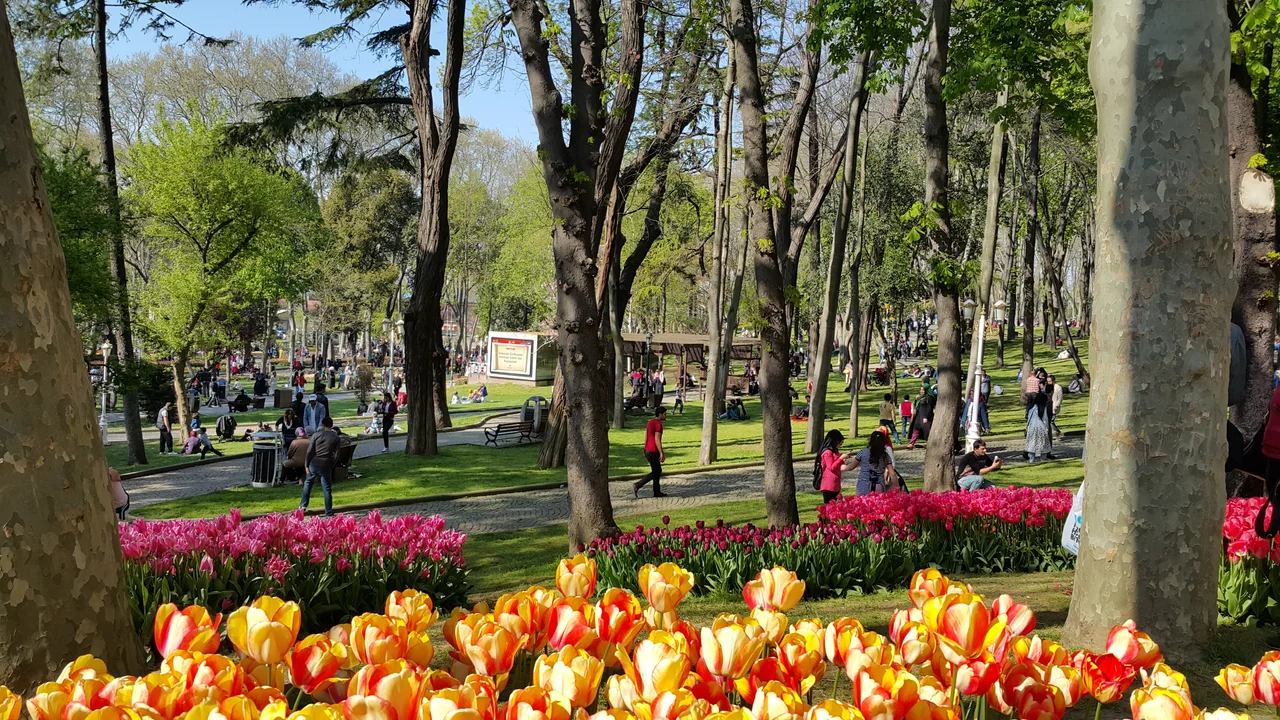

Gülhane Park
On November 3, 1839, Foreign Minister Mustafa Reşid Pasha stood in the park known as Gülhane and read aloud a document that would change the Ottoman Empire: the Edict of Gülhane, which declared, among other things, that all Ottoman subjects — Muslim, Christian, and Jewish alike — were equal before the law. The proclamation launched the Tanzimat reform era, a generation-long effort to modernize a sprawling empire that was struggling to keep pace with the industrializing world. The park from which Reşid Pasha read still exists, pressed up against the walls of Topkapı Palace, its trees older than the republic that eventually succeeded the empire, its roses still blooming every spring.
From Palace Garden to Public Park
For centuries, Gülhane was not a public space at all. It was the outer garden of Topkapı Palace, a grove that served the court — a green buffer between the sultan's world and the city below. The palace's south entrance, still standing, gives onto the park's gate, and the relationship between the two spaces is still legible in the layout: the park's paths follow the contours of what was once a royal landscape, and the trees that shade the benches today include specimens that were already old when the park opened to ordinary Istanbullus in 1912. The opening came after the Ottoman municipality took over a section of the outer garden and laid it out as a public park — one of the first in the city. Over the following decades it accumulated the usual features of a city park: coffee houses, recreation areas, playgrounds, a small zoo. It was, in other words, used.
The Edict and the Rosehouse
The name Gülhane means "Rosehouse" in Turkish, and the small structure on the grounds that gave the park its name was the same building from which the 1839 edict was proclaimed. The Tanzimat reforms that followed the edict were genuinely transformative: they reorganized the military, restructured the legal and tax systems, and created new secular courts. The equalization of Ottoman citizens regardless of religion was radical for its time, even if the full implementation of those principles remained contested for decades. Standing in the park today, with Topkapı Palace's walls rising on one side and the Golden Horn glinting in the distance, it is not hard to imagine the assembled dignitaries of 1839 gathered here, Reşid Pasha's voice carrying across the grove, the empire's future hanging in the air alongside the scent of roses.
Trees, Science, and a Kiosk
A major renovation in recent years removed the zoo, the funfair, and the picnic grounds that had accumulated in the park over the twentieth century. The concrete structures came down, the paths were rearranged, and the landscape that emerged was closer to the park of the 1950s — which was itself closer to the grove of the nineteenth century. Trees that had been planted in the 1800s became visible again. On the park's western edge, in the former stables of Topkapı Palace, the Istanbul Museum of the History of Science and Technology in Islam opened in May 2008. It displays 140 replicas of instruments and devices from the 8th through 16th centuries, spanning astronomy, medicine, architecture, optics, and warfare — a reminder that the civilization that built this palace was also producing the mathematics and engineering that the Renaissance would later inherit. The Procession Kiosk, or Alay Köşkü, sits on the outer wall overlooking the tramway, accessible from inside the park; it now houses the Ahmet Hamdi Tanpınar Museum Library, named for one of Turkey's most celebrated twentieth-century writers.
A Living Grove
Gülhane covers 9.7 hectares in the Fatih district, pressed between Topkapı Palace and the waterfront slope down toward the Bosphorus. Its ecological numbers are precise in the source records: the park absorbs 422.88 tons of dust per year, sequesters 2,738.9 tons of carbon, and produces 33.4 tons of oxygen annually — figures that speak to the unusual role a mature urban forest plays in a dense city. On any weekday afternoon, the park fills with Istanbul residents on lunch breaks, students reading on benches, families walking under the plane trees. The tourist circuit — Hagia Sophia, the Blue Mosque, the Grand Bazaar — runs nearby, and visitors who peel off to sit for half an hour in Gülhane often find it the most human-scaled experience of the entire day. The roses bloom in season. The palace walls run along one side. The trees hold their quiet.
From the Air
Gülhane Park sits at 41.0122°N, 28.9800°E on Istanbul's historic peninsula, directly adjacent to the eastern wall of Topkapı Palace. From a low-altitude pass en route to LTFM (Istanbul Airport, ~35 km northwest), the park is visible as a green rectangle pressed between the palace complex and the slope toward the Bosphorus — one of the few substantial patches of tree cover on the densely built historic peninsula. Hagia Sophia's dome and the Blue Mosque's minarets are 500 meters to the southwest. Recommended viewing altitude is 1,500–3,000 feet to see the park's full extent and its relationship to the palace walls.
Nearby Stories
- Kocaeli Peninsula 7.6 km away
- Second Battle of Çatalca 11 km away
- Istanbul's Rural Outskirts 14 km away
- MV Struma 20 km away
- HMAS AE2 36 km away
- Bursa 66 km away
- Sangarius Bridge 71 km away
- Januarius MacGahan 101 km away