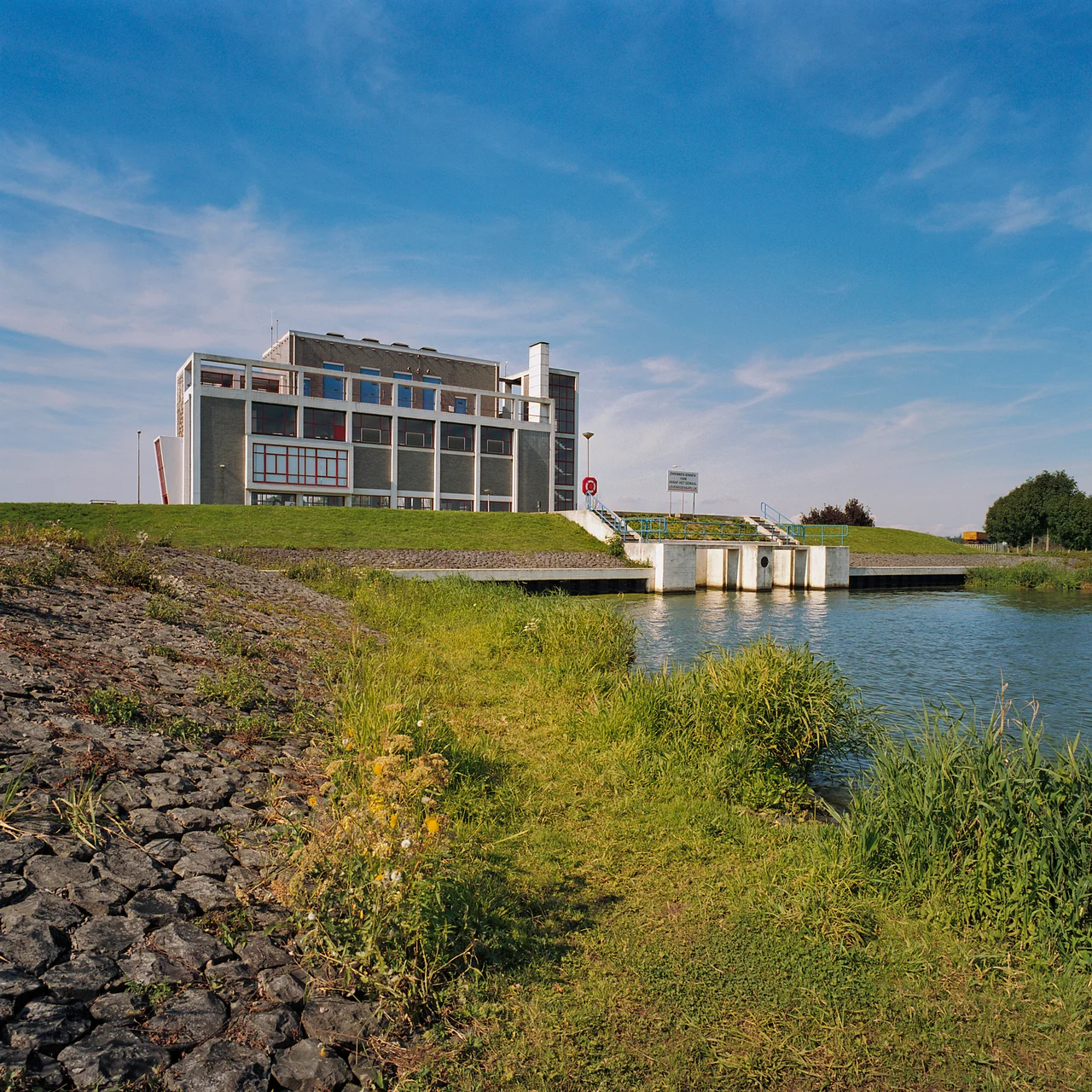

H. J. Lovink Pumping Station
Above the front door of the H. J. Lovink Pumping Station, a row of terracotta tiles tells the central story of Dutch land: a farmer on one side, a fisherman on the other, both reaching across a dyke to shake hands. The piece is called Land en Water - "Land and Water" - and the artist, J. M. Roosenburg, was the son of the architect who designed the building. Her tableau is not just decoration. It is a thesis statement, glazed white on brown, mounted above the entrance to a building whose entire reason for existing is to keep one of these two figures from drowning the other. When Lovink Station first ran its pumps in September 1956, the fisherman was still winning.
The Civil Servant
Hermanus Johannes Lovink - born in Terborg in Gelderland in 1866, died in The Hague in 1938 - was not an engineer like Hendrik Wortman. He was an agriculturalist and an administrator, and the institutions he led shaped the modern Dutch countryside. In 1891 he became deputy director of the Association for Wasteland Redevelopment, a private body charged with reclaiming heaths and moors and turning them into farmland. The next year he was promoted to director. Under his leadership the association drained parts of the Peel, halted drifting sand dunes near Kootwijk on the Veluwe, and planted forests on Schoorl and Texel. In 1901 he became Director-General of Agriculture for the Dutch government, and in 1904 he reorganized the agricultural college at Wageningen into what would eventually become Wageningen University. Naming a pumping station for him was not simply a tribute. It was an acknowledgment that the polder beneath the pumps owed something to the man who had spent half a century arguing that the Netherlands could grow.
Modernism on the Veluwemeer
Construction began in 1954 to a design by Dirk Roosenburg, who also designed the Wortman station up the dyke and whose architectural lineage runs forward into Dutch modernism's most influential firms. The building is composed of three rectangular blocks: a long horizontal engine room, a smaller block above it housing the transformer, and a vertical stair tower linking ground and terrace. Steel-framed windows run in clean horizontal bands. Built on a slight slope, the southwestern facade rises noticeably taller than the northeastern - a small structural elegance that emphasizes the entrance and its terracotta relief. Inside, the engine room is largely open, exposing the concrete trusses overhead and the two vertical centrifugal pumps below. Modernism, in this idiom, meant making the machinery legible. You can see what the building does.
Pumping the Polder
The engines were installed by March 1956, and the Lovink began full operations in September of that year. Together with the Colijn station at Ketelhaven and the H. Wortman station in Lelystad, the Lovink helped drain East Flevoland, officially declared dry on 27 June 1957. Its two pumps move a combined 1,160,000 litres of water per minute - that is, more than nineteen tonnes every second - lifting it 5.2 metres up from the polder canals into the Veluwemeer, the long ribbon of water that separates the Flevopolder from the old Dutch mainland of Gelderland. Because the region's canals are all interconnected, the three stations were called back into action through the 1960s to help drain South Flevoland as well, completing that polder in 1968. The Lovink was automated in 1991. Its engines were refitted between 1993 and 1995, and the switching system upgraded at the same time. In 2002 a recreational lock was added just south of the building so pleasure boats could pass between the canal and the Veluwemeer.
First Monument of the New Land
On 13 December 2010, the Lovink Station was declared a rijksmonument - a Dutch national monument. The Rijksdienst voor het Cultureel Erfgoed cited four reasons: the station's historical importance to the reclamation of the Flevopolder, its architectural value as a clear example of modernism, the artistic value of J. M. Roosenburg's terracotta tableau, and the integrity of the surviving structure. It was the first national monument ever designated in the Flevopolder. There is a quiet symmetry to that. The polder is the youngest Dutch province, drained from the seabed within living memory of the people standing in it. To rank one of its buildings alongside seventeenth-century canal houses and Gothic cathedrals is to declare that the act of making land is itself a form of Dutch heritage worth preserving. Out in the canal Jacqueline Verhaagen's blue-concrete artificial island, De Blauwe Dromer - "The Blue Dreamer", placed there in 2001 - floats as a reminder that the polder is still adding to itself, one work of imagination at a time.
From the Air
The H. J. Lovink Pumping Station sits at 52.37N, 5.62E, on the southern edge of Biddinghuizen along Provincial Road N306, where a polder canal meets the Veluwemeer. From altitude, look for the long arrow of the Veluwemeer separating Flevoland from the wooded Veluwe to the south, and a small modernist building tight against the shoreline at the canal mouth. The Lovink Lock and its 2002 recreational lock are visible immediately southwest. Nearby: the Walibi Holland theme park lies a few kilometres north in Biddinghuizen, and the wooded Veluwe National Park spreads across the water to the south. Nearby airports: Lelystad (EHLE) 11 NM north, Teuge (EHTE) 19 NM east, Hilversum (EHHV) 18 NM southwest.
Nearby Stories
- Amstelveen 4.4 km away
- 2001 United Kingdom foot-and-mouth outbreak 7.2 km away
- Dorestad 9.7 km away
- Schoonhoven 11 km away
- Noordhollandsch Kanaal 13 km away
- Liemers 15 km away
- Urk 15 km away
- Den Hulst 21 km away