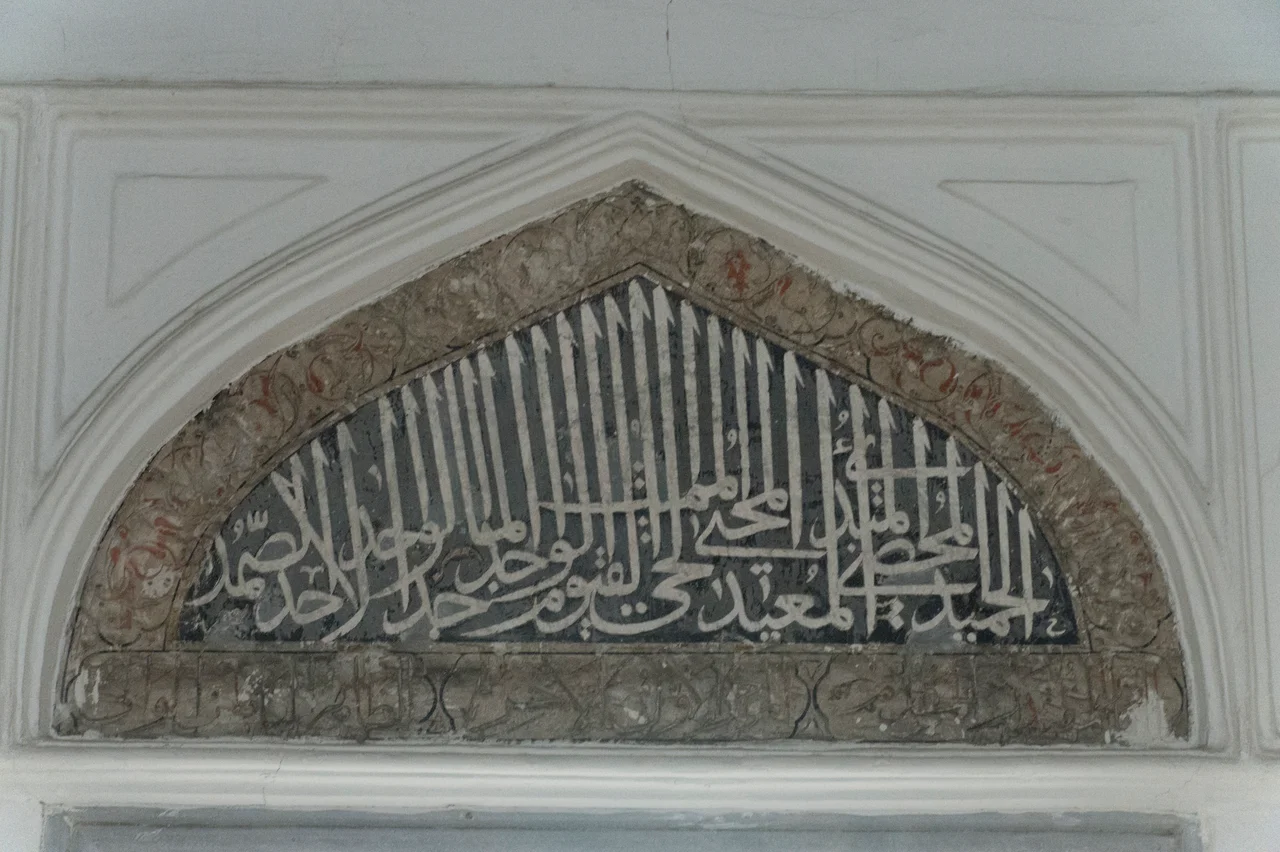

Hadim Ibrahim Pasha Mosque
Hidden behind the Silivrikapı section of Istanbul's old Byzantine walls, the Hadim Ibrahim Pasha Mosque does not announce itself. There is no grand forecourt, no sweeping approach. You simply turn a corner in a quiet residential neighborhood and find a perfectly proportioned domed cube waiting for you — Mimar Sinan at his most precise, built in 1551 for a man whose title tells an entire story: Hadim, meaning eunuch.
The Man Behind the Mosque
Hadim Ibrahim Pasha rose from the enslaved ranks of the Ottoman imperial household to become one of the most powerful men in the empire. Born in Bosnia, he was brought to Istanbul as a youth, educated in the palace system, and climbed to the position of grand vizier — the sultan's second in command. The title "Hadim" marked him as a eunuch, a designation the Ottomans used to distinguish him from the other Ibrahim Pasha who had been executed by Süleyman the Magnificent decades earlier. Despite the diminishing connotation of the name, Hadim Ibrahim Pasha wielded genuine authority, and when he chose to build a mosque, he commissioned the greatest architect in the empire. Sinan was already famous; this was not the grandeur of the Süleymaniye or later Selimiye, but a commission that asked for something different — a neighborhood mosque, modest in footprint but immaculate in craft.
Geometry Made Sacred
The mosque's form is almost elementary: a domed cube with an attached portico. But Sinan understood that simplicity executed perfectly is harder than complexity done carelessly. The main dome spans 12 meters and rests on eight internal buttresses, transferring its load invisibly while keeping the interior open and luminous. Three tiers of windows climb the walls, flooding the prayer hall with changing light across the day. Outside, the five small domes of the portico are carried by arches on marble columns, creating a shaded transitional space between street and sanctuary. The stone minaret at the southwest end of the portico was rebuilt in 1763–64, but the body of the mosque has remained essentially as Sinan left it. Scholars point to its similarity to the earlier Bali Pasha Mosque, completed around 1504–05, suggesting Sinan was working within a known formal vocabulary while refining it toward greater elegance.
Cobalt, Purple, and the Secrets of Iznik
Step under the portico and the tiles arrest you. Three lunette panels and two roundels decorate the north facade, their white thuluth calligraphy reserved against a deep cobalt blue ground. Between the letterforms, flowers in purple and turquoise fill the negative space with a restless energy. Above the mihrab inside, a larger lunette panel layers cobalt blue with turquoise and a dark olive green. The purple, tile specialists note, is highly unusual — it is characteristic of what ceramics historians call the "Damascus" style of Iznik pottery, a technique that places these panels at a specific and brief moment in the evolution of Iznik workshops. The tiles are not merely decorative; they are dateable documents. They help establish the chronology of stylistic change in sixteenth-century Ottoman ceramics, making this quiet mosque in Silivrikapı a reference point for scholars studying one of the great traditions of Islamic decorative art.
A Neighborhood Landmark, Still Standing
Centuries have passed and the neighborhood around the mosque has changed many times over — Byzantine fortifications crumbled and were restored, communities shifted, the city sprawled and contracted. The mosque endured. It functions today as it was intended: a place of daily prayer for the people who live nearby. Sinan's mark is literally present; a carved stamp on one of the pillars identifies the architect's involvement, a practice he used on a number of his buildings. Mimar Sinan is best known for the imperial mosques that define Istanbul's skyline, but connoisseurs of his work argue that his smaller commissions — the mosques tucked into Istanbul's neighborhoods, built for viziers and lesser patrons — reveal the full range of his intelligence. The Hadim Ibrahim Pasha Mosque is one of the finest of those quieter masterpieces.
Finding It from the Air
From above, Silivrikapı sits along the western edge of the historic peninsula, close to where the old Theodosian Walls ran from the Golden Horn toward the Sea of Marmara. The mosque's single dome is visible among the rooftops, modest against the larger domes of more famous neighbors but unmistakable to anyone who knows where to look. Approaching Istanbul from the west, pilots following the Marmara coastline will see the old city walls running north in a pale stone line — the mosque lies just east of those walls, in the dense urban fabric of the historic peninsula. Istanbul Airport (LTFM) lies to the northwest, roughly 30 kilometers away, across the European hinterland.
From the Air
The Hadim Ibrahim Pasha Mosque sits at 41.006°N, 28.923°E in the Silivrikapı neighborhood on Istanbul's historic peninsula, near the ancient Theodosian Walls. Best appreciated at low altitude (1,000–2,000 ft) during a visual approach. The Marmara coastline and the old city walls are the key navigation references from the air. Nearest major airport: Istanbul Airport, LTFM, approximately 30 km to the northwest.
Nearby Stories
- Kocaeli Peninsula 7.6 km away
- Second Battle of Çatalca 11 km away
- Istanbul's Rural Outskirts 14 km away
- MV Struma 20 km away
- HMAS AE2 36 km away
- Bursa 66 km away
- Sangarius Bridge 71 km away
- Januarius MacGahan 101 km away