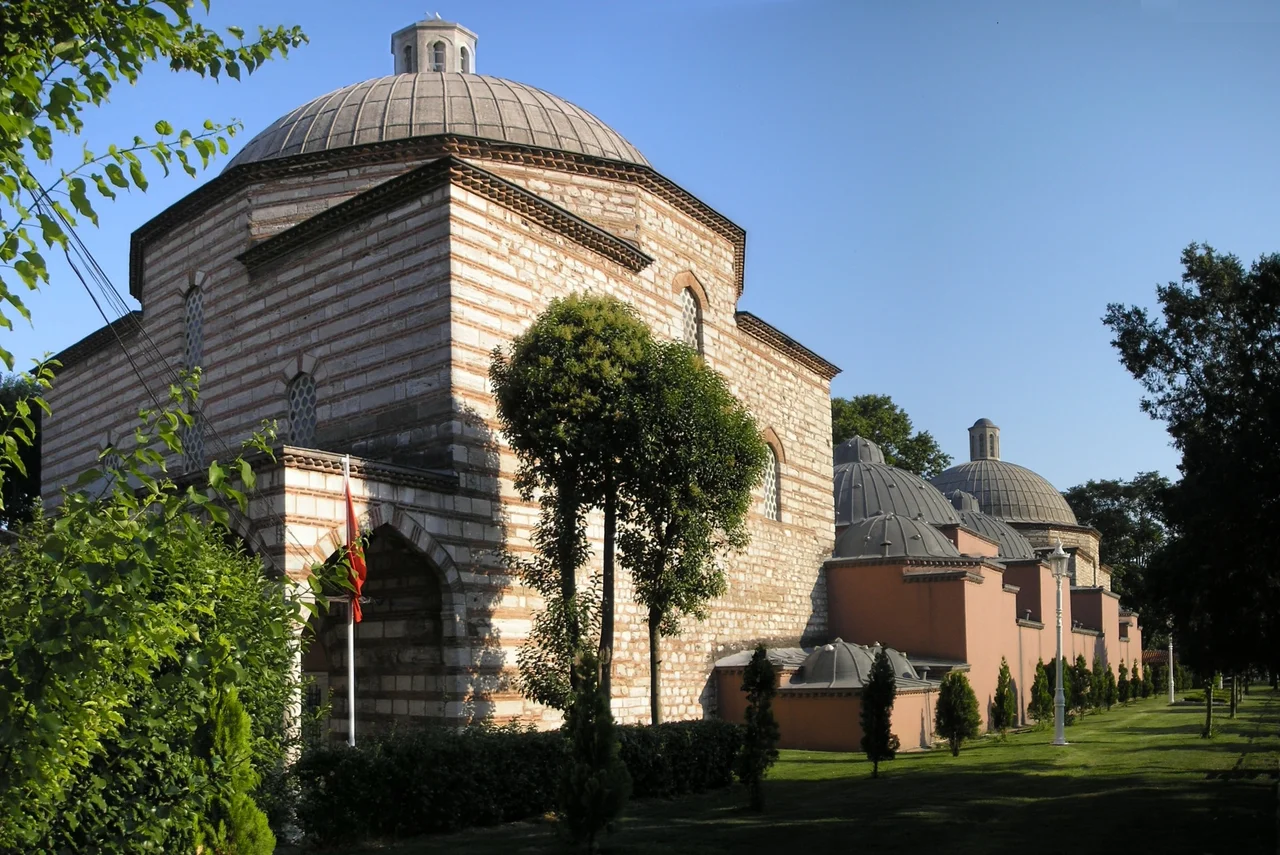

Hagia Sophia Hurrem Sultan Bathhouse
Süleyman the Magnificent ruled at the height of Ottoman power, but it was his wife who solved a logistics problem that had plagued the spiritual heart of Istanbul for centuries. The workers, pilgrims, and religious scholars serving the great Hagia Sophia had no public bath. Hürrem Sultan — the woman Europeans called Roxelana, a former enslaved person from the Black Sea region who became the most powerful woman in the empire — commissioned Mimar Sinan to fix that. What he built in 1556, wedged between two of the world's most famous religious monuments, was a masterpiece of functional symmetry.
Roxelana's Gift to the City
Hürrem Sultan arrived at Süleyman's court as a slave and became, through intelligence and political acumen, his legal wife — an almost unprecedented status for a consort in the Ottoman system. She was a prolific patron of charitable works: soup kitchens, schools, hospitals, mosques. The bathhouse beside Hagia Sophia was one of her most prominent endowments, built to serve the religious community attached to that ancient church-turned-mosque. The site Sinan chose carried its own history. Beneath the ground where workers laid the hamam's foundations lay the ruins of the Baths of Zeuxippus, a Roman bath complex that had served Constantinople since the third century. Empire upon empire, bath upon bath: Istanbul's layers run deep.
The Geometry of Cleanliness
Sinan designed the bathhouse as a double hamam — two fully separate sections, one for men and one for women, each with its own entrance, dressing room, warm room, and hot room. At 75 meters in length, the structure is substantial. What made it genuinely innovative was Sinan's decision to align both sections along a single north-south axis, the men's section to the north and the women's to the south. Ottoman bath architecture typically placed male and female sections at angles to each other or in entirely separate buildings; putting them on the same axis was a novelty that demonstrated Sinan's willingness to rethink the inherited forms of the tradition. The mirrored floor plan is almost architectural calligraphy — a doubled form expressing the symmetry that Ottoman aesthetics prized.
A Century of Silence, Then Revival
The hamam operated for centuries before falling out of use as a bath. For more than a hundred years — a hiatus of exactly 105 years by the time Istanbul authorities acted in 2007 — it served other purposes: a carpet warehouse at various points, a storage facility. When the city decided to return the building to its original use, the restoration work was serious. A US$11 million project ran from 2008 to 2011, stabilizing the structure, repairing the marble interiors, and addressing centuries of accumulated wear. The bathhouse reopened in May 2011. Visitors can now enter as paying guests, as they would have done in Hürrem Sultan's time, to experience the marble slabs, the domed ceilings pierced with star-shaped skylights, and the steam that has defined the Turkish bath tradition for half a millennium.
Between the Giants
The bathhouse occupies one of the most extraordinary pieces of real estate in the world. To the north, Hagia Sophia — built by the Emperor Justinian in 537, converted to a mosque in 1453, made a museum in 1934, and returned to active mosque use in 2020 — rises on its hilltop. To the southwest, the Blue Mosque, completed in 1616, extends its six minarets into the sky. The Haseki Hürrem Sultan Hamamı, as it is also known, sits quietly between these giants, doing what it was always meant to do: providing warmth and water. Walking past it on the Hippodrome side, it is easy to overlook. Step inside and the scale of Sinan's achievement becomes clear.
Approaching from Above
From altitude, the historic peninsula of Istanbul presents one of the most recognizable silhouettes in aviation: the dome of Hagia Sophia, the pencil minarets of the Blue Mosque, the mass of Topkapi Palace, all compressed onto a triangle of land between the Bosphorus, the Golden Horn, and the Sea of Marmara. The bathhouse is invisible from cruising altitude but appears during a low approach — a long, low structure tucked between the two great monuments, its twin sections covered by a series of small domes. Istanbul Airport, LTFM, lies roughly 35 kilometers to the northwest, across the European side of the city.
From the Air
The Hagia Sophia Hurrem Sultan Bathhouse sits at 41.007°N, 28.979°E on Istanbul's historic peninsula, between Hagia Sophia to the north and the Blue Mosque to the southwest. Visible during low approaches over the peninsula (below 2,000 ft). Key landmarks from the air: the dome cluster of Hagia Sophia, the six minarets of the Blue Mosque, and Topkapi Palace to the east. Nearest major airport: Istanbul Airport, LTFM, approximately 35 km northwest.
Nearby Stories
- Kocaeli Peninsula 7.6 km away
- Second Battle of Çatalca 11 km away
- Istanbul's Rural Outskirts 14 km away
- MV Struma 20 km away
- HMAS AE2 36 km away
- Bursa 66 km away
- Sangarius Bridge 71 km away
- Januarius MacGahan 101 km away