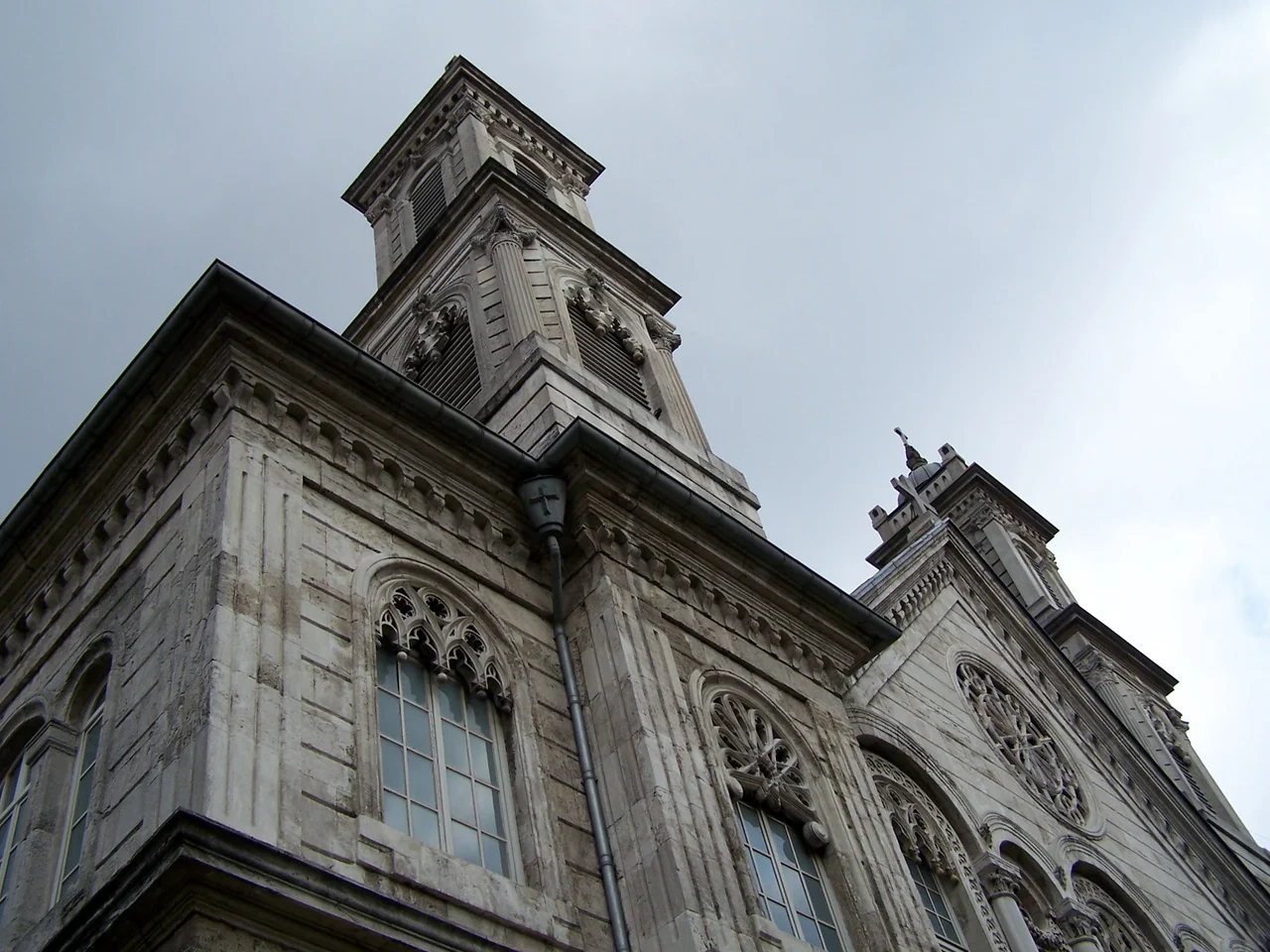

Hagia Triada Church, Istanbul
On a narrow street called Meşelik sokak, a few minutes' walk from the crowds of Taksim Square, twin bell towers rise above the rooftops and announce a different Istanbul. Hagia Triada — Holy Trinity in Greek — is the largest Greek Orthodox church in the city, a place of worship and community for the Greek population that has called Istanbul home for millennia. About 150 parishioners gather here regularly, a figure that speaks quietly to a much larger history: of a community that once numbered in the hundreds of thousands, shaped by waves of departure across the twentieth century, and of those who remained.
A Church Built on Sacred Ground
The land where Hagia Triada stands had long served the Greek Orthodox community before the current church was built. A cemetery and hospital occupied the site, both of which were demolished to make way for the new building. Construction began on August 13, 1876, guided by the designs of P. Kampanaki, an Ottoman Greek architect. It was completed on September 14, 1880 — the feast of the Exaltation of the Holy Cross, a date of deep significance in the Orthodox calendar. The church blends styles in a way that reflects the cosmopolitan ambitions of late nineteenth-century Istanbul: a neo-baroque silhouette with basilica proportions, a large central dome, twin bell towers, and a neo-Gothic facade. The result is distinctive, even idiosyncratic, and entirely suited to a community that had spent centuries navigating between Byzantine heritage and Ottoman present. On the church grounds, the Zapyon Rum Lisesi — the Zappeion Greek Lyceum — continues to educate students from the Greek community, carrying on an educational tradition that predates the church building itself.
September 1955
The most violent night in Hagia Triada's history came on September 6–7, 1955, when rioters moved through Istanbul attacking Greek-owned homes, businesses, and churches in what is now known as the Istanbul Pogrom. The church was wrecked and pillaged. The mob that arrived at Hagia Triada attempted to burn it down. Nubar Terziyan, an ethnic Armenian actor who witnessed the attack, later described what he saw: people dumping kerosene onto the church and lighting it with burning sticks. The building withstood the arson attempt. But the pogrom accelerated the departure of Istanbul's Greek community, which had already been shrinking under economic pressures and legal restrictions. Tens of thousands left in the years that followed. What happened on those two nights is remembered with grief by the community's descendants across Greece and the diaspora. The fact that Hagia Triada survived is not simply an architectural fact — for those who have kept faith with it, the church's survival carries the weight of the community's own.
Restoration and Rededication
Decades after 1955, Hagia Triada was still standing but in need of significant repair. The restoration that finally addressed those needs came through the generosity of Panagiotis Angelopoulos, an industrialist and businessman honored by the Patriarchate of Constantinople with the titles Megas Archon Logothetes and Great Benefactor. His donation of US$90,000 to Patriarch Bartholomew funded a two-year renovation project. The inauguration took place on March 23, 2003, attended by officials of the Greek Orthodox Church, the consuls general of Greece, France, and Germany, and hundreds of people from both Istanbul and Greece. Patriarch Bartholomew delivered the inaugural address. The church returned to daily use. A sacred spring in the courtyard, additional buildings for social services, and the school beside it make Hagia Triada not merely a place of worship but a compound of communal life — exactly what a diaspora community that has remained in place through extraordinary pressure requires.
Holy Trinity, Still Standing
Today Hagia Triada is open and active. Its approximately 150 parishioners represent a community that has endured in Istanbul through circumstances that drove most of their neighbors away. The church is a physical expression of that endurance: the twin bell towers visible from the streets below, the dome catching whatever light Beyoğlu allows, the iconostasis intact inside. Visitors of any background are generally welcome during services and appropriate hours; the church asks only the respect that any active house of worship deserves. Standing in the nave beneath the dome, surrounded by icons and the smell of candle wax and incense, it is possible to understand why those who remained have stayed — and why those who left have not forgotten.
The View from the Air
Hagia Triada sits at 41.035°N, 28.984°E in the Beyoğlu district, on the northern side of the Golden Horn. From altitude, the twin towers are identifiable among the dense roofscape of the neighborhood. Taksim Square, with its open plaza and the Atatürk Cultural Center, provides the aerial reference point — the church is a short walk southeast of the square. Istanbul Airport, LTFM, lies approximately 35 kilometers to the northwest. On approach to the city from the north or west, the Golden Horn waterway and the dense urban fabric of Beyoğlu come into view before the historic peninsula appears to the south.
From the Air
Hagia Triada Church is located at 41.0355°N, 28.9842°E in the Beyoğlu district of Istanbul, a short distance southeast of Taksim Square on the northern bank of the Golden Horn. The twin bell towers are visible during low approaches over Beyoğlu. Aerial reference: Taksim Square's open plaza lies to the northwest. Nearest major airport: Istanbul Airport, LTFM, approximately 35 km northwest.
Nearby Stories
- Kocaeli Peninsula 7.6 km away
- Second Battle of Çatalca 11 km away
- Istanbul's Rural Outskirts 14 km away
- MV Struma 20 km away
- HMAS AE2 36 km away
- Bursa 66 km away
- Sangarius Bridge 71 km away
- Januarius MacGahan 101 km away