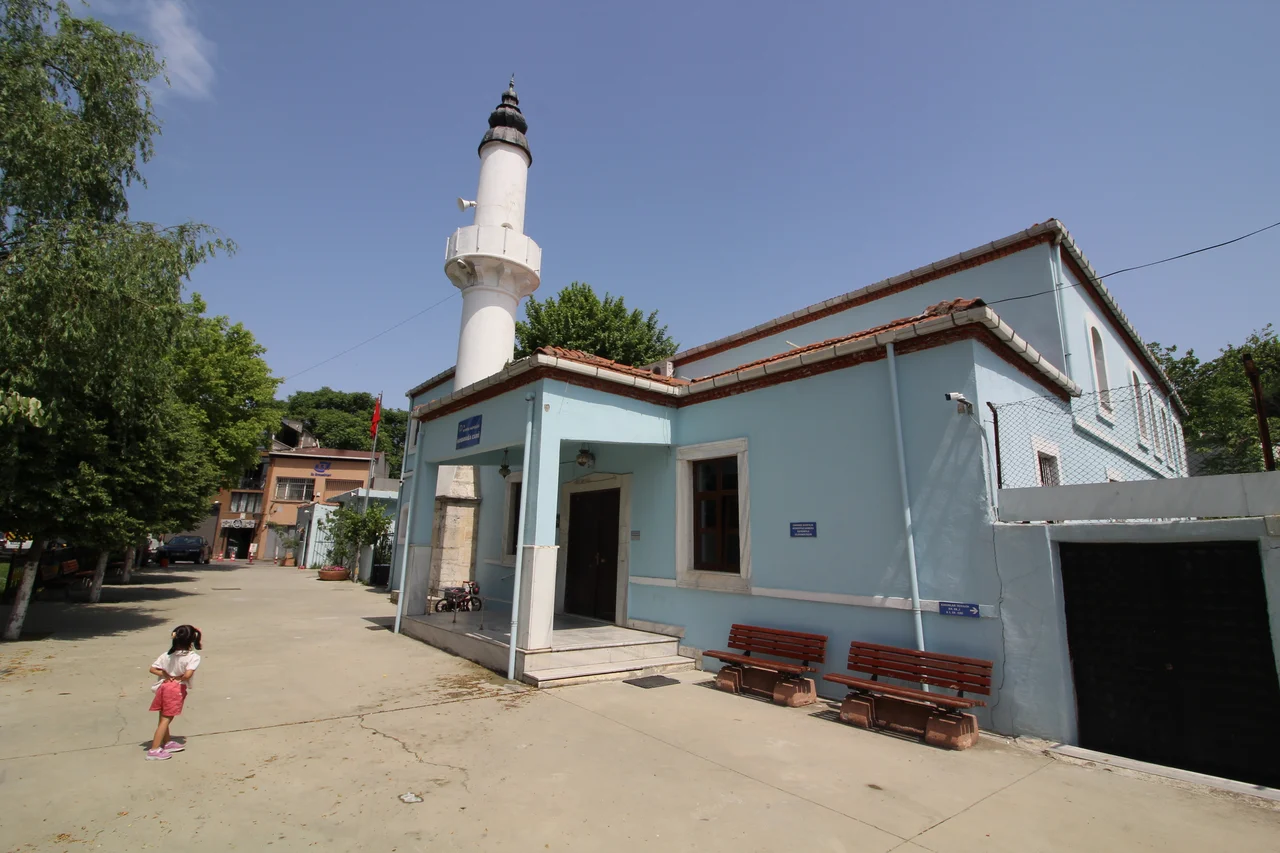

Handan Agha Mosque
The mosque has a name that stops people mid-sentence: Kuşkonmaz, Birds Don't Perch. No one is entirely sure what it refers to — perhaps the minaret's shape discourages roosting birds, or perhaps local legend has attached the phrase to the building over the centuries. Whatever the origin, the nickname gives this quiet 15th-century mosque in the Hasköy neighborhood a personality distinct from grander Islamic landmarks a few kilometers to the south. The Handan Agha Mosque earned its place in Istanbul not through imperial ambition but through the quiet accumulation of time.
Mehmed's Man on the Golden Horn
Handan Agha served as one of the aghas — senior court officials — of Sultan Mehmed II, the conqueror who took Constantinople in 1453 and made it the new capital of the Ottoman Empire. In the decades that followed that conquest, Istanbul was being rebuilt, resettled, and reimagined. Mehmed II encouraged members of his court to build mosques and charitable institutions across the city, populating his new capital with Islamic architecture that would signal Ottoman authority and provide for Ottoman subjects. Handan Agha's mosque in Hasköy was part of that broader project: a neighborhood mosque on the Golden Horn shore, serving the community that was beginning to grow in what would become one of the more diverse districts of Ottoman Istanbul. Hasköy would later become home to significant Jewish and Armenian communities alongside its Muslim residents — a neighborhood whose history reflects the complex, layered demographics of the city.
A Mosque That Floated
What makes the Handan Agha Mosque architecturally unusual is a detail hidden below ground level. The basement of the mosque was originally a boathouse. The building stood directly at the edge of the Golden Horn, the water lapping against its lower story, boats sheltered beneath the prayer hall above. The coastline of the Golden Horn was not fixed; over the centuries, land reclamation gradually pushed the shore outward, filling in the shallows and extending the district into water. By the time the shoreline had shifted, the boathouse below was no longer at the water's edge. The inlet that once allowed boats to enter the building was sealed. The mosque, which had begun its life practically floating, was now firmly landlocked. This kind of vertical stratigraphy — different eras of use layered one upon another — is characteristic of Istanbul's architecture and of the Golden Horn shore in particular.
Centuries in Tile
Inside, the mosque's walls carry a compressed history of Ottoman decorative ceramics. Iznik tiles from the sixteenth and seventeenth centuries line portions of the interior — the characteristic cobalt blues, turquoises, and complex floral patterns that made Iznik pottery the defining decorative tradition of the Ottoman classical period. Alongside these are maiolica tiles from the nineteenth century, added during one of the mosque's several rounds of repair. The juxtaposition is not seamless; the maiolica has a different palette and a different quality than the earlier Iznik work. But together the tiles form a kind of timeline: the mosque was worth maintaining across four centuries, and each era of repair left its own mark. The building was repaired in the eighteenth and nineteenth centuries and again in the 1960s. It has been kept in use throughout.
Hasköy and Its Waters
Hasköy sits on the northern bank of the Golden Horn, part of the Beyoğlu district. It is not one of Istanbul's famous tourist neighborhoods, which is part of its character. The streets are residential, the pace is quieter than Karaköy or Galata below, and the Golden Horn itself — once heavily polluted and now substantially cleaner after decades of environmental work — gives the neighborhood its particular atmosphere. Walking along the waterfront near the mosque, you are in a part of Istanbul that tourists rarely reach and that locals use as a neighborhood rather than a destination. The Haliç Bridge, the road crossing to Ayvansaray on the historic peninsula, is visible a short distance away. The mosque stands a few streets back from the water, its former boathouse basement now firmly above the level of the reclaimed land.
Finding the 'Birds Don't Perch' Mosque
From above, Hasköy is part of the dense urban fabric of the European shore of the Golden Horn, easily identified by the curve of the waterway and the busy coastal road that runs along it. The mosque's minaret rises among the rooftops, not as dramatically as the minarets of the great imperial mosques but with the quiet insistence of a building that has been in the same place for six hundred years. Istanbul Airport, LTFM, is approximately 25 kilometers to the northwest. Approaching from that direction, the Golden Horn comes into view as the city opens up below — a long inlet running southeast from where the waterway finally meets the Bosphorus at Eminönü.
From the Air
The Handan Agha Mosque is located at 41.038°N, 28.951°E in the Hasköy neighborhood of Beyoğlu, on the northern bank of the Golden Horn. The minaret is visible from low altitude amid the rooftops north of the waterway. Key aerial reference: the curve of the Golden Horn and the Haliç Bridge crossing to the east. Nearest major airport: Istanbul Airport, LTFM, approximately 25 km northwest.
Nearby Stories
- Kocaeli Peninsula 7.6 km away
- Second Battle of Çatalca 11 km away
- Istanbul's Rural Outskirts 14 km away
- MV Struma 20 km away
- HMAS AE2 36 km away
- Bursa 66 km away
- Sangarius Bridge 71 km away
- Januarius MacGahan 101 km away