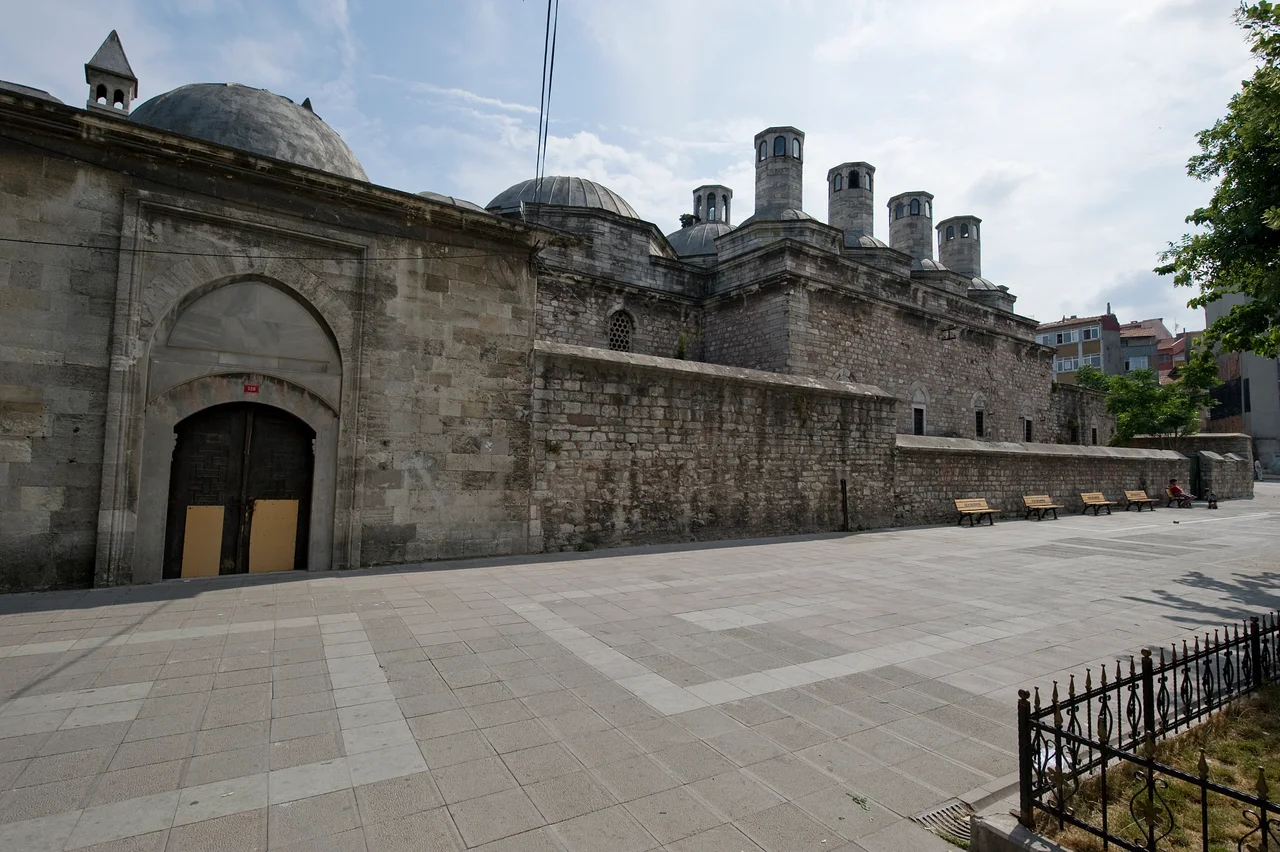

Haseki Sultan Complex
Hürrem Sultan paid for it herself. That detail — buried in the complex's 16th-century history — says more about her than any biography could. The Haseki Sultan Complex in Istanbul's Fatih district was the first major royal project ever designed by Mimar Sinan, the architect who would go on to define Ottoman building for generations. But the commission did not come from Sultan Suleiman the Magnificent. It came from his wife, who had married him around 1534 and apparently used her own dowry to fund the construction. In an empire where women of the imperial household exercised influence obliquely and carefully, Hürrem Sultan built a mosque, a hospital, a school, and a soup kitchen under her own name — and gave Sinan his start.
Hürrem and the Commission That Launched a Career
Hürrem Sultan, known in European sources as Roxelana, was already a figure of remarkable power in the Ottoman court by the time she commissioned this complex. She had broken with convention by marrying Suleiman rather than remaining a concubine — a change that scandalized court traditionalists and fascinated European diplomats in equal measure. The complex that bears her title (haseki means "favoured consort" or "favourite") was her most visible public act of patronage in Istanbul. She chose as her architect a man who was at that point relatively new to the imperial workshops: Mimar Sinan, who would later design the Süleymaniye Mosque and the Selimiye Mosque — buildings that many consider the apex of Ottoman architecture. The Haseki complex was, for Sinan, the beginning. For Hürrem Sultan, it was a statement: her wealth, her piety, and her permanent presence in the city's fabric, all at once.
A City Within a Street
The complex was built in stages across the late 1530s and 1540s, straddling a narrow street in Fatih — the Friday mosque completed in 1538–39, the madrasa a year later, the soup kitchen (imaret) by 1540–41, and finally the hospital (darüssifa) in 1550–51. This was the Ottoman külliye model at its most comprehensive: not just a place of worship, but an entire social infrastructure on a single plot. The madrasa trained students in theology and law, arranged in sixteen cells around a U-shaped courtyard. The imaret fed the poor and the students of the madrasa — a surviving account book records that tiled lunette panels once decorated six of its windows. The hospital, with its distinctive octagonal courtyard, is the only building in the complex constructed entirely of cut ashlar stone; its entrance inscription is a chronogram in Turkish, a poem whose letters also encode the date of construction.
The Mosque That Grew
The mosque Sinan designed was deliberately restrained. Built of alternating courses of stone and brick — a rhythm that gives the structure texture without ostentation — it has a single galleried minaret and a portico of five arches supported by six slim marble columns. The original prayer hall was covered by a single dome just 11.3 meters in diameter. By any measure this was a modest space, nothing like the great imperial mosques Sinan would later design. But Istanbul grew, and so did the congregation. In 1612–13, during the reign of Ahmed I, the prayer hall was doubled in size: a second dome was added, and the mosque expanded along its length. The painted decorations visible today on the domes are later additions, not Sinan's original scheme. Unlike the madrasa and imaret, the mosque was not decorated with the cuerda seca tilework that characterized much Ottoman building of the period — a deliberate simplicity, or simply an economy of means on an early project.
First Work, Lasting Legacy
There is something striking about the fact that Sinan's very first imperial project was commissioned by a woman who was, in a sense, also establishing her own firsts. Historians have sometimes called Hürrem Sultan the most powerful woman in Ottoman history — a claim that depends on definitions, but points to something real about how she reshaped the court's dynamics. The complex she built has outlasted the controversies that surrounded her. Restored between 2010 and 2012, it still functions as a religious and social complex in Fatih, its courtyard buildings in use centuries after the soup kitchen first fed the neighborhood's poor. Walk through Fatih today and the complex sits in an ordinary streetscape, easy to pass without realizing you are beside the debut work of one of history's great architects — built by the woman who gave him his chance.
From the Air
The Haseki Sultan Complex sits at 41.0086°N, 28.9418°E in the Fatih district on the European (Thracian) shore of Istanbul. Departing from Istanbul Havalimanı (LTFM, approximately 40 km to the northwest), the site is inland from the Sea of Marmara shore, within the dense urban fabric of the old walled city. At 2,000 feet, the historic peninsula is clearly identifiable: Hagia Sophia and the Blue Mosque mark its eastern tip, while the Süleymaniye Mosque — Sinan's later masterwork — is visible on the ridge to the northwest. The Haseki complex itself is several blocks south of the Süleymaniye, in the lower, more densely built Fatih quarter. Clear days allow identification of the street grid and the mosque's single minaret.
Nearby Stories
- Kocaeli Peninsula 7.6 km away
- Second Battle of Çatalca 11 km away
- Istanbul's Rural Outskirts 14 km away
- MV Struma 20 km away
- HMAS AE2 36 km away
- Bursa 66 km away
- Sangarius Bridge 71 km away
- Januarius MacGahan 101 km away