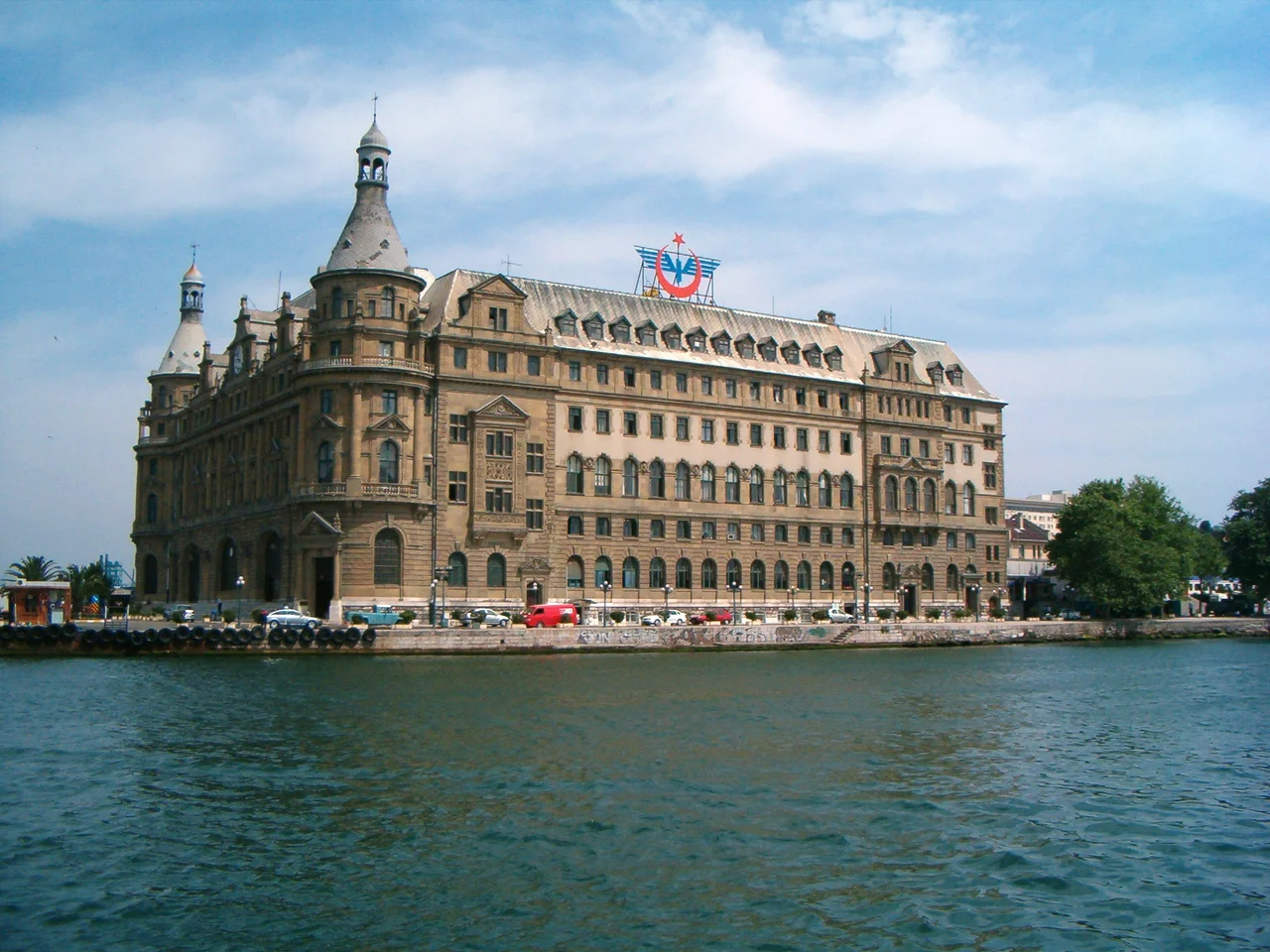

Haydarpaşa Railway Station
Stand on the waterfront at Haydarpaşa and look at the building from the water, as generations of ferry passengers once did: a German-designed chateau of pale stone, its twin towers and steep rooflines reflected in the Bosphorus, looking more like a Rhineland castle than a railway station. That impression was the point. When the current terminal was inaugurated in 1908 — designed by German architects Otto Ritter and Helmut Cuno, decorated with Kütahya tiles — it announced to anyone arriving by sea that Asia began here in style. For nearly a century afterward, Haydarpaşa was where you boarded the train for Ankara, for Baghdad, for Tehran and beyond. In February 2012 the last long-distance train departed. The station has been silent ever since.
The Gate to Anatolia
The story begins in 1871, when Sultan Abdülaziz ordered the construction of a railway line from Haydarpaşa to İzmit. The station that opened the following year was simpler than what stands today — a functional Ottoman-era building suited to a modest regional line. In 1888, the Anatolian Railway (the French concession known as Chemins de fer Ottomans d'Anatolie, or CFOA) took over the line and began extending it east. The station's strategic position on the Bosphorus waterfront made it a natural intermodal hub: freight trains could be unloaded directly onto ships, connecting the railway to the sea lanes of the Marmara and the Mediterranean. By 1890 the first regular passenger service — a daily train to İzmit — had established Haydarpaşa as the hinge between Istanbul's ferry network and the rail system stretching into Anatolia.
Express Trains and Epic Distances
The 20th century turned Haydarpaşa into the starting point for some of the world's most ambitious rail journeys. In 1927, the Compagnie Internationale des Wagons-Lits launched the Anatolian Express, an all-sleeper service running daily between Haydarpaşa and Ankara — a premium train for diplomats, businessmen, and the Ottoman elite's Republican successors. In 1938, the Eastern Express began its run to Kars, covering 1,994 kilometers to Turkey's eastern edge near the Armenian border. Then came the Taurus Express in 1940: Haydarpaşa to Baghdad, 2,566 kilometers, connecting Istanbul to British-administered Iraq through the mountains of Anatolia and the plains of the Fertile Crescent. In 1965 the Trans-Asia Express pushed the network further: Haydarpaşa to Tehran, 3,059 kilometers, threading through the Iranian highlands. These trains carried passengers, mail, and an idea — that Istanbul was a hub connecting Europe to the Middle East and Central Asia. Haydarpaşa was where that idea had a physical address.
War, Occupation, and What the Station Saw
World War I made Haydarpaşa a military node. The Ottoman Empire entered the war in 1914 on the side of the Central Powers, and the station became critical to moving troops and supplies toward the Caucasian and Palestinian fronts. When the Ottomans lost, Istanbul fell under Allied occupation, and Haydarpaşa passed briefly into British military control. The Turkish War of Independence ended with British withdrawal in 1923 and the proclamation of the Republic of Turkey. The newly formed Turkish State Railways (TCDD) nationalized the CFOA in 1927 and took over the terminal. In a separate chapter, a 2010 fire damaged the building significantly — the cause was later attributed to negligence during restoration work, and three people were eventually convicted. The fire accelerated a closure that was already coming: on 2 February 2012, Haydarpaşa shut to long-distance traffic to allow construction of the Marmaray rail link, the underground crossing of the Bosphorus that now connects Istanbul's Asian and European rail networks.
Under the Station, Under the Sea
The silence since 2012 has not been entirely empty. Restoration work begun on the station building in 2018 uncovered something unexpected beneath the platforms: the remains of a Byzantine coastal settlement, including a fortification wall, a fountain, and a ceramic brick kiln. Archaeologists found dozens of graves. In October 2018, an intact skeleton wearing a scented necklace was recovered. Coins and jewelry dated the burials to the reigns of Emperor Heraclius (610–641 AD) and Emperor Justinian (527–565 AD). The layer of Byzantine Haydarpaşa lies just below the layer of Ottoman Haydarpaşa, which in turn lies just below the German-designed terminal of 1908. Istanbul's tendency to reveal its past whenever anyone digs is not a surprise anymore — but it remains extraordinary. As of 2025, plans call for Haydarpaşa to serve again as both a terminus and a museum. The Haydarpaşa Solidarity Group, which has staged regular protests against proposals to demolish or commercialize the station, continues to watch. The building has been on the World Monuments Fund's Watch list since 2011. The trains have not yet returned.
From the Air
Haydarpaşa Railway Station sits at 40.9961°N, 29.0186°E on the Asian (Anatolian) shore of Istanbul, on an embankment jutting into the Bosphorus just south of the Port of Haydarpaşa. The nearest airport is Sabiha Gökçen International (LTFJ), approximately 25 km to the southeast. The station is unmistakable from the air or water: its twin towers and steep-pitched roofline make it one of the most architecturally distinctive buildings on the Bosphorus waterfront. Approaching from the south at 1,500–2,000 feet, look for the container terminal immediately to the north and the Kadıköy ferry piers to the south. The station's stone facade faces west, toward the European shore — toward Sirkeci station and Topkapi Palace across the water.
Nearby Stories
- Kocaeli Peninsula 7.6 km away
- Second Battle of Çatalca 11 km away
- Istanbul's Rural Outskirts 14 km away
- MV Struma 20 km away
- HMAS AE2 36 km away
- Bursa 66 km away
- Sangarius Bridge 71 km away
- Januarius MacGahan 101 km away