.jpg)
Hippodrome of Constantinople
On a January day in 532, the roar inside the Hippodrome of Constantinople turned from sport to fury. What began as chariot racing — the empire's great passion, its common bond between emperor and citizen — had become an uprising, and then a massacre. The Hippodrome held the whole arc of Byzantine civilization within its U-shaped walls: the spectacle, the politics, the violence, and the long, slow forgetting. Today it is Sultanahmet Square, a quiet park in the heart of Istanbul, and three ancient monuments still stand on the ground where chariots once thundered.
Built for Speed, Enlarged for Empire
The Hippodrome did not begin as a monument to imperial power. It began as a provincial facility. In AD 203, the Emperor Septimius Severus rebuilt the city of Byzantium and added a hippodrome — a racing circuit for chariots — as a standard amenity of a rebuilt Roman city. It was in AD 324 that everything changed. The Emperor Constantine the Great, having consolidated his rule over the empire after his victory at the nearby Battle of Chrysopolis, chose Byzantium as the site of his refounded capital, renaming it Nova Roma — New Rome, though the world quickly settled on Constantinople instead. Constantine enormously expanded the city, and at the center of that expansion was a rebuilt and enlarged Hippodrome, estimated at roughly 450 meters long and 130 meters wide. It could hold around 100,000 spectators. The emperor's private box, the Kathisma, connected directly to the Great Palace through a passage reserved for the imperial family alone.
Factions, Chariots, and the Edge of Civil War
Chariot racing in Constantinople was not a casual entertainment. It was the central social institution of the city, the place where the boundary between public life and imperial politics blurred most visibly. Four teams — the Blues, Greens, Reds, and Whites — competed on the track, but these were not simply sporting clubs. Each faction was a political organization within the Byzantine system, financially supported by different constituencies, and their rivalries carried the weight of real ideological disputes. The Reds and Whites gradually faded, absorbed into the Blue and Green factions, whose competition sometimes shaded into something darker. Fights, riots, and outbreaks of civic violence were not unknown. The Hippodrome was where the emperor could address his subjects directly, where petitions could be made, where the mood of the city made itself legible — and where that mood could turn dangerous.
The Nika Riots: January 532
The worst of those dangerous turns came in January 532. The Nika riots — named for the Greek word for 'conquer,' shouted as a battle cry — began during chariot races when supporters of the Blue and Green factions, normally bitter rivals, united against the government of Emperor Justinian I. For five days the city burned. Major buildings were destroyed, including the second Hagia Sophia, which stood near the Hippodrome. The insurgents attempted to crown a rival emperor. Justinian reportedly considered fleeing. What ended the uprising was an act of deliberate, organized violence. Imperial troops, commanded by the general Belisarius, surrounded the Hippodrome where tens of thousands of rioters had gathered, then sealed its exits and moved inward. There was no escape. Historical sources estimate that approximately 30,000 people died inside the Hippodrome that day. They were ordinary people of Constantinople — men and women who had come to the Hippodrome for racing, for politics, for the shared life of the city, and who died there without ceremony, in enormous numbers, in a space they had always considered their own. The Hagia Sophia that Justinian built immediately afterward — the third on that site, and the one that still stands — was raised in part as a monument to his survival of the crisis. The people who died in the Hippodrome received no monument.
A Museum of the Ancient World
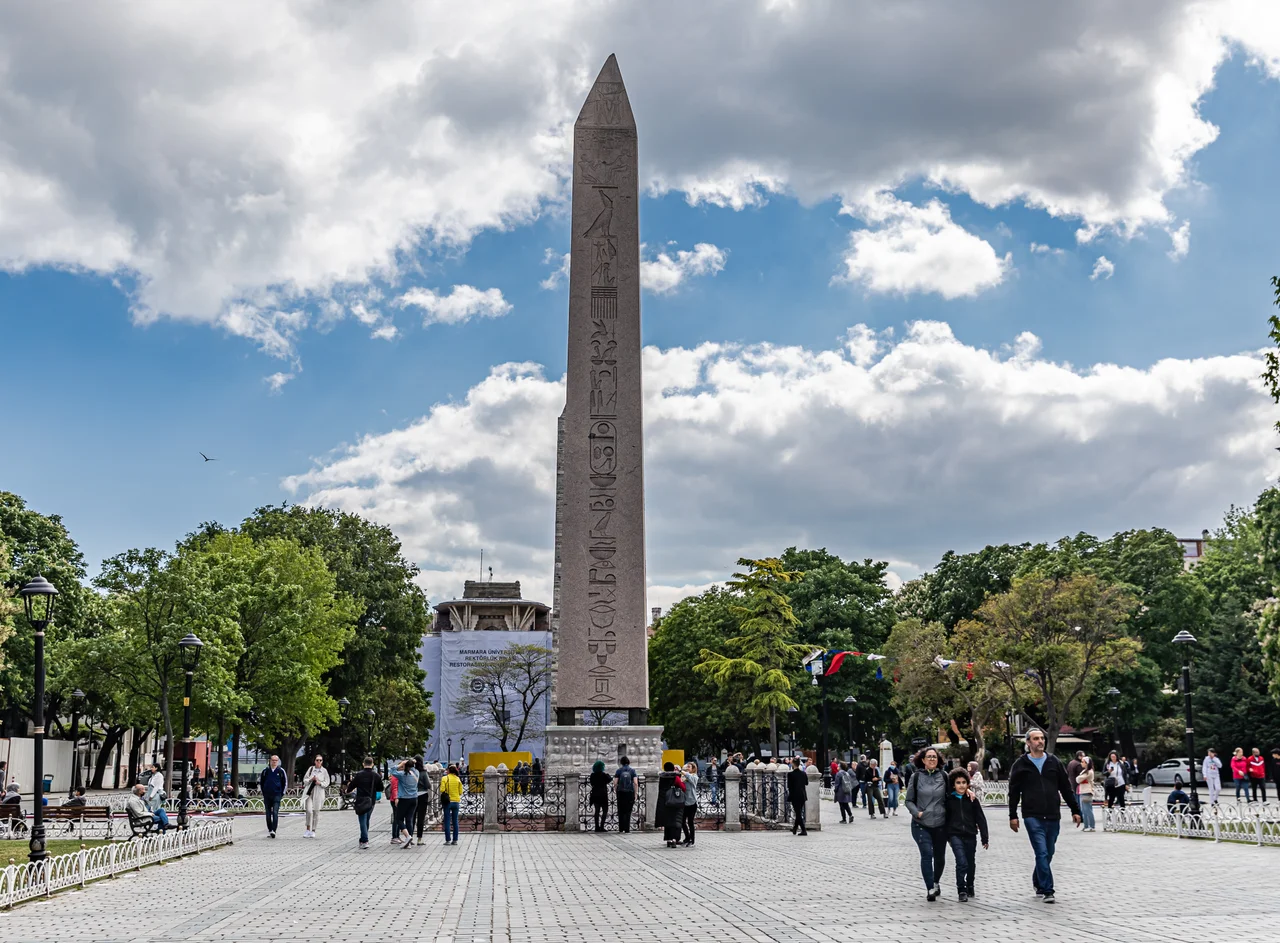
The Hippodrome was more than a racetrack. Constantine and his successors filled its central spine — the spina, the barrier running down the middle of the circuit — with monuments gathered from across the empire and the ancient world. The Serpent Column, cast in bronze to celebrate the Greek victory over Persia at the Battle of Plataea in the 5th century BC, was brought from the Temple of Apollo at Delphi. An Egyptian obelisk of pink granite, carved during the reign of Pharaoh Thutmose III around 1490 BC, was carried from the Temple of Karnak in Luxor by the Emperor Theodosius the Great in 390 AD and erected inside the racing circuit. Both of these still stand in Sultanahmet Square today. A third monument, the Walled Obelisk built by Emperor Constantine Porphyrogenitus in the 10th century, also survives, though the gilded bronze plaques that once covered it were stripped by Latin soldiers during the sack of Constantinople in the Fourth Crusade of 1204. The four gilded bronze horses that once stood atop the starting gates were also taken in 1204; they have stood on the façade of St Mark's Basilica in Venice ever since.
Decline, Forgetting, and What Remains
The Fourth Crusade's sack of Constantinople in 1204 began the Hippodrome's long decline. The city never fully recovered from that catastrophe, and by the time Sultan Mehmed II captured Constantinople in 1453 and made it the capital of the Ottoman Empire, the Hippodrome had fallen into ruin. The Ottomans had no tradition of chariot racing, and the great structure was gradually stripped for building stone — though, remarkably, the site itself was never built over. The open ground persisted, and the three ancient monuments continued to stand. In the nineteenth and twentieth centuries, excavations beneath Sultanahmet Square have periodically uncovered rows of ancient seats and columns. It is possible that much more of the Hippodrome lies beneath the park, preserved in the soil of a city that has always been built, layer by layer, on what came before.
From the Air
The Hippodrome of Constantinople (Sultanahmet Square) sits at approximately 41.006°N, 28.976°E at the heart of Istanbul's historic peninsula, on the European side of the city. From the air at 1,500 to 2,000 feet AGL, the open green space of Sultanahmet Square is immediately recognizable between the Blue Mosque (Sultanahmet Camii) to the southwest and Hagia Sophia to the northeast. The three surviving Hippodrome monuments — the Serpent Column, the Obelisk of Thutmose III, and the Walled Obelisk — are visible as vertical markers in the park. The nearest major airport is Istanbul Airport (LTFM) to the northwest.
Nearby Stories
- Kocaeli Peninsula 7.6 km away
- Second Battle of Çatalca 11 km away
- Istanbul's Rural Outskirts 14 km away
- MV Struma 20 km away
- HMAS AE2 36 km away
- Bursa 66 km away
- Sangarius Bridge 71 km away
- Januarius MacGahan 101 km away