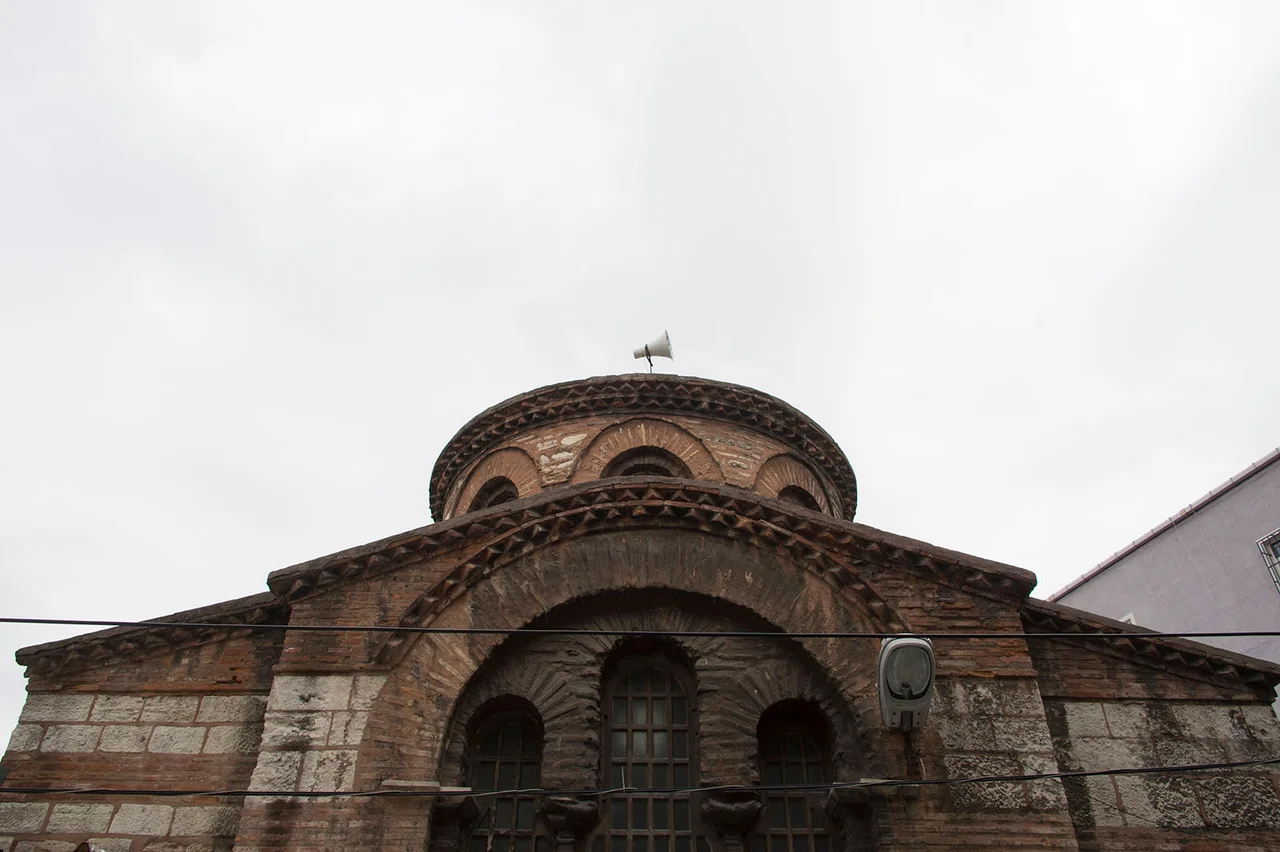

Hirami Ahmet Pasha Mosque
It has no minaret. For a mosque in Istanbul, that absence is the first thing you notice — the sky above is simply sky, unaccented. The Hirami Ahmet Pasha Mosque in the Fatih district wears its Byzantine origins more plainly than almost any other converted church in the city. It is small enough that new buildings crowd close around it. Historians believe it dates to the twelfth century, making it one of the oldest standing structures in Istanbul, and it is considered the smallest Byzantine church of Constantinople still extant.
Saint John by the Dome
The church's original name was precise and somewhat architectural: Saint John the Forerunner by-the-Dome, in Greek Hagios Ioannis ho Prodromos en tō Trullō. The 'Trullos' in the name referred to a dome-roofed palace that stood somewhere in the neighborhood — 'troullos' in Greek means dome, cognate with the Italian 'trullo.' Constantinople had at least 36 churches dedicated to Saint John the Baptist, which gives some sense of how dense the city's religious fabric was. This particular one was part of a monastery, later housing a small community of nuns. The style of its construction dates the building to the twelfth century, though nothing is known of its history before the Ottoman conquest of 1453.
Nuns, a Patriarch, and a Reorganization of Faith
After Constantinople fell in 1453, the new Ottoman administration permitted the continuation of Christian worship under the Ecumenical Patriarchate, but the institutional landscape shifted constantly in those early years. When Patriarch Gennadios moved the Patriarchate from the Church of the Holy Apostles to the nearby Pammakaristos church between 1454 and 1456, nuns who had been living at Pammakaristos were relocated to the small nunnery of Troullos — probably established on this occasion. For over a century the nuns maintained their community in what had been, and remained, a functioning Byzantine church within an Ottoman city. That arrangement ended toward the close of the sixteenth century.
Conversion and Closure
Hırami Ahmet Pasha served as Agha of the Janissaries — commander of the elite Ottoman infantry — before rising to the rank of Pasha under Sultan Murat III. In the late 1580s he was responsible for converting the Pammakaristos church itself into a mosque, a landmark act that removed one of the last remaining major Christian institutions from the old city center. He then turned to the small church of Saint John as well, closing the nunnery and expelling the nuns who had lived there, and converting the building to Islamic use. The conversion likely took place between 1587 or 1588, when the Pammakaristos conversion occurred, and 1598, the year of his death. The diaconicon — a service room in Byzantine church architecture — was repurposed as the mosque's mihrab, the niche indicating the direction of Mecca.
Ruin and Return
By the early twentieth century the small building had fallen into serious disrepair. The narthex was nearly destroyed, the columns had vanished, and whatever paintings remained on the interior walls were barely legible. A careful restoration in 1961 stabilized the structure and returned it to active use as a mosque. Four replacement columns were installed in place of the missing originals; their exact origin is not known. The three semicircular apses survive, including the projecting central apse with its large window divided into three sections. Barrel vaults cover the north and south arms of the cross-shaped plan, and four columns with capitals carry an octagonal drum supporting the dome. The building has never been the subject of a systematic archaeological or architectural study — remarkable for a structure of its age and uniqueness.
The Smallest, Still Standing
The Hirami Ahmet Pasha Mosque sits in Koltutçu Sokak in the Çarşamba neighborhood, one of the most religiously conservative areas of the old walled city — a setting that makes its continued function as a mosque feel continuous with the neighborhood around it, even as the building itself predates the Ottoman period by several centuries. Less than 400 meters to the north stands the Pammakaristos, now the Fethiye Mosque and Museum. Between them, in the dense streets of Fatih, a thousand years of Byzantine and Ottoman history press close. The church that became a mosque without a minaret is easy to miss. That may be part of why it survived.
From the Air
The Hirami Ahmet Pasha Mosque is located at approximately 41.028°N, 28.946°E in the Çarşamba neighborhood of Istanbul's Fatih district, on the European side of the city within the historic walled peninsula. At 1,500 to 2,000 feet AGL, the densely built fabric of Fatih is visible as a continuous urban grid between the Theodosian Walls to the west and the Golden Horn to the north. The nearest major airport is Istanbul Airport (LTFM) to the northwest.
Nearby Stories
- Kocaeli Peninsula 7.6 km away
- Second Battle of Çatalca 11 km away
- Istanbul's Rural Outskirts 14 km away
- MV Struma 20 km away
- HMAS AE2 36 km away
- Bursa 66 km away
- Sangarius Bridge 71 km away
- Januarius MacGahan 101 km away