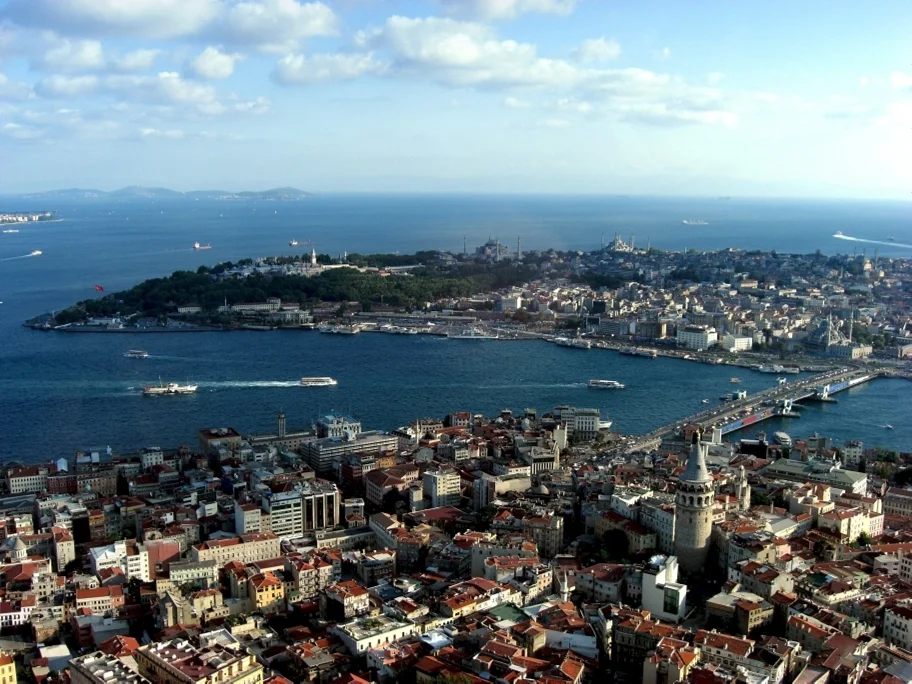

Historic Areas of Istanbul
Fourteen centuries of empire-building compressed onto a single triangular peninsula — that is what UNESCO recognized in 1985 when it inscribed the Historic Areas of Istanbul on its World Heritage List. Constantinople, Byzantium, Istanbul: the city has worn three names, served three civilizations, and every iteration left monuments so enduring that they simply absorbed the next conqueror rather than yielding to him. Walk from the Theodosian Walls at the peninsula's western edge to the Sarayburnu promontory where the Bosphorus meets the Golden Horn, and you walk through Roman grandeur, Byzantine spirituality, and Ottoman magnificence — often within a single city block.
Four Zones, One Unbroken Story
The World Heritage designation is organized into four distinct zones, each anchored to a different phase of the city's long history. At the tip of the peninsula, the Archaeological Park encompasses the ruins of the ancient hippodrome — the Byzantine racing and ceremonial ground that the Ottomans later ringed with mosques — along with Topkapı Palace and Hagia Sophia. Moving westward, the Süleymaniye quarter clusters around the great mosque that Mimar Sinan built for Suleiman the Magnificent in the 1550s, a hillside composition that still dominates the skyline. The Zeyrek quarter preserves the Pantokrator Monastery complex, now the Zeyrek Mosque, a twelfth-century Byzantine ensemble of rare completeness. Finally, the zone of the ramparts protects the Theodosian Walls themselves: the fifth-century triple fortification that kept Constantinople unconquered for over a thousand years. Together these zones don't represent tidy historical eras — they overlap, contradict, and complicate each other in ways that make the peninsula one of the most layered places on Earth.
Monuments That Outlasted Their Makers
Hagia Sophia is the site's most famous building, and also its most instructive. Built as a Christian cathedral by Emperor Justinian in 537, converted to a mosque after the Ottoman conquest of 1453, turned into a museum in 1934, then reconverted to a mosque in 2020 — its biography mirrors the city's. The Sultan Ahmed Mosque, known outside Turkey as the Blue Mosque for its interior Iznik tilework, faces Hagia Sophia across an ancient plaza where chariot races once drew a hundred thousand spectators. Nearby, the Little Hagia Sophia (the Church of Saints Sergius and Bacchus, completed around 536) predates its larger namesake and served as a prototype for the dome system Justinian's architects later perfected. Hagia Irene, the oldest surviving church building in Istanbul, still stands inside the first courtyard of Topkapı Palace — never converted to a mosque, never demolished, simply absorbed into the new order's geography.
Sinan's Hillside and the Zeyrek Silhouette
Not everything here is a palace or a cathedral. The Süleymaniye Mosque complex is a full urban institution — built between 1550 and 1557 by the architect Mimar Sinan, it includes a hospital, a caravanserai, a soup kitchen, and theological schools arranged around the mosque on a terraced hillside above the Golden Horn. Sinan reportedly considered it his masterwork, though he later judged his Selimiye Mosque in Edirne the greater achievement. The Zeyrek quarter's centerpiece, the Pantokrator complex, is less visited but equally remarkable: three Byzantine churches joined together in the twelfth century, now preserved as a mosque with much of their original masonry intact. On the western edge of the heritage area, the Theodosian Walls stretch for nearly seven kilometers. Built in the fifth century under Emperor Theodosius II, the triple walls — inner, outer, and a wide moat — held off Attila the Hun, multiple Arab sieges, and the Crusaders for over a millennium.
The Pressure of the Present
World Heritage status protects monuments but cannot freeze a living city. The historic peninsula sits in Istanbul, a metropolis of more than fifteen million people, and the tension between preservation and daily urban life is constant. Air pollution, including fine particulate matter from heavy traffic, poses an ongoing threat to stone and tile. The peninsula was partially pedestrianized in the early twenty-first century, and studies have repeatedly identified it as the part of the city that would benefit most from a low-emission zone. As of 2022, the area remained largely car-oriented, a reality that UNESCO and Turkish heritage authorities continue to negotiate. The monuments endure — but endurance, in a city this alive, is never passive.
From the Air
The Historic Areas of Istanbul cluster on the triangular peninsula at approximately 41.008°N, 28.980°E, where the Bosphorus, the Golden Horn, and the Sea of Marmara converge. From 5,000 feet on approach to Istanbul Airport (LTFM, roughly 35 km to the northwest), the blue domes of the Sultan Ahmed Mosque and the massive half-domes of Hagia Sophia are unmistakable landmarks on the skyline. The Theodosian Walls trace a visible north-south line on the peninsula's western side. Recommended viewing altitude is 3,000–5,000 feet on a clear day; the sea routes around the peninsula were historically the city's lifelines and remain busy shipping lanes today.
Nearby Stories
- Kocaeli Peninsula 7.6 km away
- Second Battle of Çatalca 11 km away
- Istanbul's Rural Outskirts 14 km away
- MV Struma 20 km away
- HMAS AE2 36 km away
- Bursa 66 km away
- Sangarius Bridge 71 km away
- Januarius MacGahan 101 km away