_01_by_shakko.jpg)
Hodegon Monastery
The guides were the monastery's first reputation. Long before the icon arrived, before the pilgrims came, there were the hodegoi — men who led the blind toward a miraculous well where, tradition held, the Virgin Mary had appeared and restored two sightless visitors to full sight. The monastery took its name from them: Hodegon, the place of the guides. It is a name built around an act of compassion, which makes it fitting that the place eventually became the home of the most beloved image in all of Christendom.
A Princess's Foundation
The Hodegon Monastery in Constantinople was allegedly founded by Saint Pulcheria, born in 399 and a daughter of Emperor Arcadius. Pulcheria was a formidable figure — she served as regent for her younger brother Theodosius II, wielded real political power in the early fifth century, and was eventually recognized as a saint by both Eastern and Western Christianity. Her monastic foundations in Constantinople were acts of both piety and patronage, and she is credited with establishing three of the city's principal Marian churches: the Blachernai near the Theodosian Walls, the Chalkoprateia in the city's commercial heart, and the Hodegon along the Marmara shore. These three buildings were not merely churches — they were nodes in a system of processions and devotional geography that structured Byzantine religious life for centuries. The Hodegon stood at the sea's edge, as the eastern counterpart to the Blachernai at the walls, and together they bracketed the city's sacred topography.
The Icon That Showed the Way
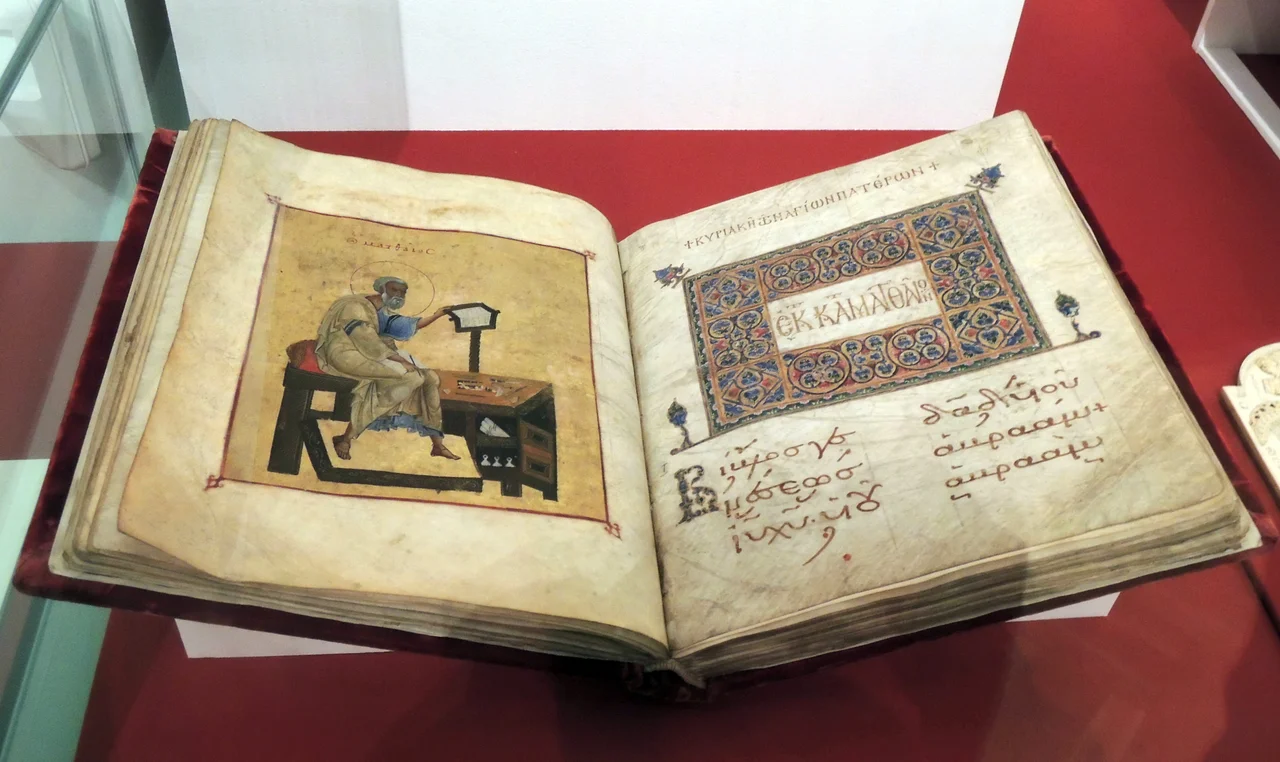
What made the Hodegon famous was what it held: the Icon of the Hodegetria, meaning 'She Who Shows the Way.' Tradition attributed the painting to Saint Luke, who was believed to have depicted the Virgin Mary from life. According to an account by the Byzantine historian Xanthopoulos, the icon was brought to Constantinople from Antioch and presented to Pulcheria, who upon receiving it took a vow of chastity. Whether or not the attribution to Luke is historical, the icon was treated as an object of extraordinary sacred power. It was paraded through the city, carried into battle, and venerated by emperors and common people alike. The monastery was understood as its permanent earthly home — a place where the blind had been healed and where the image of the one who guides the lost resided side by side.
Rebuilt, Revered, and Lost
The monastery complex was rebuilt by Emperor Michael III, who reigned from 842 to 867, during a period of Byzantine cultural revival following the resolution of the Iconoclast controversy — the decades-long theological dispute over the legitimacy of sacred images. That Michael chose to rebuild the Hodegon in particular was no accident: restoring the home of the most iconic of icons was a statement about the restored legitimacy of icons themselves. The monastery occupied a site beyond the Chalkoprateia church, by the sea on the eastern shore of the peninsula. Its exact location remains a subject of scholarly discussion. The building is gone. A few ruins are visible near Gülhane Park, the green space that runs along the eastern slope below Topkapı Palace — scattered stonework that marks where guides once led the blind toward healing waters, and where the most venerated image in Constantinople was kept through conquests and catastrophes alike.
What Remains
Physical remains of the Hodegon Monastery are scant: fragments near the park, traces in the ground, a name that survived the Byzantine world that created it. The Icon of the Hodegetria did not survive the Ottoman conquest of 1453. Historical accounts describe it being carried in procession during the final days of the siege; after the city fell, the icon disappeared. What persists is the concept — the Hodegetria image type, the Madonna pointing toward the Christ child, became one of the most reproduced iconographic forms in Eastern Christianity, replicated across Orthodox churches from Greece to Russia. The original may be gone, but 'She Who Shows the Way' still shows it, in thousands of copies, in churches that the founders of the Hodegon Monastery could never have imagined.
From the Air
The Hodegon Monastery once stood near the eastern shore of Istanbul's historic peninsula at approximately 41.009°N, 28.985°E, close to the modern Gülhane Park at the base of Topkapı Palace's outer gardens. From the air at 3,000–4,000 feet over the Bosphorus, the palace's sprawling roofline and the green of Gülhane are visible just inland from the water. Istanbul Airport (LTFM) lies roughly 35 km to the northwest. The Sea of Marmara shoreline below marks where the monastery once stood at the water's edge, within view of the Bosphorus strait.
Nearby Stories
- Kocaeli Peninsula 7.6 km away
- Second Battle of Çatalca 11 km away
- Istanbul's Rural Outskirts 14 km away
- MV Struma 20 km away
- HMAS AE2 36 km away
- Bursa 66 km away
- Sangarius Bridge 71 km away
- Januarius MacGahan 101 km away