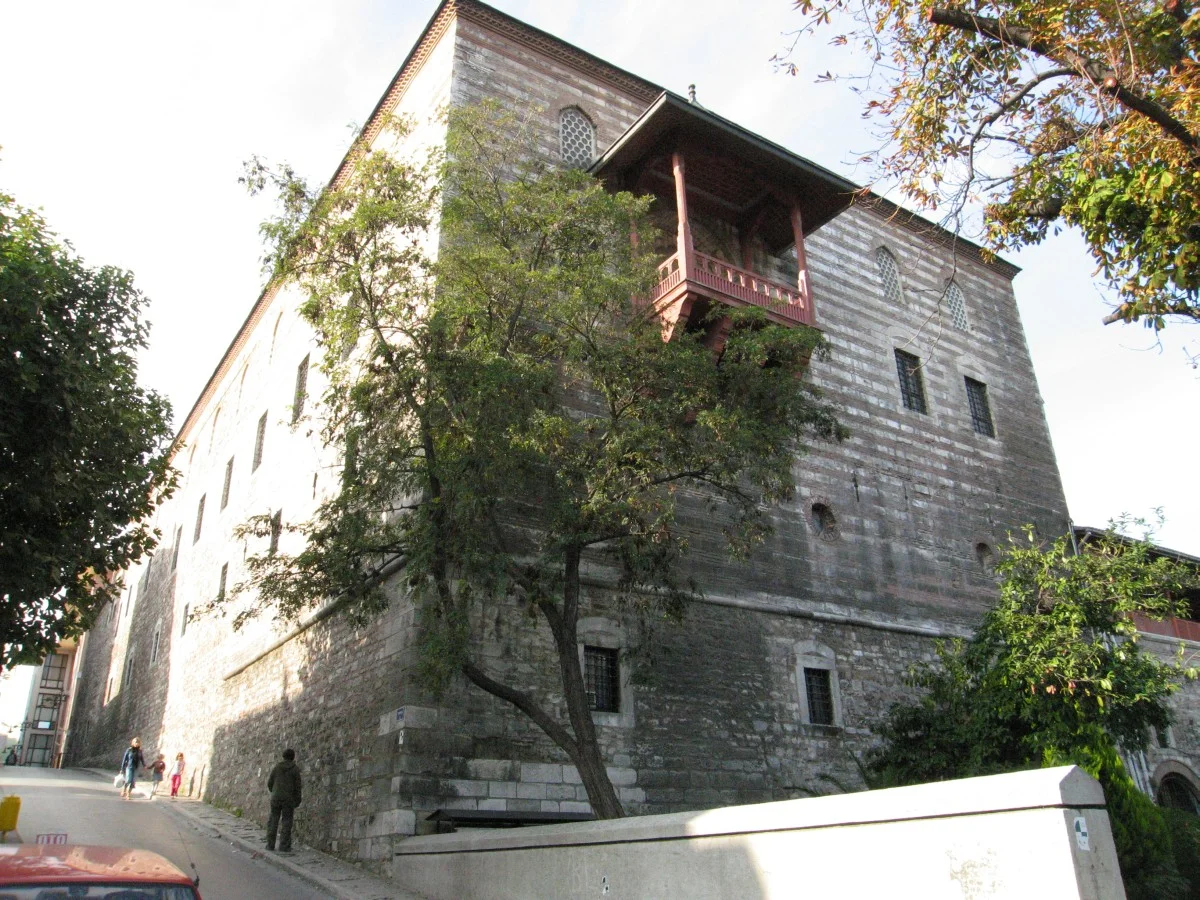

Ibrahim Pasha Palace
In the spring of 1536, Pargalı Ibrahim Pasha went to sleep in Topkapı Palace and did not wake up. He had been the Grand Vizier of Suleiman the Magnificent for thirteen years, the sultan's most trusted companion since childhood, the man who had negotiated with European kings and commanded Ottoman armies. By morning he was dead, strangled on the sultan's orders. His palace on the Hippodrome — the most magnificent private residence in Constantinople, with views across the ancient racetrack to the Blue Mosque — continued to stand. It stands today, now housing the Museum of Turkish and Islamic Arts, its stones outlasting the friendship and the betrayal both.
A Palace on the Hippodrome
The building that would become known as the Ibrahim Pasha Palace was constructed on the western side of the ancient Hippodrome of Constantinople, the great Byzantine racetrack and ceremonial ground whose spine still runs through what is now Sultanahmet Square. The exact construction date is uncertain. Ottoman historian Solakzade Mehmet Hemdemi Efendi, writing in the seventeenth century, could not fix the date with confidence; most scholars believe it was built during the reign of Sultan Bayezid II, who ruled from 1481 to 1512, and the building is known to have undergone repairs in 1521. It was originally called the Hippodrome Palace, a simple description of its location. When Pargalı Ibrahim Pasha received it as a gift from Suleiman — an extraordinary act of royal generosity that reflected their extraordinary bond — it took his name, and has kept it ever since.
The Sultan's Friend
Pargalı Ibrahim Pasha was born around 1494 in Parga, a coastal town in what is now northwestern Greece. He came to the Ottoman court as a page, where he met the young prince Suleiman, and the two developed a friendship that endured when Suleiman became sultan in 1520. Ibrahim rose rapidly: he was appointed Grand Vizier in 1523, a position he held for thirteen years. Suleiman granted him the palace on the Hippodrome, married him to his own sister, and reportedly addressed him in private correspondence as 'my Ibrahim.' European ambassadors noted the intimacy with some unease — the two men were understood to be inseparable. Ibrahim was brilliant, effective, and, as it turned out, dangerously outspoken. He had a reputation for comparing himself to the sultan, for taking liberties that others could not afford. Contemporary sources suggest he made powerful enemies at court. In March 1536, Suleiman had him killed. The reasons have been debated ever since.
Life After Ibrahim
The palace did not fall with its most famous owner. After Ibrahim Pasha's death, it continued to serve the Ottoman state in a succession of capacities. Other grand viziers lived there. It functioned at various points as military quarters, an embassy, a revenue office, a sewing workshop, quarters for the Ottoman military band, and a prison. The range of uses over the centuries reflects the building's scale and adaptability — it is large enough to absorb institutional change. Its survival was not guaranteed: at one point an argument was seriously advanced that the palace should be demolished on the grounds that an Armenian craftsman had at some point contributed to its renovation, and that this disqualified it from being considered part of the Turkish cultural patrimony. The decision to preserve the building was made in 1946, during the presidency of İsmet İnönü. It was a close call.
The Museum It Became
Today the palace houses the Museum of Turkish and Islamic Arts, one of the most significant collections of Islamic art in the world. The building holds carpets, manuscripts, ceramics, metalwork, and ethnographic objects spanning more than a thousand years of Islamic civilization across multiple regions. Across the square, Hagia Sophia's dome rises into the sky. The ancient obelisk of Theodosius I stands at the center of what was once the hippodrome's track, a few meters from the palace entrance. Visitors move through rooms where a grand vizier once entertained European ambassadors, past windows that once framed chariot races and public executions and imperial processions. Pargalı Ibrahim Pasha built his palace in the most visible spot in Constantinople. He would have wanted it that way.
From the Air
The Ibrahim Pasha Palace stands at approximately 41.006°N, 28.975°E on the western edge of Sultanahmet Square (the ancient Hippodrome) in the Fatih district. From 3,000–4,000 feet, the Hippodrome's elongated open space is visible as a linear plaza between the Sultan Ahmed Mosque and Hagia Sophia, with the palace facade on its western side. Istanbul Airport (LTFM) is roughly 35 km to the northwest. The Bosphorus shines beyond the rooftops to the east, while the Sea of Marmara curves around the southern tip of the peninsula.
Nearby Stories
- Kocaeli Peninsula 7.6 km away
- Second Battle of Çatalca 11 km away
- Istanbul's Rural Outskirts 14 km away
- MV Struma 20 km away
- HMAS AE2 36 km away
- Bursa 66 km away
- Sangarius Bridge 71 km away
- Januarius MacGahan 101 km away