.jpg)
Imperial Arsenal
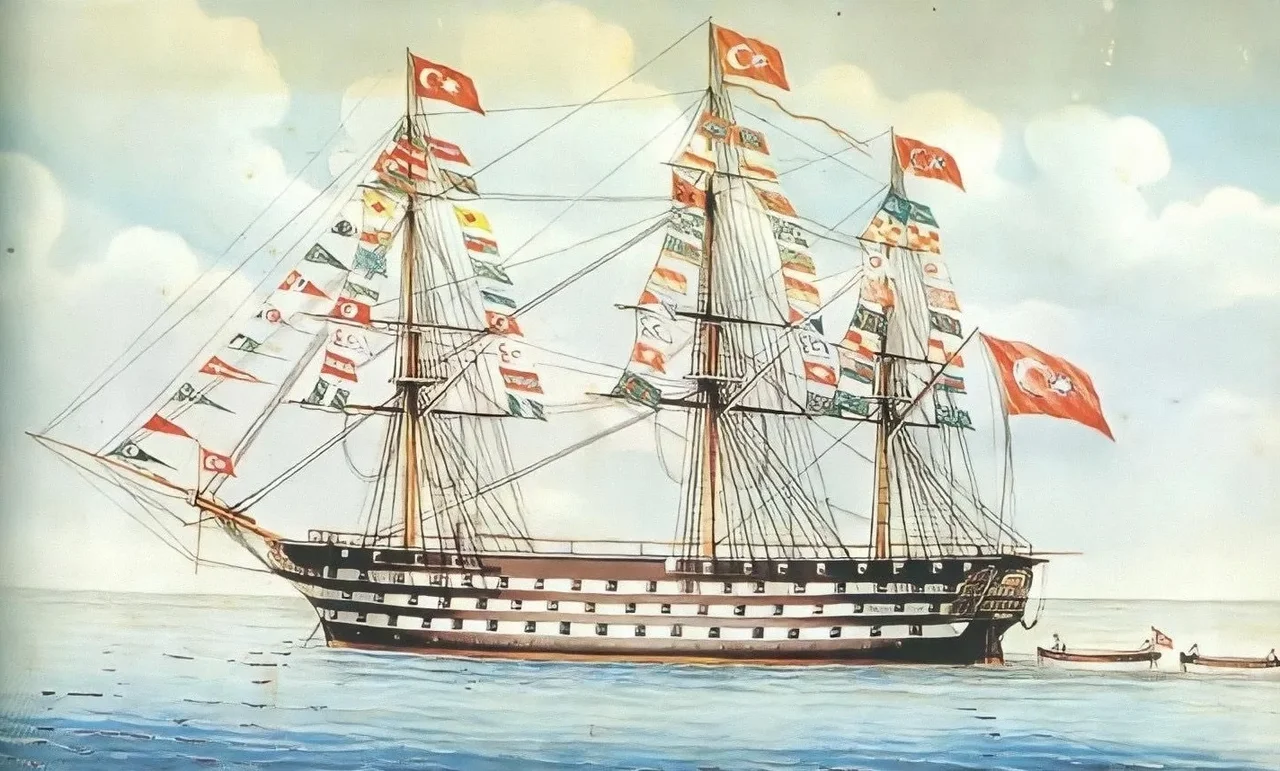
The word 'arsenal' traveled a long road to English. It began as the Arabic dār al-sināʿa — 'house of manufacture' — passed through Italian as darsena, entered Ottoman Turkish as tersane, and eventually drifted into English in its current form. Every step of that journey tracks the movement of naval power around the Mediterranean, and the Ottoman Imperial Arsenal on the Golden Horn was one of the places where that power was most concentrated. For roughly four centuries, this waterfront complex launched the warships of one of history's great navies. The Golden Horn's sheltered waters are quiet now, but the shipyard that grew from a Genoese dock into an imperial institution still occupies the same shore.
From Gallipoli to the Golden Horn
The Ottoman navy did not begin at Constantinople. During the empire's early expansion, the main naval base was at Gallipoli, captured by the Ottomans in 1354. When Sultan Mehmed II took Constantinople in 1453, he moved quickly to establish a new imperial shipyard across the Golden Horn from the city proper, in the formerly Genoese suburb of Galata — likely on or near the site of a Genoese shipyard already there, the vetus tersana, the 'old shipyard.' Construction continued under Mehmed's successor Bayezid II. Then, in the winter of 1513 to 1514, Selim I ordered a major expansion. The treasury allocated 200,000 ducats for the project. Covered dry docks were built to allow warship maintenance through the winter months. By 1515, with 160 docks constructed along the northern shore of the Golden Horn, the Galata arsenal had surpassed Gallipoli as the empire's primary naval installation. The cartographer Piri Reis included it in his 1526 map, depicting a continuous line of docks stretching from the gate of Azab Kapisi to the vicinity of Hasköy.
A City Within a City
By the time the Grand Vizier Sokollu Mehmed Pasha added stone storehouses behind each dock between 1546 and 1549, the arsenal had become something far larger than a shipyard. He also walled off the entire complex from the landward side, shielding its operations from outside view. Inside those walls, a self-contained industrial and civic world operated. The arsenal housed the offices of the Kapudan Pasha, the fleet's chief admiral. A powder magazine tower, a dungeon, covered storehouses for oars and rigging, a pavilion, and multiple gates organized the compound. By 1557, the complex contained 123 docks. After the devastating Ottoman naval defeat at the Battle of Lepanto in 1571, the arsenal was rebuilt and expanded again, with eight new inland dockyards surrounding a royal garden. At its peak in the sixteenth and seventeenth centuries, the complex held dry docks, spinning mills for making cordage, iron foundries for casting anchors, a mosque, fountains, a hospital, and a prison — all clustered along the Golden Horn's northern bank.
The Human Engine
The scale of the arsenal's workforce reflects its ambitions. In 1601, the shipyard employed 3,524 people. By 1700, that number had fallen to 726 — a measure of the navy's declining centrality as the empire's strategic situation changed. The men who kept the arsenal running ranged from senior administrators to, as the records put it, 'captains, mariners, overseers, messengers, shipwrights, caulkers, oar makers, ironsmiths, repairmen, spoolers, towmen, grenade-makers, guards, and retired personnel.' The administration was headed by three officials — the kethüda, the agha, and the emin — with the emin, as the chief fiscal officer, holding the most power. Records were kept in the merdiban accounting system. And the labor force included people who had no choice in the matter: enslaved workers and convicts, whom the imperial records treated as resources, either for the shipyard itself or as oarsmen in the galleys. Their names were not generally preserved.
Five Centuries and Still Running
The Imperial Arsenal was bombed by British aircraft during World War I. It adapted, as it had adapted to every other disruption in its long history. The Ottoman Empire ended in the early twentieth century, but the shipyard did not. Today, the waterfront along the Golden Horn where Mehmed II established his arsenal in the 1450s is occupied by the Haliç Shipyards — three distinct facilities known as Camialtı Shipyard, Taşkızak Shipyard, and Haliç Shipyard. Only Haliç Shipyard remains in active operation. It is, the historical record suggests, the oldest shipyard in the world in continuous operation. The docks that Selim I expanded with 200,000 ducats, that Sokollu Mehmed Pasha walled against prying eyes, that Piri Reis drew in ink on a 1526 map — those docks are still, in some form, still working.
From the Air
The Imperial Arsenal site lies along the northern shore of the Golden Horn at approximately 41.034°N, 28.958°E, in the Beyoğlu district of Istanbul. From 3,000–5,000 feet on approach from the northwest via Istanbul Airport (LTFM, roughly 30 km away), the Golden Horn's distinctive inlet is immediately recognizable as it cuts into the city between the historic peninsula to the south and Beyoğlu to the north. The Galata Bridge crosses its mouth; the Atatürk Bridge crosses upstream. The shipyard area occupies the northern bank of the Golden Horn's upper reach, inland from Galata, where the waterway bends. The dome of the Süleymaniye Mosque on the opposite hillside provides a prominent landmark for orientation.
Nearby Stories
- Kocaeli Peninsula 7.6 km away
- Second Battle of Çatalca 11 km away
- Istanbul's Rural Outskirts 14 km away
- MV Struma 20 km away
- HMAS AE2 36 km away
- Bursa 66 km away
- Sangarius Bridge 71 km away
- Januarius MacGahan 101 km away