
Imperial Library of Constantinople
Somewhere beneath the streets of modern Istanbul — perhaps under a parking lot, perhaps under a park — lies the ghost of the most consequential library that ever existed. Not the most famous: that honor goes to Alexandria. But the Imperial Library of Constantinople outlasted Alexandria by centuries, quietly keeping Homer, Sophocles, and hundreds of other ancient voices alive through fire, invasion, and the slow rot of papyrus. Most of what we call "classical Greek literature" survives today not because of Alexandria, but because of this place — a library founded in the fourth century on a peninsula between two seas, in a city determined to be the center of the world.
The Emperor's Scriptorium
The library owed its existence to a single urgent problem: papyrus decays. By the reign of Constantius II — who ruled from 337 to 361 AD — the great literary works of ancient Greece were literally crumbling in their scrolls. Constantius appointed the philosopher Themistius to lead a systematic rescue operation: a team of calligraphers would copy the fading papyrus texts onto parchment, a more durable medium, and transfer them to a proper imperial collection. The Emperor Valens expanded the project in 372 AD, employing four Greek scribes and three Latin ones.
The collection grew to an estimated 100,000 volumes. Among its treasures was a scroll of Homer's complete works — one hundred and twenty feet long and written in gold ink — a physical object that makes modern luxury editions look modest. Themistius and his team made deliberate choices about what to save: Homer and the Hellenistic historians came first, then the Attic dramatists like Sophocles. Latin works ranked lower. The Stoic philosophers, known to Themistius, didn't make the cut. Some of those lost works have since been found only in fragmentary form at Herculaneum, offering a glimpse of what the library might have contained had priorities been different.
A Thousand Years of Guardianship
For roughly a millennium, the library served as the West's backup drive for antiquity. When knowledge of Greek declined in Western Europe, when monasteries in Ireland and France were copying texts they barely understood, Constantinople's scholars were reading Homer in the original and arguing about the finer points of Attic syntax.
Agathon the Reader — the first to hold that title, then the first Librarian at Constantinople — exemplifies how seriously the institution was taken. In 680 AD, during his tenure, he served as Notary at the Third Council of Constantinople, recording its proceedings in his own hand and dispatching copies to the five Patriarchates. In 712 AD he composed a treatise on theological controversy that survives to this day. These were not passive custodians. They were active intellectuals for whom the library was a living institution, not a warehouse.
Fire threatened repeatedly. In 473 AD, a blaze destroyed an estimated 120,000 volumes. But the work of Themistius was not lost entirely: copies had circulated, texts had been recopied, the intellectual network of the Byzantine world had spread the contents outward even as the physical building suffered.
The Crusaders' Catastrophe
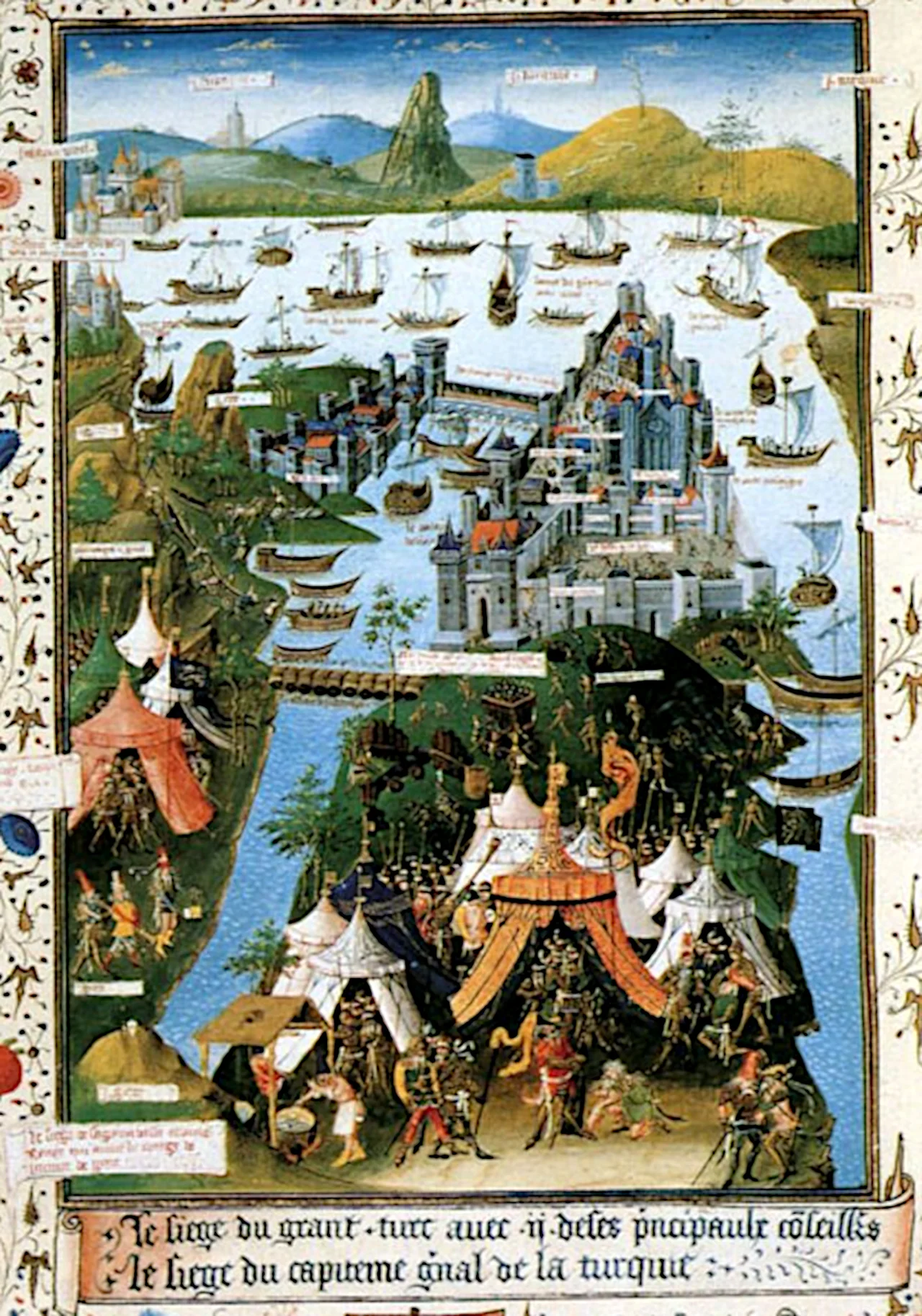
What fire had failed to accomplish, the Fourth Crusade very nearly did. On 12 April 1204, a Christian army sacked the Christian city of Constantinople — an event still regarded as one of history's most baffling acts of self-sabotage. The Franks and Venetians who poured through the city's gates torched it three separate times in the course of their occupation. Historian Donald Queller noted that by 1204 there may have been no formal imperial library still functioning — the collection may already have dispersed into private and monastic hands. But whatever remained of the physical institution was obliterated in those three fires.
Reports persisted that texts had survived into the Ottoman era. In 1800, a British scholar named Joseph Dacre Carlyle was granted access to the Seraglio — the Topkapi Palace — on the theory that manuscripts from the old imperial collection might be shelved there. He found nothing from the library. A notable exception is the Archimedes Palimpsest: a manuscript that surfaced in 1840, was translated in 1915, disappeared again, and was sold at auction in 1998. It is the closest thing to a rescued artifact from Constantinople's lost intellectual hoard.
What Survives, and Why It Matters
Scholars debate whether there was ever truly one single unified Imperial Library, or whether Constantinople's literary legacy was always distributed across a constellation of monasteries, private collections, and church libraries. What is clear is that no public libraries existed in Constantinople after the fifth century. The Byzantine Empire was, by medieval standards, a remarkably literate society — but its book culture was private and ecclesiastical rather than public.
The larger truth is simpler and more vertiginous: the majority of Greek classics that exist today — the plays of Sophocles and Euripides, the histories of Thucydides and Herodotus, the philosophy of Plato and Aristotle — survive because Byzantine scribes copied them in Constantinople. They are Byzantine copies. When the library burned, when the city fell, when the manuscripts scattered, those copies had already done their work. The library is gone. The texts remain.
Over the Golden Horn
From the air, Istanbul's historic peninsula juts southward into the Marmara Sea like a ship's prow — bounded by the Bosphorus to the east, the Golden Horn to the north, and open water to the south. The library stood somewhere on this peninsula, probably not far from the imperial palace complex near today's Sultanahmet district, though no physical remains have been identified. Hagia Sophia's dome is unmistakable from altitude, rising above the old city's cluster of minarets and rooftops. The library would have been within walking distance. Flying in from the west, descend toward Istanbul Airport (LTFM) on the European shore.
From the Air
The Imperial Library of Constantinople stood on the historic peninsula of Istanbul at approximately 40.996°N, 28.929°E — somewhere in today's Sultanahmet district, within sight of Hagia Sophia. From cruising altitude, the peninsula is clearly visible between the Golden Horn and the Sea of Marmara. Recommended viewing altitude: 2,000–5,000 feet for a clear view of the old city's layout. Nearest airport: LTFM (Istanbul Airport), approximately 35 km northwest on the European shore. The Bosphorus and the Golden Horn are useful navigation landmarks from the air.
Nearby Stories
- Kocaeli Peninsula 7.6 km away
- Second Battle of Çatalca 11 km away
- Istanbul's Rural Outskirts 14 km away
- MV Struma 20 km away
- HMAS AE2 36 km away
- Bursa 66 km away
- Sangarius Bridge 71 km away
- Januarius MacGahan 101 km away