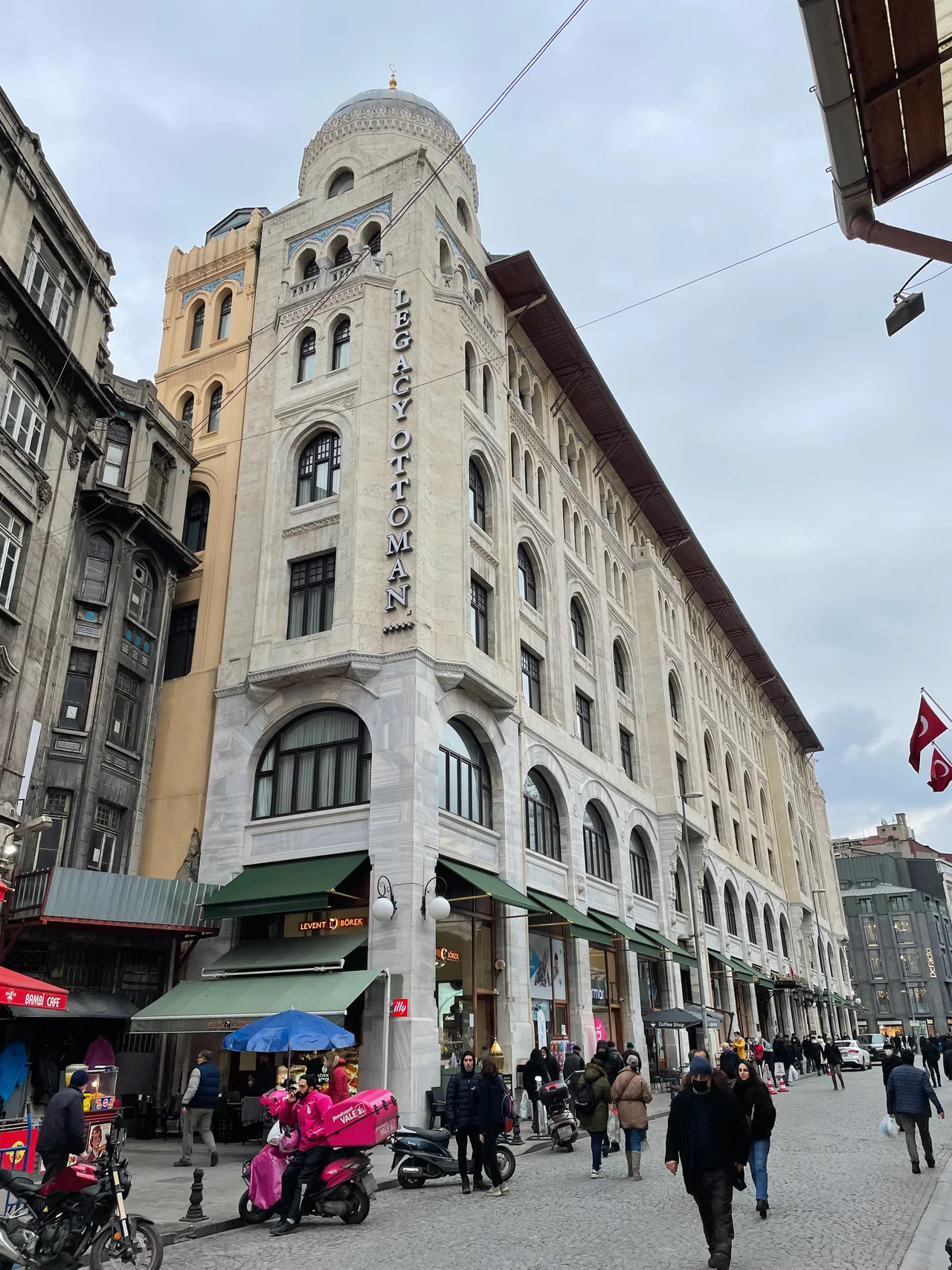

Istanbul 4th Vakıf Han
Construction began in 1916 and still wasn't finished when the soldiers arrived. French troops, garrisoning the defeated Ottoman capital after World War I, requisitioned the half-built structure in 1920 and renamed it Caserne Victor. For three years, a building designed to be a modern commercial hub served as military barracks, its stone walls enclosing a different kind of empire's business. When the French left in 1923, the building finally became what architect Kemaleddin Bey had intended a decade earlier: one of Istanbul's most imposing office blocks, a statement in stone about what the new Turkey could build.
Kemaleddin Bey's Vision
The man who designed the 4th Vakıf Han was no ordinary architect. Kemaleddin Bey — born in 1870, died in 1927 — was the director of the Construction and Restoration Department at the Ottoman Ministry of Foundations, and the leading practitioner of what became known as the First Turkish National architectural movement, sometimes called Ottoman Revivalism. Where late-19th-century Ottoman architecture had absorbed heavy European Baroque influences, Kemaleddin Bey looked backward and inward, drawing from the classical Ottoman vocabulary of domes, arches, and decorative stone patterning.
He designed the 4th Vakıf Han in 1911, in the waning years of the Ottoman Empire. The commission came from the Foundations Administration (Vakıflar), which managed pious endowments — property held in trust for religious and charitable purposes. Building a large commercial han was a way of generating income for those endowments. The site had a past: it occupied the former grounds of the Hamidiye Külliyesi, the religious complex built for Sultan Abdul Hamid I, who reigned from 1774 to 1789.
Wars, Interruptions, and Occupation
The building was supposed to be constructed between 1916 and some reasonable endpoint. It was not. The Ottoman Empire entered the Balkan Wars in 1912 and World War I in 1914, draining the empire of resources, labor, and administrative attention. Construction dragged. The war ended badly for the Ottomans — the empire was carved up by the Allied powers, and in 1920, French troops moved into the Sirkeci district of Constantinople as part of the Allied occupation.
The French found the 4th Vakıf Han still unfinished and made it their barracks, calling it Caserne Victor. From 1920 to 1923 — the years of Atatürk's War of Independence — soldiers quartered in the building that was meant to be the commercial heart of a modernizing city. When the French withdrew in 1923, following the establishment of the Turkish Republic, construction resumed and the building was finally completed in 1926. It had taken a decade of conflict and occupation to finish what should have taken a few years.
A Century of Commerce
Once open, the 4th Vakıf Han settled into the role it had been built for: a large office block in the Sirkeci district, near the old Orient Express terminus and the commercial arteries of the Golden Horn. For much of the 20th century it housed ordinary commercial tenants — the kind of mid-level business activity that keeps a city's economy running.
In the later decades of the 20th century, it became something more significant: the Istanbul Stock Exchange moved in, along with the offices of bankers and financiers. The building that had once been a French barracks was now the beating heart of Turkey's capital markets. The irony — a vakıf property, built on the site of a sultan's religious complex, housing stock traders — would have bewildered Kemaleddin Bey, though perhaps amused him.
The Legacy Ottoman
In the 21st century, the 4th Vakıf Han became a hotel: the Legacy Ottoman, a five-star property operated by the World Park Hotel chain. The conversion was handled with restraint. The two original street entrances were closed and a central shop was restructured as the main entrance, giving the hotel a more dignified threshold. The mansard roof was converted into a restaurant. Beyond those changes, the historic fabric was preserved.
The building's stone facade, its Ottoman Revivalist arches and details, its bulk along the Sirkeci streetscape — all remain intact. Guests sleeping in what was once an office block, in a building that was once a barracks, on land that was once a sultan's külliye, are resting inside a compressed history of Istanbul's last two centuries. The Foundations Administration still owns it. Kemaleddin Bey's building, a century later, is still generating income for its original trust.
From the Air, Sirkeci
The Sirkeci district sits at the tip of Istanbul's historic peninsula, where the Golden Horn meets the Bosphorus. From altitude, it's the commercial wedge between the old city walls to the south and the waterfront to the north — a dense neighborhood of stone buildings, ferry terminals, and the century-old Sirkeci railway station where the Orient Express once terminated. The 4th Vakıf Han is part of that dense fabric, a few blocks from the waterfront at 41.016°N, 28.974°E. Flying in from the west, approach Istanbul Airport (LTFM) and the historic peninsula resolves below: Hagia Sophia's dome, the Blue Mosque's minarets, and the commercial blocks of Sirkeci crowded along the water's edge.
From the Air
The Istanbul 4th Vakıf Han is located in the Sirkeci district at 41.016°N, 28.974°E, on Istanbul's historic European-side peninsula near the confluence of the Golden Horn and the Bosphorus. From altitude, Sirkeci is identifiable by the dense commercial fabric at the tip of the old city, just east of the Sultanahmet mosque district. Nearest airport: LTFM (Istanbul Airport), approximately 35 km northwest. The Galata Bridge and the Bosphorus are reliable visual landmarks when approaching from the west. Recommended viewing altitude: 2,000–4,000 feet for a clear view of the Sirkeci streetscape.
Nearby Stories
- Kocaeli Peninsula 7.6 km away
- Second Battle of Çatalca 11 km away
- Istanbul's Rural Outskirts 14 km away
- MV Struma 20 km away
- HMAS AE2 36 km away
- Bursa 66 km away
- Sangarius Bridge 71 km away
- Januarius MacGahan 101 km away