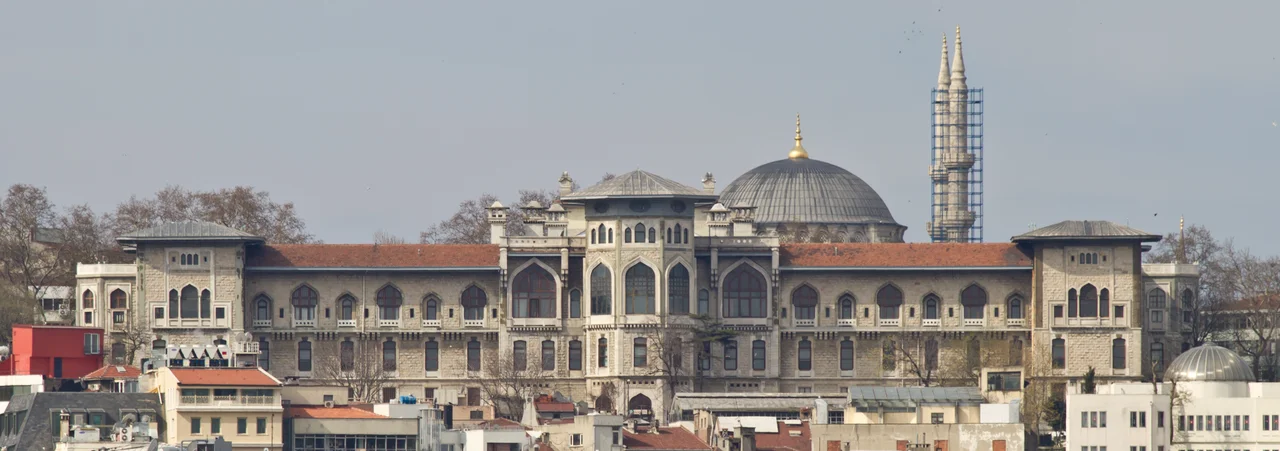

Istanbul High School
In 1915, fifty senior students from a school in Istanbul volunteered for the defense of the capital. They were sent to Gallipoli. All fifty died, at Kabatepe, on May 19, at 3:30 in the morning. The students who remained behind painted the windows and doors of the school black in memoriam. The color stayed. And somehow the school kept going—through the collapse of the Ottoman Empire, through the Allied occupation of Istanbul, through the founding of the Turkish Republic, through a Second World War that suspended its German-language program for the duration. Istanbul High School has been surviving things for 142 years.
Numune-i Terakki: The Example of Progress
Mehmet Nadir Bey was a retired Navy captain and a mathematician who believed, apparently with great conviction, that Istanbul needed better schools. In 1882 he partnered with a school principal named Selanikli Abdi Kamil Efendi to open the Şems'ül Maarif—The Sun of Education—Istanbul's first private school. The partnership dissolved for reasons that history has not preserved. Undeterred, Mehmet Nadir Bey opened his own school in 1884: Numune-i Terakki, The Example of Progress.
The school grew quickly. By 1891 it had 600 students, 150 of them boarders. It attracted the attention of the Ministry of Education and the Sultan himself. Then, in 1896, some teachers were found to have been involved in a failed coup attempt against Abdülhamid II. The government purchased the school and renamed it Terakki İdadisi—Progress High School. The founder's school had been absorbed into the state. This is the peculiar origin of one of Turkey's most prestigious public institutions: a private venture that became too successful to remain private.
A School That Named Things First
Istanbul High School's list of firsts is long enough to be suspicious—but it is documented. In 1886, it was the first Turkish school to offer private high school education. Before 1887, it published Turkey's first student newspaper. In 1910, it was the first school to use the word Lise—equivalent of lyceum—which has since become the standard Turkish term for high school. In 1912, it was the first to provide German-language education. Around 1913, it was the first to screen a film on school grounds: Les Misérables, shown under the Turkish title Jean'in Hikayesi—Jean's Story.
The same year, the school established Turkey's first student theatre group, which staged a Molière adaptation alongside works by the Ottoman playwright Abdülhak Hâmid Tarhan. In 1925, following Atatürk's Hat Reform, its students were among the first in Istanbul to replace their fezzes with European-style hats. These aren't footnotes. They add up to a portrait of an institution that consistently found itself at the leading edge of Turkish modernity—not by accident, but because it had been designed, from Mehmet Nadir Bey's founding moment, to be exactly that.
Through Empire and Republic
The First World War reshaped the school profoundly. When foreign schools in Istanbul closed at the outbreak of hostilities, İstanbul Sultanisi—as it was then called—absorbed their resources and their teachers. The student population exceeded 1,600. Twenty-two German instructors arrived from the German Ministry of Education. The curriculum shifted to German. Then came Gallipoli, and the school's fifty dead.
The Armistice of Mudros ended the war and brought Allied occupation. The school was given two days to evacuate its building. Most of its library—accumulated over decades—had to be left behind. Teachers dispersed. Students continued in scattered buildings, sometimes in other institutions. Yet the faculty included people who would go on to shape the Republic: Hasan Ali Yücel, who would become Minister of Education; Memduh Şevket Esendal, who would serve as ambassador and novelist. When Atatürk established the Republic in 1923, the school received a new name—İstanbul Erkek Lisesi, Istanbul Boys' High School—and eventually, in 1933, a new building: the former Ottoman Public Debt Administration building in Çağaloğlu, designed by architects Alexander Vallaury and Raimondo D'Aronco. The school has occupied it ever since.
180 Students From 1.4 Million Applicants
Today Istanbul High School is a state school—free, with optional boarding—that admits students through Turkey's national Secondary Education Institutions Transition Exam. The numbers make the selection process stark: 180 students are accepted each year from approximately 1,400,000 applicants. The school typically draws from the top 600 exam scorers in the entire country.
The curriculum runs for five years: one year of intensive German preparation (23 hours of German per week in the first year, 18 in the second), then four years of high school combining German and Turkish curricula under joint supervision of the Turkish Ministry of Education and the German government. Mathematics, chemistry, physics, biology, and computer science are taught in German. History, literature, philosophy, and the arts are taught in Turkish. German and English are both compulsory foreign languages. Since 2002, the school has offered the German Abitur, whose diploma permits direct admission to German universities.
Germany formally recognizes Istanbul High School as a German international school—an unusual designation for an institution that is also simultaneously one of Turkey's most demanding public schools.
An Extraordinary Alumni List
The school's graduates include three prime ministers of Turkey: Mesut Yılmaz, Necmettin Erbakan, and Ahmet Davutoğlu. Ministers, scientists, artists, writers, and athletes crowd the alumni rolls. The poet Edip Cansever went here; so did the actor Şener Şen; so did the novelist Sait Faik Abasıyanık. Cahit Arf, the mathematician whose work in algebra and number theory is commemorated on the Turkish 10-lira note, was an alumnus. Ekrem Akurgal, one of the twentieth century's leading archaeologists of Anatolia, graduated in 1931.
The scout group founded by physical education teacher Abdurrahman Roberson in 1912—named Sakarya after the Battle of Sakarya, in which Istanbul High School alumni fought in the Turkish War of Independence—is still active. It is the oldest continuously operating scout group in Turkey. The school's chess festival, the Chesstival, draws some 60 schools from Turkey and abroad each year and has run annually since 2001. The Model United Nations conference IELMUN conducts proceedings in three languages: English, German, and Turkish.
The building that houses all of this overlooks the entrance to the Bosphorus and the Golden Horn from its position in Çağaloğlu. It was designed to project Ottoman imperial financial power. It has spent the last ninety years projecting something more enduring.
From the Air
Istanbul High School sits at approximately 41.01°N, 28.97°E in the Çağaloğlu district of historic Istanbul, on the European side. From LTFM (Istanbul Airport, IATA: IST), approaching from the northwest, the school's neighborhood is part of the dense historic peninsula visible south of the Golden Horn. The building occupies a position just inland from the waterfront, near the convergence of the Bosphorus and the Sea of Marmara. The Hagia Sophia and Blue Mosque are visible about 600 metres to the southeast. At 2,000–4,000 feet, the historic peninsula's Byzantine and Ottoman monuments cluster together, with the Çağaloğlu district lying just north of Sultanahmet.
Nearby Stories
- Kocaeli Peninsula 7.6 km away
- Second Battle of Çatalca 11 km away
- Istanbul's Rural Outskirts 14 km away
- MV Struma 20 km away
- HMAS AE2 36 km away
- Bursa 66 km away
- Sangarius Bridge 71 km away
- Januarius MacGahan 101 km away