_-_611.jpg)
Istanbul Modern
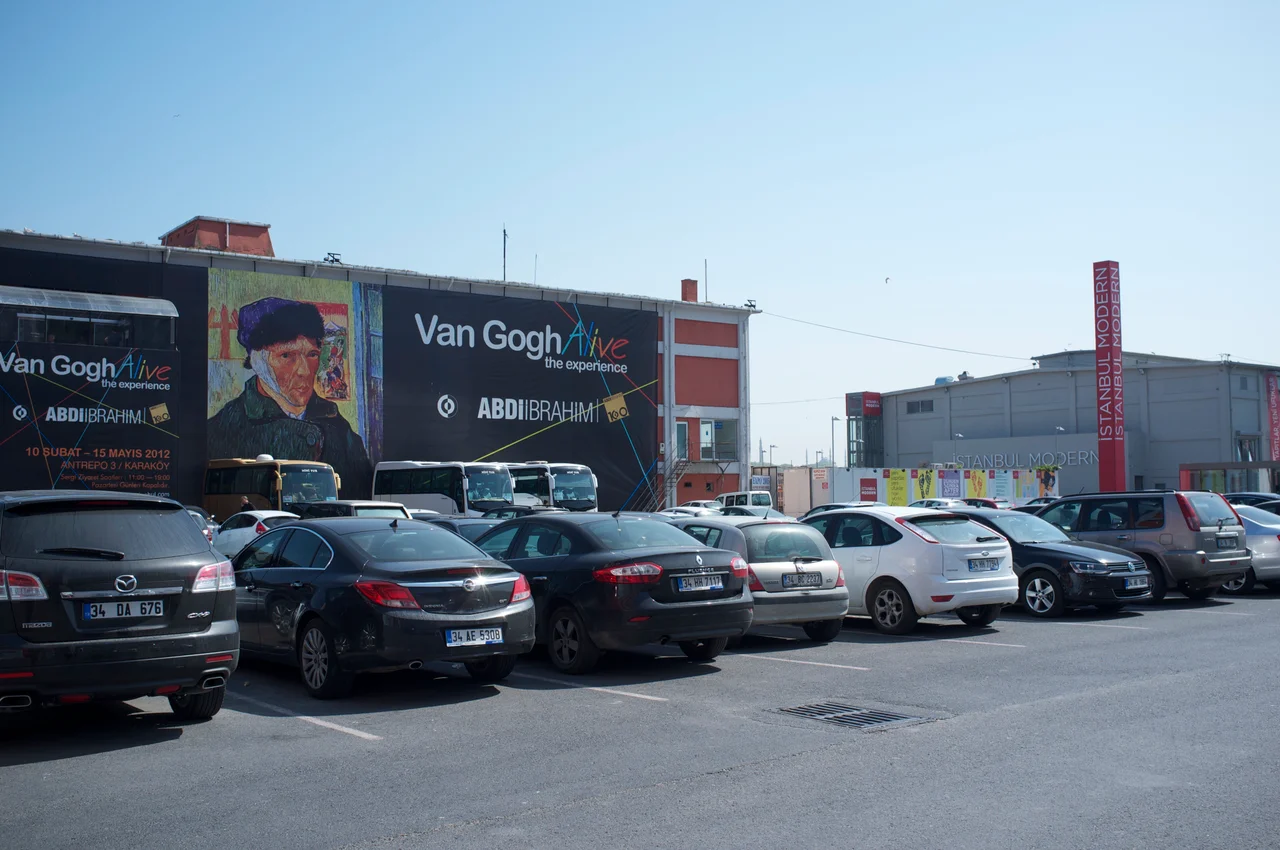
Turkey had been making modern art for decades before it had a proper place to show it. That changed on December 11, 2004, when a converted customs warehouse on the Galata waterfront opened its doors as Istanbul Modern — the country's first museum dedicated to modern and contemporary art. In a city where the established institutions were almost entirely devoted to Ottoman and ancient heritage, the arrival of a contemporary art space felt like a declaration. The question of what Turkish art could be, and how it fit into both a national identity and an international conversation, finally had a building to argue it out in.
A Family's Long Bet on Culture
The museum did not appear from nowhere. Behind it was the Eczacıbaşı family, one of Turkey's major industrial dynasties, who had founded the nonprofit Istanbul Foundation for Culture and Arts (IKSV) in 1973. For decades IKSV had been placing Istanbul on the international cultural calendar — most visibly through the Istanbul Biennial, which began in 1987. Their first attempt at a permanent modern art space focused on Feshane, a 19th-century textile factory on the Golden Horn, where architect Gae Aulenti — who had designed the Musée d'Orsay transformation in Paris — was brought in to plan a conversion. That effort didn't result in a museum. What finally did was the 8th Istanbul Biennial in 2003, staged in a former government customs warehouse on the Galata Pier. The space worked. The Turkish firm Tabanlıoğlu Architects converted it into Istanbul Modern: minimalist, functional, with expansive exhibition halls, a library, a cinema, and a restaurant. It opened the following year.
What Turkish Art Looks Like
From the beginning, Istanbul Modern positioned itself as a gallery of Turkish art from the latter half of the 20th century onward — with room for international work, but with Turkish artists at its center. The collection includes painters like Fahrelnissa Zeid, whose vast abstract canvases were decades ahead of their time; Semiha Berksoy, better known as an opera singer but also a serious painter; and Bedri Baykam, one of Turkey's most internationally visible contemporary artists. To supplement its holdings and provide historical context, the museum arranged long-term loans from other institutions — including the Istanbul Museum of Painting and Sculpture and the collection of Türkiye İş Bankası, which holds around 2,500 paintings. The Military Museum and the Istanbul Metropolitan Municipality's library directorate contributed historical artifacts. A white sculpture called Runner (2017) by British artist Tony Cragg greets visitors at the entrance.
The Renzo Piano Building
The waterfront warehouse was always a temporary solution. The search for a permanent home had begun even before the 2004 opening, and it took nearly two decades to complete. On 4 May 2023, Istanbul Modern reopened in a purpose-built structure close to its original Karaköy location, designed by Renzo Piano — the Pritzker Prize-winning architect who co-designed the Centre Pompidou in Paris. The connection to Pompidou was not incidental: Istanbul Modern and the Paris institution had maintained a formal collaboration since 2007. Piano's building, sited within the Galataport development, faces the Bosphorus and is designed to let the water and light into the visitor experience — a deliberate contrast with the enclosed industrial aesthetic of the warehouse. The new building turns what had been a functional stopgap into a long-term institutional statement.
Art in a City of Monuments
Opening a contemporary art museum in Istanbul requires a certain confidence. The competition for attention is formidable: Hagia Sophia, Topkapı Palace, the Grand Bazaar, the entire accumulated weight of Byzantine and Ottoman civilization. Istanbul Modern's answer has always been to argue that the conversation didn't stop in 1923 — that Turkish artists in the 20th and 21st centuries were doing something worth serious attention. The museum's vicinity helps make that case spatially. Galataport has concentrated cultural institutions along a stretch of the European waterfront that previously served container shipping; Istanbul Modern and the nearby Istanbul Museum of Painting and Sculpture now anchor an arts district that didn't exist a decade ago. The contrast between ancient monument and new building, old city and waterfront renewal, is visible from the same spot. That layering is, of course, entirely characteristic of Istanbul.
From the Air
Istanbul Modern sits at approximately 41.03°N, 28.98°E on the European shore of the Bosphorus, within the Galataport development at Karaköy. From the air at 3,000–5,000 feet, the Galata Tower is a clear landmark 500 meters inland to the northeast; the Galata Bridge crossing the Golden Horn is visible to the south. The museum's Renzo Piano building faces directly onto the Bosphorus. Nearest airport is Istanbul Airport (LTFM) on the European side, approximately 30 km northwest. Sabiha Gökçen (LTFJ) on the Asian shore is approximately 40 km to the east.
Nearby Stories
- Kocaeli Peninsula 7.6 km away
- Second Battle of Çatalca 11 km away
- Istanbul's Rural Outskirts 14 km away
- MV Struma 20 km away
- HMAS AE2 36 km away
- Bursa 66 km away
- Sangarius Bridge 71 km away
- Januarius MacGahan 101 km away