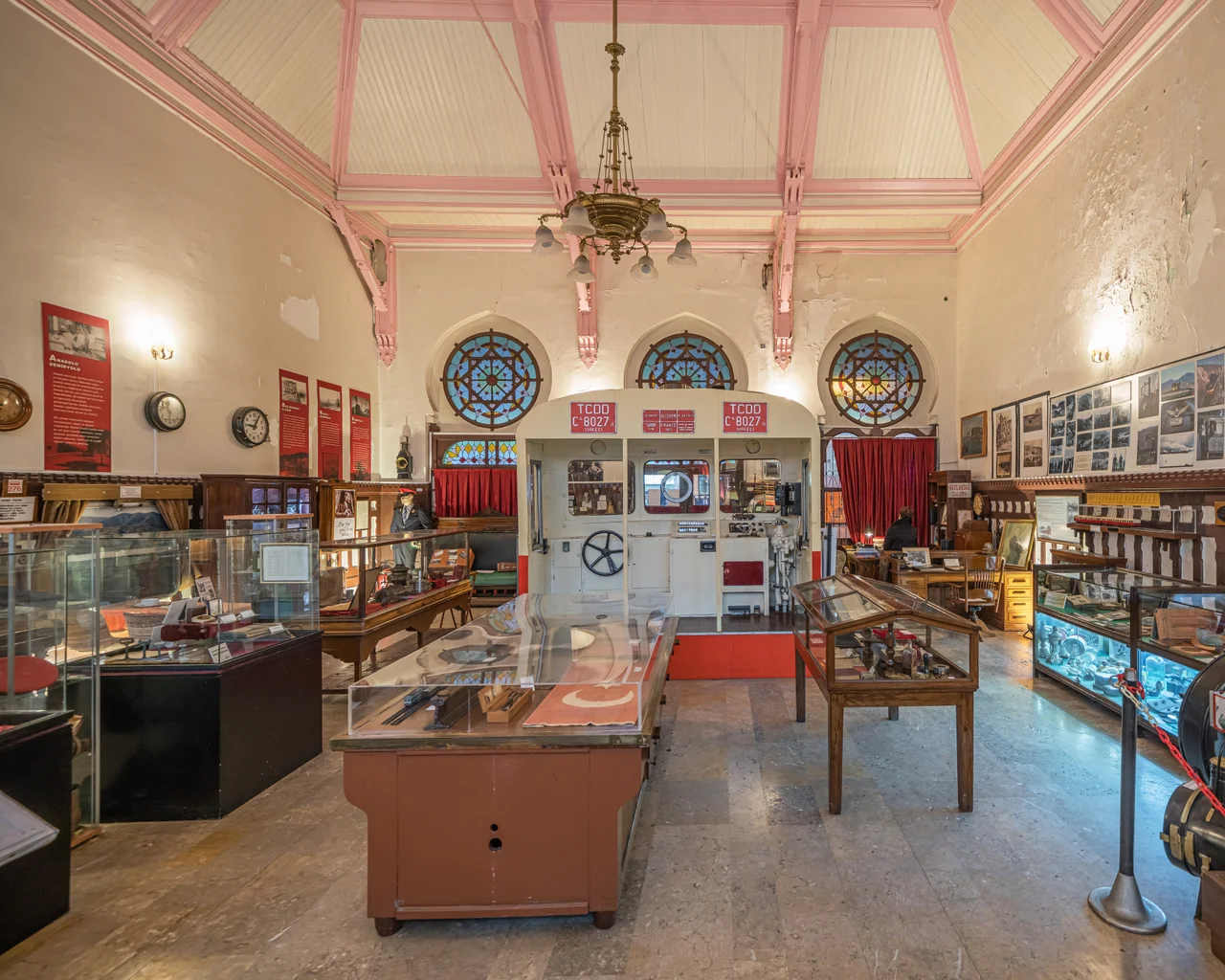

Istanbul Railway Museum
For nearly a century, the most glamorous train journey in the world ended here. The Orient Express, departing Paris and passing through Vienna, Budapest, Belgrade, and Sofia, pulled into Istanbul's Sirkeci Terminal for the last time in its original form in 1977. The station itself — designed by German architect August Jasmund and opened in 1890 — blended European Orientalist and Ottoman motifs in a way that announced you had arrived somewhere that belonged to neither Europe nor Asia, but to itself. Inside the terminal today, a free railway museum preserves 300 artifacts from those decades of steam and silk and international intrigue.
The Terminal That Ended the Journey
Sirkeci was built between 1888 and 1890 at a moment when the Ottoman Empire wanted to signal its modernity to Europe — and what better signal than connecting to the continent's most prestigious railway line? Jasmund's building blends Gothic arches with Ottoman tilework, stained glass with pointed windows, gas lighting with tile stoves. It was, by the standards of its day, state-of-the-art. The Orient Express first linked Paris to Istanbul beginning in 1883, though Sirkeci's current building postdates that inaugural journey. The terminal restaurant, still operating today as the Orient Express Restaurant, was in the 1950s and 1960s a gathering point for journalists, writers, and diplomats passing through. Agatha Christie, who set her most famous novel on the train that terminated here, visited Istanbul repeatedly and drew on Sirkeci's particular atmosphere of transit and intrigue.
Inside the Museum
The Istanbul Railway Museum opened on September 23, 2005 in a 145-square-meter gallery within the terminal building, operated by the Turkish State Railways (TCDD). Around 300 historical items are on display: documents and photographs from the Ottoman railway era, architectural drawings, tools used in rail construction, timetables, tickets, uniforms, and Orient Express memorabilia. Some of the photographs capture Sirkeci during its busiest decades — crowds of passengers with trunks, platform scenes that feel simultaneously foreign and familiar. The collection touches on the engineering achievement of connecting Istanbul to the European rail network, a project that required tunneling through mountains and bridging ravines across thousands of kilometers. The terminal building itself dates to 1888, and the collection it now houses speaks to the entire arc of rail history in the region, from the Ottoman engineers who threaded track through the Anatolian highlands to the luxury dining cars that carried European aristocracy and American novelists toward the Bosphorus. Admission is free, and the museum is rarely crowded — most visitors to Sirkeci are catching trains or exploring the surrounding old-city neighborhoods, and walk past the museum door without registering it.
Sirkeci and the City Around It
The terminal sits in the Sirkeci neighborhood of Fatih district, one of the most historically dense corners of Istanbul. The Topkapı Palace and its grounds lie a ten-minute walk uphill. The Egyptian Spice Bazaar is nearby. The Galata Bridge, linking the old city to Beyoğlu across the Golden Horn, is visible from the station approach. Ferries depart from Eminönü, steps away, to the Asian shore and the Princes' Islands. Sirkeci is, in a sense, where Istanbul concentrates: ancient walls, ferry piers, a nineteenth-century European railway terminal, and the tram line all within a few hundred meters of each other. The museum is open Tuesday through Saturday, 09:00 to 17:00, closed Sundays, Mondays, and public holidays.
The End of the Line
When the last traditional Orient Express ran in 1977, Sirkeci's role as an international rail terminus effectively ended. The Marmaray rail tunnel under the Bosphorus, which opened in 2013, shifted rail connections in the city dramatically. The station now serves suburban trains. But the building remains, largely intact, with its ornate ironwork and its faintly melancholy atmosphere of somewhere that once mattered enormously on the world's travel map. The museum exists partly to hold that memory — of the passengers who stepped off trains here carrying diplomatic cables, manuscript drafts, or just the tiredness of a three-day journey from Paris. The artifacts in the cases are modest. The building around them is not.
From the Air
The Istanbul Railway Museum and Sirkeci Terminal sit at 41.015°N, 28.977°E at the southern end of the old city, where the Golden Horn meets the Bosphorus. From altitude, the landmark is identifiable by its position at the water's edge just east of the historic peninsula's tip — look for the Galata Bridge spanning the Golden Horn to the northwest, and the Topkapı Palace gardens above on the hill. The terminal's ornate roofline is visible at lower altitudes. Nearest major airport: LTFM (Istanbul Airport), approximately 40 km to the northwest. The confluence of the Golden Horn and the Bosphorus directly below this location is one of Istanbul's most geographically distinctive features from the air.
Nearby Stories
- Kocaeli Peninsula 7.6 km away
- Second Battle of Çatalca 11 km away
- Istanbul's Rural Outskirts 14 km away
- MV Struma 20 km away
- HMAS AE2 36 km away
- Bursa 66 km away
- Sangarius Bridge 71 km away
- Januarius MacGahan 101 km away