
Kılıç Ali Pasha Complex
A Grand Vizier once told the admiral that since he served on the sea, he should build his mosque on the sea. It was meant as an insult. Kılıç Ali Pasha took it as an engineering challenge. He ordered rocks hauled from across the region and constructed his mosque on an artificial island in the Bosphorus, connected to the shore by a narrow causeway. The Grand Vizier did not get the last word. The water was eventually filled in during the construction of a modern port, and the mosque now stands inland — but the story of how it came to exist has outlasted the sea it once faced.
The Admiral's Monument
Kılıç Ali Pasha was among the most celebrated naval commanders of the Ottoman Empire, serving as Kapudan-ı Derya — Grand Admiral — at the height of Ottoman maritime power. When he decided to endow a mosque toward the end of his life, as successful Ottoman statesmen customarily did, he commissioned it from the greatest architect of the age: Mimar Sinan. What makes this commission extraordinary is when it happened. The complex was designed and built between 1580 and 1587. Sinan was in his nineties. The mosque itself rose between 1578 and 1580. This was not an early work by an ambitious young architect; it was a late masterpiece by a man who had already built more than four hundred structures across the empire, still refining his understanding of space and light.
A Dome Echoing Hagia Sophia
The interior of the mosque announces its ambitions immediately. The central dome, 12.70 meters in diameter, rests on granite piers and rises with two half-domes along the Qibla axis toward Mecca. Sinan organized the space to echo the Byzantine basilica of Hagia Sophia, using two exedrae to flank the dome as Hagia Sophia's architects had done in the 6th century. Light pours in through 247 windows — including twenty-four in the dome itself — and falls across tile panels inscribed with Quranic verses mounted high on the prayer hall walls. A single minaret, with one gallery, keeps the exterior composed. Above the prayer hall, five smaller domes rest on six marble columns. A 16th-century ship lamp that once hung from the central dome was transferred to the Istanbul Naval Museum in 1948, a reminder that a sailor commissioned this building.
Courtyard, Calligraphy, and the Türbe
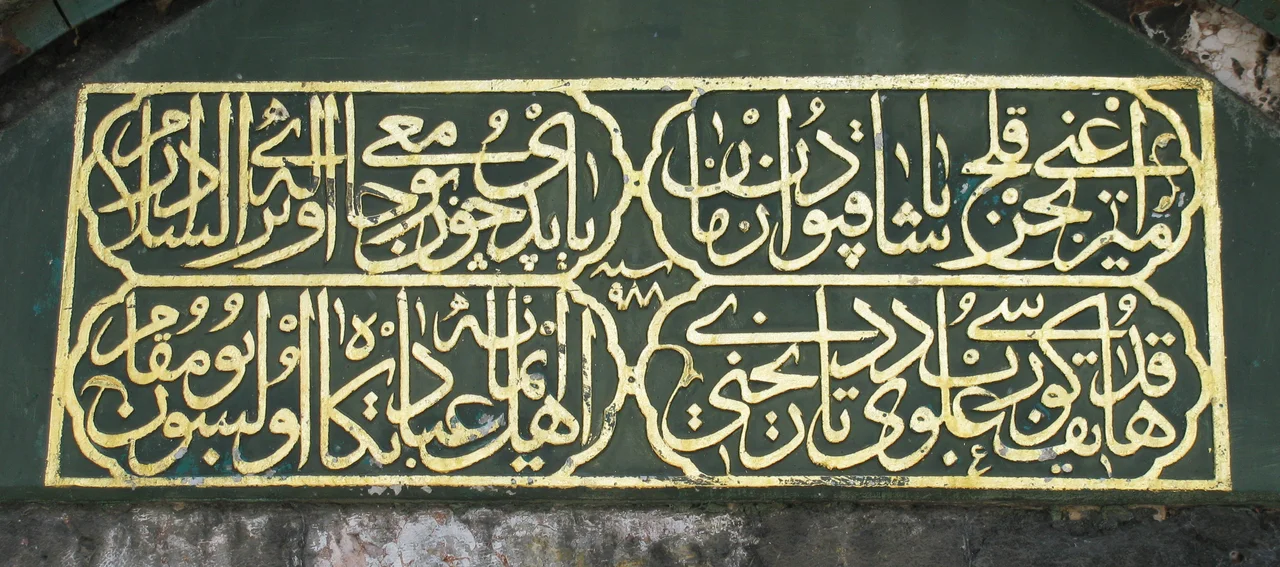
The courtyard is a measured space of marble and water. A fountain for pre-prayer ablutions stands at its center, sheltered by eight columns and a dome. The outer porch is supported by twelve columns on the west façade, three at each end, their capitals cut in a distinctive rhombus pattern. At the outer entrance of the complex, visitors can read one of the building's two chronograms: a four-verse poem in jali thuluth calligraphic script, composed by the poet Ulvî and written by the calligrapher Demircikulu Yusuf. The final line — May this be a house of worship for people of the faith — encodes the date 988 in the Hijri calendar (1580 in the Julian calendar), each letter carrying a numerical value that adds to the year. The octagonal türbe, the tomb of Kılıç Ali Pasha himself, stands in the graveyard beside the mosque, its dome also designed by Sinan. Wooden doors inlaid with mother-of-pearl mark the entrance.
The Hamam and a Literary Ghost
To the right of the mosque stands the hamam, completed in 1583. Its layout departs from Sinan's usual approach: two soğukluks — cool rooms — flank a hexagonal hararet, the caldarium, with bathing places set into four of its six arched recesses. The medrese, opposite the mosque's southeast corner, may not be Sinan's work at all; it doesn't appear in the Tazkirat-al-Abniya, the official list of his buildings. The complex has also attracted a remarkable literary footnote. Turkish researcher Rasih Nuri İleri studied the foundation documents and claimed that the Spanish writer Miguel de Cervantes — captured by Ottoman corsairs and held in Algiers before his ransom was paid — may have been present during the mosque's construction, echoing the captive character in Don Quixote. The claim is contested, but it refuses to be entirely dismissed.
From the Air
Coordinates: 41.026°N, 28.981°E. The Kılıç Ali Pasha Complex sits in the Tophane neighborhood on Istanbul's European shore, close to the Bosphorus waterfront between Karaköy and Kabataş. From altitude the complex is recognizable by its single minaret and cascading dome profile, set against the backdrop of the Galataport cruise terminal that now occupies what was once open water in front of the mosque. The Galata Tower, roughly 700 meters to the northwest, is the most useful navigational reference from the air. Istanbul Airport (LTFM) lies approximately 40 km to the northwest. Best viewed at 2,000–3,000 feet on approach over the Bosphorus.
Nearby Stories
- Kocaeli Peninsula 7.6 km away
- Second Battle of Çatalca 11 km away
- Istanbul's Rural Outskirts 14 km away
- MV Struma 20 km away
- HMAS AE2 36 km away
- Bursa 66 km away
- Sangarius Bridge 71 km away
- Januarius MacGahan 101 km away