
Kaiser Wilhelm Memorial Church
Berliners call it der hohle Zahn — the hollow tooth. The damaged spire of the Kaiser Wilhelm Memorial Church rises in the middle of Breitscheidplatz on the Kurfürstendamm, surrounded by department stores and traffic, its top blown off by RAF bombs on the night of 23 November 1943. After the war, the city debated what to do with the ruin. Tear it down for safety? Restore it to its original neo-Romanesque grandeur? Berlin chose neither. The hollow tooth still stands, with a new octagonal church and freestanding belfry built around it in cobalt-blue stained glass. The intentional decision to leave a wound visible — that is what the Memorial Church really commemorates.
The First Church
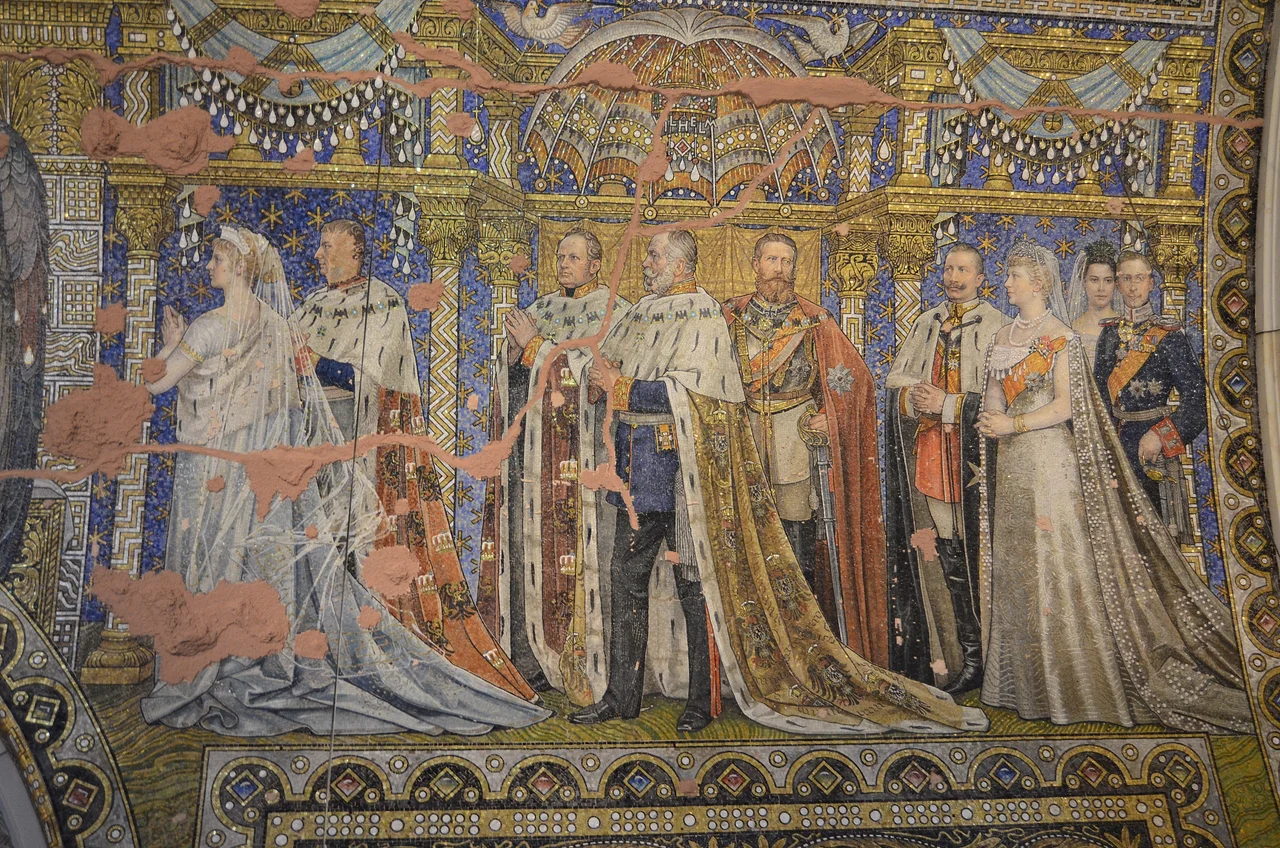
Kaiser Wilhelm II commissioned the church in the 1890s as part of a Protestant building campaign meant to push back against the rising labour and socialist movements. He named it for his grandfather, Wilhelm I, the first emperor of unified Germany. The architect Franz Schwechten — known for the vast Anhalter Bahnhof — designed a neo-Romanesque pile of tuff stone modelled on the Bonn Minster, with 2,740 square metres of mosaic, a 113-metre spire, and seating for over 2,000 worshippers. Construction cost 6.8 million gold marks, raised mostly by donations. The church was consecrated on 1 September 1895. Its design was so unfamiliar to Brandenburg that it inspired an entire neighbourhood, including the Romanisches Café where 1920s Berlin's avant-garde drank coffee until the Nazi years scattered them.
The Night of 23 November 1943
By late 1943 RAF Bomber Command had been pursuing Berlin systematically as part of the Battle of Berlin air campaign. On the night of 22-23 November a major raid struck the western districts. The Kaiser Wilhelm Memorial Church took direct hits. The roof collapsed, the nave burned, the spire was sheared off above its broken stump. When the smoke cleared, what remained was the hollow shell of the entrance tower with mosaics still clinging to its inner walls. The chunks of plaster and stone that fell that night included a damaged statue of Christ from the original altar — it survived, and now stands inside the memorial hall.
The Argument Over the Ruin
After the war, the church's foundation decided in 1947 to rebuild — but how? Through the 1950s the question divided Berliners. Some wanted full restoration, the imperial church returned. Others wanted clean slate modernism. A 1956 design competition by Egon Eiermann left open whether to keep the spire stump at all. The eventual answer, finalised between 1959 and 1963, was to keep it: preserve the war-damaged tower as a witness, and surround it with new buildings in concrete, steel, and glass. The new church is octagonal, 35 metres across, with walls made of concrete honeycomb holding 21,292 stained glass inlays designed by Gabriel Loire of Chartres. Step inside on a sunny afternoon and the entire space saturates blue, with rubies and emeralds catching the light. Berliners promptly nicknamed the new buildings Lippenstift und Puderdose — the lipstick and the powder box.
Inside the Hollow Tooth
The ground floor of the damaged spire was reopened as a memorial hall in 1987. Surviving mosaics on the upper walls show medieval German monarchs and Reformation figures. Three objects stand at the far end: the damaged Christ statue from the old altar, a Russian Orthodox icon cross given to the church in 1988, and a small cross made from nails recovered from the bombed roof of Coventry Cathedral. The Coventry Cross of Nails is the key object. The Luftwaffe destroyed Coventry Cathedral on the night of 14 November 1940 in one of the war's most notorious raids. Nails from the burned roof timbers were later assembled into a cross that became a symbol of reconciliation. That a Coventry-made cross now sits inside a Berlin church bombed by the British, in a city whose air force destroyed Coventry — that is the Memorial Church's quiet, working argument.
What the Bells Say
Six bronze bells hang in the new belfry, cast from French cannon captured during the Franco-Prussian War of 1870-71 — themselves spoils of one war, now ringing in memorial of another. Different combinations sound for different occasions: bells 6, 5, and 4 for weddings and baptisms; all six for festive services. A bronze plaque commemorates the Protestant clergy murdered by the Nazi regime between 1933 and 1945, and was placed in the church on 20 July 1964 — the twentieth anniversary of the failed assassination attempt against Hitler by Claus von Stauffenberg. Around the corner is the Stalingrad Madonna, drawn in charcoal by the German army doctor Kurt Reuber on the back of a Soviet map at Christmas 1942 inside the encircled city. Reuber died in Soviet captivity. His drawing came home. Copies hang in Coventry Cathedral, in Volgograd, and here, in the church Berliners refused to repair completely so they would not forget.
From the Air
The church stands at 52.50°N, 13.34°E on Breitscheidplatz, at the eastern end of the Kurfürstendamm in Berlin's Charlottenburg-Wilmersdorf district. From the air the damaged spire is conspicuous — a broken stump rising from a busy commercial square, with the modern octagonal church and hexagonal belfry beside it. Berlin Brandenburg (EDDB) lies roughly 25 km southeast. This is in central Berlin's restricted airspace. The church sits about 4 km west of the Brandenburg Gate; from low altitude in clear conditions, the rooftop ribs of the broken spire and the cobalt glow visible through the new church's stained glass make the complex easy to identify.
Nearby Stories
- Genthin Rail Disaster 35 km away
- Kingdom of Prussia 35 km away
- Lutherhaus 38 km away
- Battle of the Seelow Heights 47 km away
- Ravensbruck concentration camp 51 km away
- Lichtenburg Concentration Camp 63 km away
- Ludwigslust Palace 102 km away
- Semperoper 128 km away