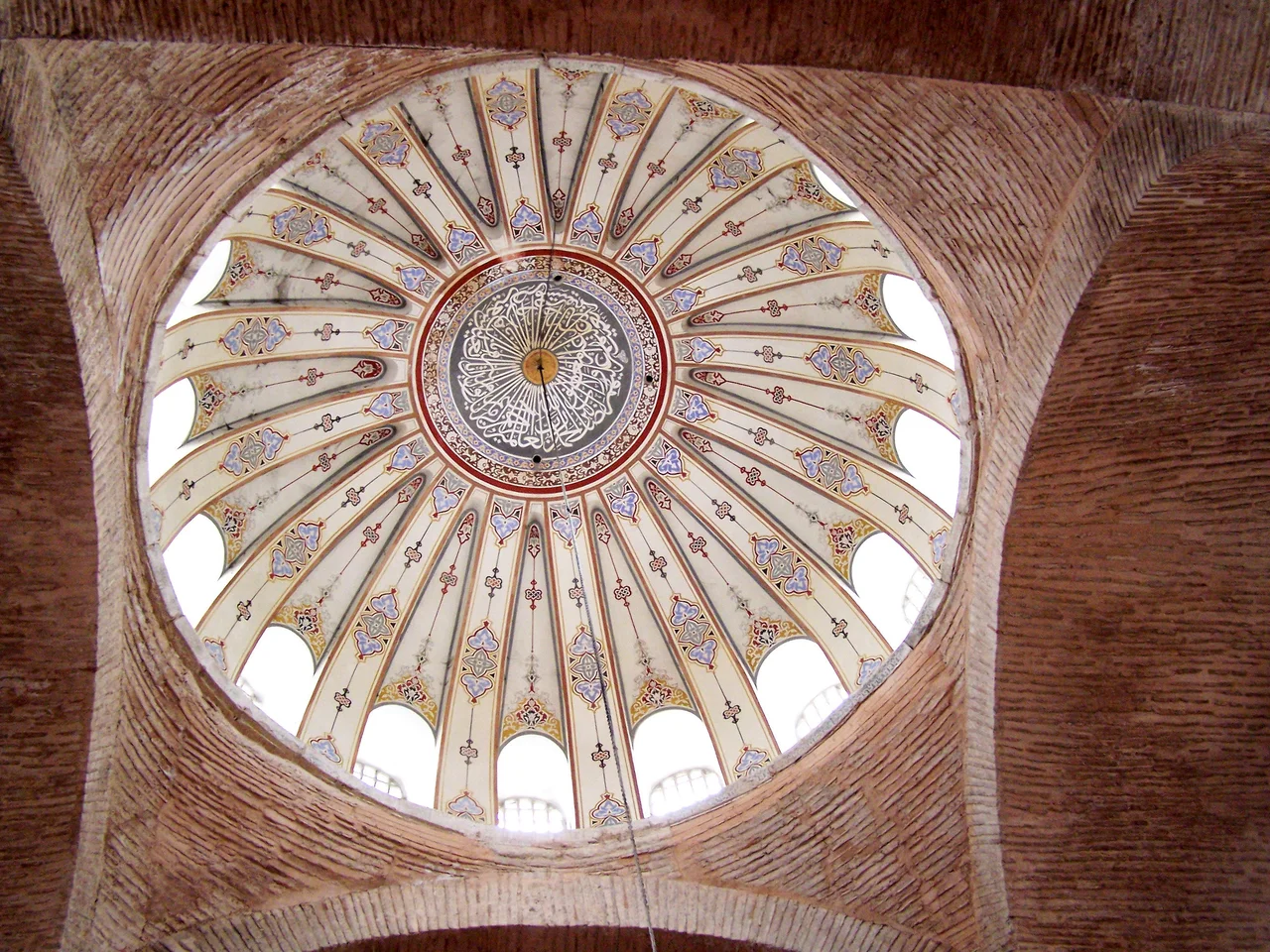

Kalenderhane Mosque
The archaeologists who excavated beneath Kalenderhane Mosque in the 1960s and 1970s found something unexpected under each layer they removed: another building. A mosque sat atop a Byzantine church. The church sat atop an earlier church. That church sat atop the ruins of a Roman bath. Four civilizations, one plot of ground, and a single continuous thread of human need — the need for a place that gathers and consecrates. Istanbul has no shortage of layered histories, but few structures make those layers as legible as this quiet mosque tucked beside the Aqueduct of Valens.
Seventeen Centuries of Building
The story begins with Romans. The first structure on this site was a bath — thermae — of the kind that Roman cities built as civic infrastructure and social institution. After the baths fell out of use, a hall church rose in their place, probably in the sixth century; coin finds in stratigraphic excavation pin the date with unusual precision. Sometime in the seventh century, a larger church was built to the south of the first. Then, at the end of the twelfth century, a third church replaced or incorporated its predecessor. This final Byzantine church may date to between 1197 and 1204: the scholar Constantine Stilbes mentioned its destruction in a fire in 1197, which suggests either that the dating is off or that reconstruction was swift.
Crusaders, Dervishes, and a Name
After the Fourth Crusade seized Constantinople in 1204, the church passed to the Latin conquerors. Franciscan clergy celebrated Mass here for several decades — a detail that makes the building's later history all the more striking. In 1453, when Mehmed II took Constantinople, he assigned this church personally to the Kalenderi sect of the Dervish. The Dervishes used it as a *zaviye* (a Sufi lodge) and an *imaret* (a public kitchen). From the name of that order the building took the name it still carries: Kalenderhane, meaning, roughly, the house of the Kalenders. A mihrab, minbar, and mahfil were added to complete its conversion to a mosque.
The Architecture: A Greek Cross in Brick and Stone
The building survives in a form recognizable to its Byzantine builders, though the Ottoman additions have become part of its character. The plan is a central Greek cross with deep barrel vaults over each arm and a dome above the crossing — the dome has sixteen ribs, a technical refinement typical of middle Byzantine construction. The masonry alternates layers of brick and stone in the style that Byzantine builders used across the eastern Mediterranean. Entry today is through an esonarthex and an exonarthex on the west side. An upper gallery once occupied the space above the esonarthex, following the same arrangement found in the great Church of the Pantokrator; it was removed in 1854. Alongside the Gül Mosque in Istanbul, the Church of Hagia Sophia in Thessaloniki, and the Church of the Dormition in Iznik, Kalenderhane stands as one of the principal surviving examples of the domed Greek cross plan from the Byzantine middle period.
The Frescoes and the Discovery
The excavations that began in the 1960s did more than reveal the building's structural history. Restorers discovered two frescoes bearing the Greek word *Kyriotissa* — meaning enthroned — in the southeastern chapel and above the main entrance to the narthex. The find resolved a long-standing mystery about the church's original dedication: it was almost certainly dedicated to the Theotokos Kyriotissa, the Enthroned Mother of God. A separate fresco cycle depicting scenes from the life of St. Francis of Assisi was also uncovered — among the oldest known representations of the saint, painted only a few years after his death in 1226. Both fresco groups have been detached, partially restored, and transferred to the Istanbul Archaeology Museums, where they can be seen today. What the walls of Kalenderhane once showed, the museum now preserves.
From the Air
Kalenderhane Mosque stands at 41.013132°N, 28.960304°E in the Vefa neighborhood of Fatih district on Istanbul's European side. Approaching from Istanbul Airport (LTFM), the Aqueduct of Valens — a massive Roman-era arched viaduct running east-west across the city — is an unmistakable landmark at roughly 2,000 feet. Kalenderhane sits immediately to the south of the aqueduct's easternmost surviving section, its minaret marking the spot. The Süleymaniye Mosque complex is visible to the southwest; the Fatih Mosque to the northeast.
Nearby Stories
- Kocaeli Peninsula 7.6 km away
- Second Battle of Çatalca 11 km away
- Istanbul's Rural Outskirts 14 km away
- MV Struma 20 km away
- HMAS AE2 36 km away
- Bursa 66 km away
- Sangarius Bridge 71 km away
- Januarius MacGahan 101 km away