
Kanlıca
Ask anyone in Istanbul what Kanlıca is known for and the answer comes without hesitation: the yogurt. Not yogurt in the abstract, but a specific, regional product — dense, white, slightly tart, served in a small bowl dusted with powdered sugar — that has been produced in this village on the Asian shore of the Bosphorus for longer than anyone can precisely say. Ferries still stop at the wooden pier at Kanlıca, and passengers still disembark specifically to eat a bowl before boarding the next boat back. In a city of fifteen million, a village of fewer than four thousand people has managed to become synonymous with a food.
A Village on the Strait
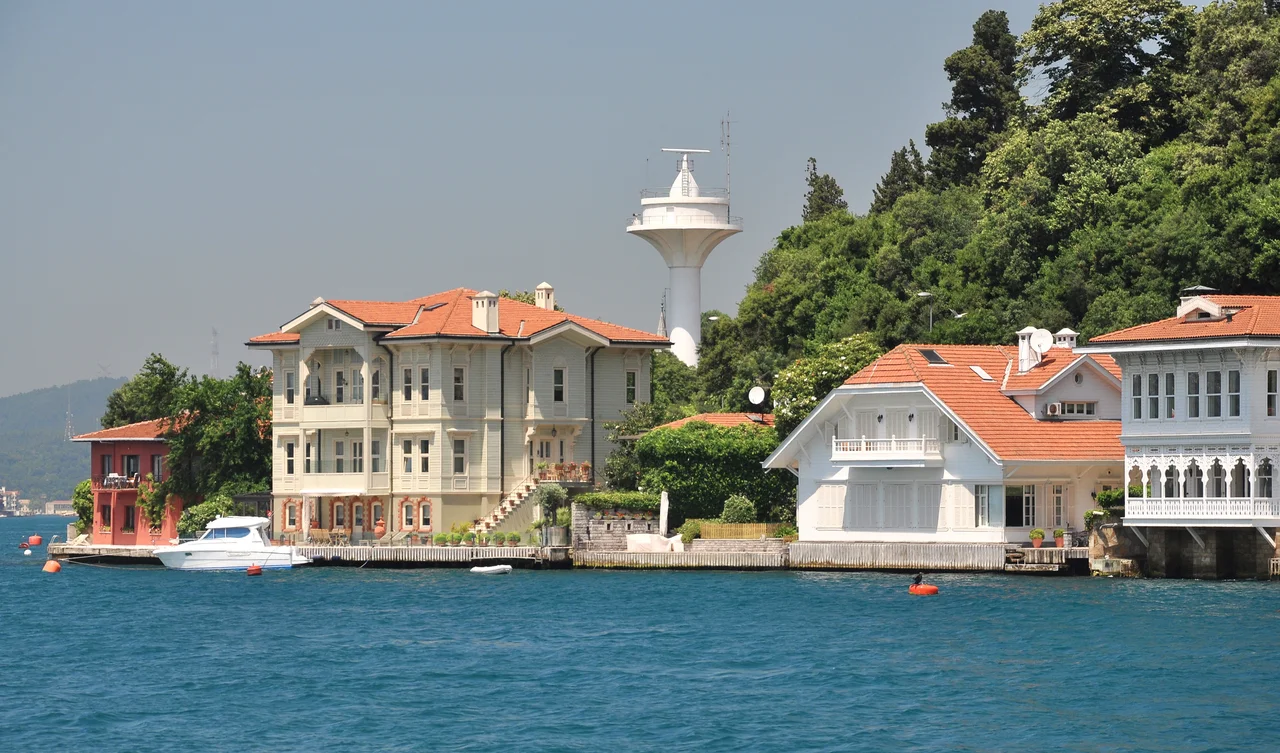
Kanlıca occupies a cove on the Asian shore of the Bosphorus, in the district of Beykoz, north of the Fatih Sultan Mehmet Bridge. The strait is narrow here, and the European shore is close enough to see clearly. The village's population numbers just under 4,000 people — tiny by Istanbul's standards, which makes its fame all the more striking. The waterfront is its center of gravity: a ferry pier, a cluster of tea gardens and yogurt shops, a radar tower for Bosphorus marine navigation, and the wooden *yalı* — the traditional waterfront mansions of the Ottoman elite — that line the shore. Passenger ferries connect Kanlıca to the city's main ferry networks, and the crossing from the European side takes less than an hour.
The Mansions of the Bosphorus
The shores of the Bosphorus were the preferred summer retreat of the Ottoman ruling class for centuries, and Kanlıca accumulated its share of grand residences. The grand vizier Sadrazam Kadri Pasha had a yalı here. So did Ahmet Rasim Pasha, the chief physician Hekimbaşı Salih Efendi, the military commander Yedi Sekiz Hasan Pasha, and members of the Ottoman royal family including a princess. These buildings — wooden, many-windowed, cantilevered over the water — were among the most desirable addresses in the empire. Some have survived; others have been replaced. What remains gives the waterfront its particular character: elegant old structures pressed close to the Bosphorus, their facades fading in the salt air, their histories accumulated in layers like the city they look out from.
The Yogurt
Kanlıca yogurt is not simply yogurt made in Kanlıca. It is a protected regional product with its own character — thicker than standard yogurt, with a specific tang that locals attribute to the local milk and the particular bacterial cultures maintained in the village. It is served almost always the same way: in a shallow ceramic bowl, dusted generously with powdered sugar, eaten with a spoon at a café table on the waterfront while ferries pass on the strait. The ritual is as much a part of the experience as the product itself. For many Istanbul residents, eating Kanlıca yogurt by the Bosphorus on a summer afternoon represents something specific about the city's pleasures — a combination of food, place, and pace of life that resists easy description.
A Cemetery by the Water
Kanlıca has a cemetery, and it turns out to be the resting place of several figures important in Turkish cultural life. The musician Barış Manço, beloved across Turkey for his blend of rock and Anatolian folk music, is buried here. So is Kayahan, another prominent Turkish singer, and Sedat Simavi, the publisher and journalist who founded the newspaper Hürriyet in 1948. The presence of these graves gives the village a quiet significance beyond its yogurt fame — a reminder that small places on the edges of great cities sometimes hold the people who shaped those cities' culture, brought back at last to the quieter water they chose for their final home.
From the Air
Kanlıca is located at 41.098669°N, 29.071076°E on the Asian shore of the Bosphorus in the Beykoz district of Istanbul. The nearest major airport is Sabiha Gökçen (LTFJ), approximately 20 kilometers to the southeast. At 1,500 feet, the Bosphorus is the dominant visual feature; Kanlıca's cove is visible just north of the Fatih Sultan Mehmet Bridge on the Asian (eastern) bank. The ferry pier and the cluster of white-and-wood buildings at the water's edge identify the village. The Kandilli Observatory hill is visible to the south, and the strait's narrowing at this section of the Bosphorus is particularly evident from the air.
Nearby Stories
- Kocaeli Peninsula 7.6 km away
- Second Battle of Çatalca 11 km away
- Istanbul's Rural Outskirts 14 km away
- MV Struma 20 km away
- HMAS AE2 36 km away
- Bursa 66 km away
- Sangarius Bridge 71 km away
- Januarius MacGahan 101 km away