
Karacaahmet Cemetery
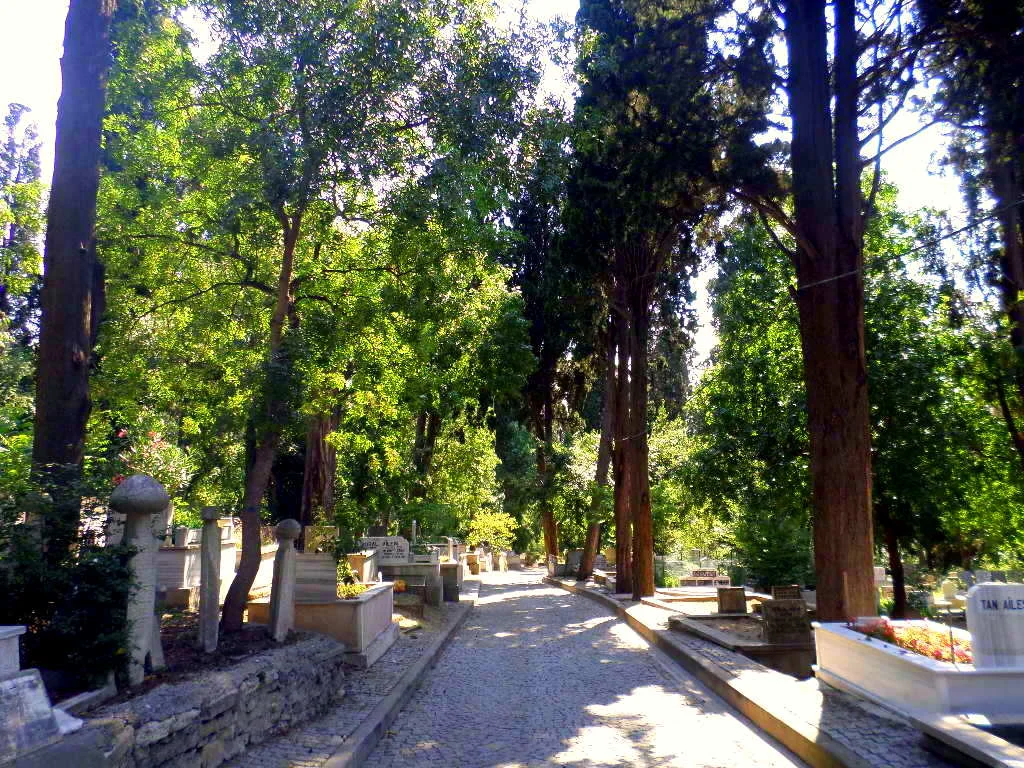
Western travelers who visited in the nineteenth century kept reaching for the same word: forest. An Anglican clergyman posted to Istanbul in the 1820s described Karacaahmet as a large forest divided by wide roads on sloping ground. The English artist Thomas Allom engraved the scene — cypress after cypress, their dark spires rising above headstones that seemed to disappear into the shade. What they were describing was a cemetery 750 acres in extent, on the Asian shore of Istanbul, holding more people beneath the earth than most cities hold above it. Karacaahmet Cemetery, believed to have been founded in the mid-fourteenth century, is the largest burial ground in Turkey by number of interred.
Named for a Warrior, Grown into a Forest
The cemetery takes its name from a companion of Orhan, the second Ottoman sultan, who is said to have been buried here after fighting alongside the forces that established early Ottoman power in the region. The mid-fourteenth century founding would place it at the very beginning of Ottoman presence on the Bosphorus, making Karacaahmet among the oldest Muslim cemeteries in Istanbul.
The trees came with the centuries. Cypress — the traditional companion of Muslim burial grounds, its vertical form said to point toward heaven — dominates, but oak, plane trees, laurel, and hackberry fill the spaces between the graves. The canopy is now dense enough to filter out much of the sunlight, which is why every account of the place, from Robert Walsh's 1820s chaplaincy notes to photographs taken in the 2010s, returns to the same observation: this cemetery reads as woodland, not as an open memorial park. Birds nest in the branches. On summer afternoons, the shade draws not only mourners but ordinary visitors looking for cool and quiet.
Seven Centuries of the Buried
A cemetery that has been in continuous use for roughly seven centuries accumulates a particular kind of human weight. The oldest headstones here, carved in Ottoman script with floral patterns and elaborate turbans indicating the rank of the deceased, record grand viziers, calligraphers, and poets. Sheikh Hamdullah, born in 1436 and considered one of the greatest masters of Ottoman calligraphy, rests here. So does Nedim, born in 1681, one of the most celebrated poets of Ottoman literature, whose verses on wine and beauty and Istanbul's gardens made him the voice of a more sensual, worldly strain of Ottoman culture.
Six grand viziers of the Ottoman Empire are buried in Karacaahmet — men who had held the highest administrative office in a state that stretched from the Danube to the Persian Gulf. Beside them, in the same earth, lie a Kurdish poet, Haji Qadir Koyi; a Naqshbandi shaykh; a painter who was one of the first professional female art teachers in the Ottoman Empire, Müfide Kadri, who died in 1912 at just twenty-two years old.
The twentieth century added Turkish composers, classical pianists, opera singers, actors, and soldiers. A retired colonel named Mustafa Şekip Birgöl, born in 1903 and the last living veteran of the Turkish War of Independence, was buried here in 2008. The cemetery continues to receive the dead.
Seen by Artists, Witnessed by History
The oldest photographs of Karacaahmet were made by Ernest de Caranza between 1852 and 1854, and the images that followed — from Pascal Sebah's 1870 portrait of women among the tombs to William Henry Bartlett's 1838 drawings — trace an unbroken visual record of a place that seemed to resist change even as the city around it transformed utterly.
Poetry was written about Karacaahmet. This is unusual. Cemeteries rarely inspire verse rather than elegy, but the particular quality of this place — its scale, its shade, the accumulated weight of its centuries — drew writers to it as a subject in its own right. The cypress groves became a recurring motif in Ottoman poetry, the cemetery itself a metaphor for the transience that Muslim thought has always held at the center of its view of earthly life.
When the Marmaray railway tunnel was excavated beneath the Bosphorus in the early 2000s, the tunneling came close enough to Karacaahmet that by June 2007 a subsidence of 1.5 meters in diameter and 4 meters deep had opened near the cemetery wall, and it was reported that some graves were damaged. The city moves forward; the cemetery endures what it must.
Crossing to the Asian Shore
Karacaahmet sits in Üsküdar, the oldest continuously settled district on Istanbul's Asian side, a short ferry ride across the Bosphorus from the European city. The contrast with the European districts is not merely geographic. Üsküdar has always had a more residential, more traditionally pious character — a neighborhood of old wooden houses, hilltop mosques, and neighborhood life pitched at a quieter frequency than the commerce of Karaköy or the tourism of Sultanahmet.
The cemetery covers a substantial portion of Üsküdar's urban fabric. To walk through it is to walk through the texture of seven centuries of one city's dead — the humble headstones alongside the elaborate ones, the children's graves alongside those of viziers, the recent burials beside stones so old the inscriptions have worn smooth. The cypress trees stand over all of it, pointing upward, as they have since before anyone now living was born.
From the Air
Karacaahmet Cemetery is located at approximately 41.01°N, 29.03°E in Üsküdar, on the Asian side of Istanbul. From altitude, the cemetery's distinctive forested profile — the dense cypress canopy dark against the surrounding urban fabric — is visible on the Asian Bosphorus shore directly east of the Bosphorus crossing. The nearest airport is Sabiha Gökçen International Airport (LTFJ), approximately 20 km to the southeast. On approach from the Marmara Sea, Üsküdar's hilltop mosques and the dark-canopied mass of Karacaahmet are visible landmarks on the Asian shoreline.
Nearby Stories
- Kocaeli Peninsula 7.6 km away
- Second Battle of Çatalca 11 km away
- Istanbul's Rural Outskirts 14 km away
- MV Struma 20 km away
- HMAS AE2 36 km away
- Bursa 66 km away
- Sangarius Bridge 71 km away
- Januarius MacGahan 101 km away