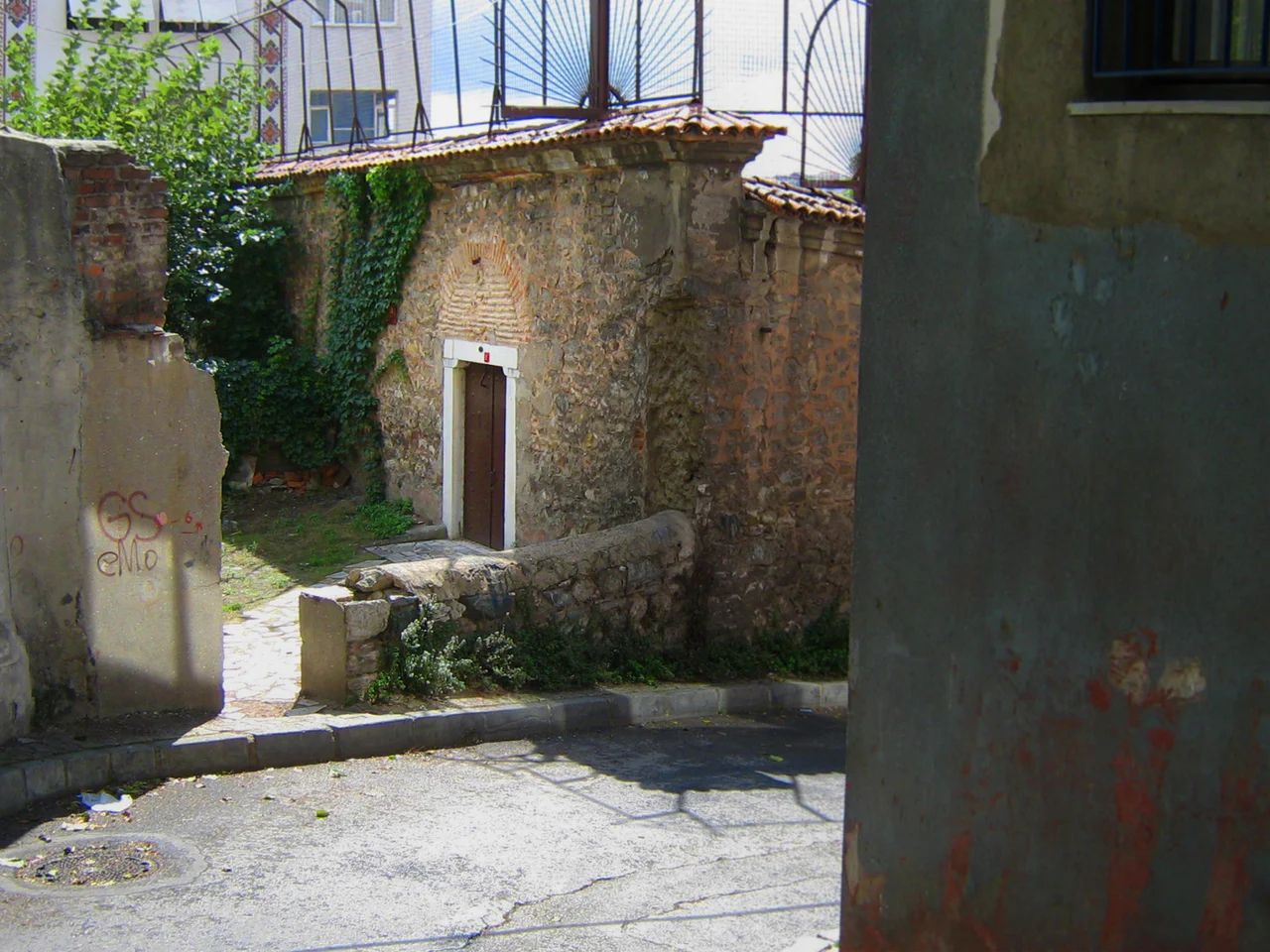

Karaite Synagogue (Istanbul)
Once a year, the doors of the kenesa on Dere Street in Hasköy open for Passover. The rest of the year, the building is quiet — open by arrangement, its congregation small, its traditions ancient and distinctive. The Karaite Synagogue of Istanbul is the home of the Karaite Jewish community of this city, a community that reads the Torah and follows its commandments as literally as they can understand them, without the rabbinic interpretation that defines mainstream Jewish practice. Their synagogue has burned and been rebuilt, burned again and been rebuilt again. The structure standing today was restored in 1842, though the congregation behind it traces its roots in this neighborhood to times that precede the Ottoman conquest of Constantinople.
A Different Way of Reading
Karaite Judaism is distinguished from rabbinic Judaism by its rejection of the Talmud — the vast body of rabbinic commentary and oral law that forms the backbone of mainstream Jewish practice. For Karaites, Scripture alone is authoritative. The movement has ancient roots, emerging as a distinct tendency in the eighth century CE in the Near East, and Karaite communities spread across the Jewish world during the medieval period, reaching Persia, Egypt, the Crimea, Lithuania, and eventually the cities of the Ottoman Empire.
The Constantinopolitan Karaites — those who settled in what is now Istanbul — formed their own community, distinct from the Sephardic Jews who arrived after the Spanish expulsion of 1492 and from the Romaniote Jews who had been in the Byzantine city since antiquity. Their kenesa, the Karaite term for a house of worship, in Hasköy on the northern shore of the Golden Horn, has been the center of their communal life. The trust that administers the building today is called the Hasköy Türk Karaim Musevi Sinagogu Vakfı.
Fire, Rebuilding, Fire Again
The Karaite synagogue's history is a chronicle of destruction and persistence. The building's origins are unclear — it may date to Byzantine times, before the Ottoman conquest of 1453, which would make it among the oldest religious foundations in the city. By the sixteenth century it was in ruins. It was repaired in 1536.
In 1729, fire. It was rebuilt. In 1774, fire again. Rebuilt between 1776 and 1780. Restored in 1842 — the date that gives the present building its formal completion year. In 1918, fire once more, during the tumult of the First World War's end and the occupation of Istanbul that followed. The building was restored again.
To have survived so many destructions is itself a kind of testimony to the community's continuity. Each rebuilding required resources, will, and enough people to sustain the effort. The Karaite community of Istanbul has never been large, and through the nineteenth and twentieth centuries it grew smaller still as members emigrated to Israel, Europe, and elsewhere. But the kenesa remained.
Hasköy and the Golden Horn
Hasköy occupies a hillside on the European shore of the Golden Horn, north of the historic peninsula, in the Beyoğlu district. It has been home to Jewish communities — Karaite, Romaniote, and Sephardic — for centuries, part of the pattern by which minority religious communities in Istanbul clustered in neighborhoods where they could maintain communal institutions: synagogues, schools, cemeteries.
Dere Street, where the kenesa stands, is a narrow lane descending toward the waterfront. The neighborhood around it has changed enormously over the centuries — the Golden Horn's industrial era left Hasköy marked by factories and workshops; more recent decades have seen some renewal. But the kenesa has remained on its street, its foundation older than anyone can say with certainty.
The community also maintains a Karaite cemetery in Hasköy, another anchor in the neighborhood. Visitors who wish to see the kenesa can contact the Turkish Chief Rabbinate or the Jewish Museum of Turkey to arrange entry outside of the Passover season.
A Congregation That Endures
The Karaite community of Istanbul today is very small — a remnant of a once-larger presence. This is not unusual for Istanbul's non-Muslim minority communities, most of which have experienced significant emigration over the course of the twentieth century. The Greek Orthodox community, the Armenian community, the Sephardic Jewish community — all have shrunk from their Ottoman-era sizes. The Karaites, never numerous, have followed the same pattern.
What remains is a living community, not a museum piece. The kenesa opens each year for Karaite Passover services, the ancient liturgy spoken in a building that has been rebuilt from ashes more than once. The trust that manages the property keeps it intact. Contact with the congregation is possible through established institutional channels. The doors open once a year on Dere Street, and the community gathers as it has gathered, in some form on some version of this site, for a very long time.
From the Air
The Karaite Synagogue is located at approximately 41.04°N, 28.95°E in the Hasköy neighborhood of Beyoğlu, on the European side of Istanbul along the northern shore of the Golden Horn. From altitude, Hasköy's hillside above the Golden Horn waterfront is visible north of the Atatürk Bridge, with the Beyoğlu district rising behind it. The nearest major airport is Istanbul Airport (LTFM), approximately 25 km to the northwest. The Golden Horn's distinctive inlet shape — curving northeast from the Bosphorus — provides clear visual orientation for locating Hasköy's position on the European shore.
Nearby Stories
- Kocaeli Peninsula 7.6 km away
- Second Battle of Çatalca 11 km away
- Istanbul's Rural Outskirts 14 km away
- MV Struma 20 km away
- HMAS AE2 36 km away
- Bursa 66 km away
- Sangarius Bridge 71 km away
- Januarius MacGahan 101 km away