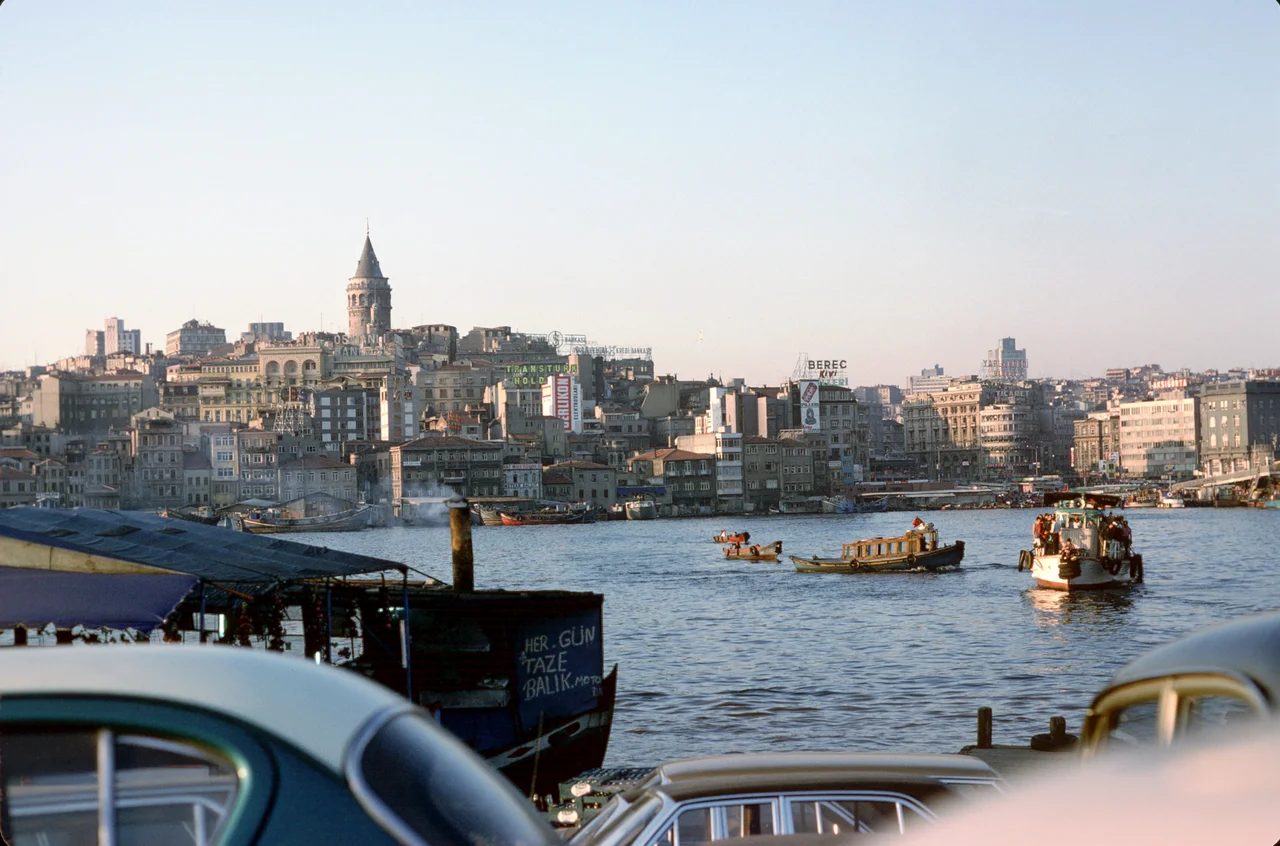

Karaköy
The French poet André Chénier was born here in 1762. His father was a French merchant and diplomat; his mother was an Ottoman Greek. That combination — French, Greek, Ottoman, mercantile — is almost a definition of what Karaköy has always been. The district at the foot of the Golden Horn, where Byzantine emperors once granted Genoese merchants the right to settle in exchange for naval alliance, has spent eight centuries absorbing newcomers and turning them into Istanbullus. Every wave of history that reached this city washed first onto Karaköy's quays.
The Genoese Foundation
Karaköy's name for most of its history was Galata — the walled Genoese enclave that faced Constantinople across the Golden Horn. After the Byzantine emperor recaptured the city from the Latin State in 1261, he granted Genoese merchants permission to settle on the northern shore of the Golden Horn as part of a defense agreement. The Genoese wasted no time. They built warehouses, then walls — sturdy fortifications to protect themselves and their trade. The settlement grew quickly into something that looked, in the fifteenth century, more like a Ligurian city than a Byzantine one.
Fragments of the Genoese walls still surface occasionally in the urban fabric of modern Karaköy, but the most substantial relic is the Galata Tower, built by the Genoese in 1348, which still commands the skyline from the highest point of the old walled enclave. In 1455, shortly after Mehmed II's conquest of Constantinople, a census counted three types of residents in Galata: visiting Genoese, Venetian, and Catalan merchants; Genoese who had taken Ottoman citizenship; and Greeks, Armenians, and Jews. By 1478, almost half the local population was Muslim. The composition kept shifting, as it always had.
A City of Arrivals
Sephardic Jews arrived from 1500 onward, expelled from Spain in 1492 and welcomed by the Ottoman sultan who saw in their commercial and intellectual skills an asset rather than a threat. They joined a Karaköy already layered with communities. From 1492 onward the neighborhood accumulated Sephardic synagogues alongside Greek Orthodox churches and Genoese Catholic chapels, each community running its own schools, maintaining its own charitable institutions, living in adjacency.
The Crimean War of 1854 to 1856 brought a second wave of Western Europeans — British, French, and Italian forces using Karaköy as a logistics base. The lack of proper piers made unloading difficult, so in 1879 a French company obtained a concession to build a new quay, completed in 1895. In the last decade of the nineteenth century, the district evolved into Istanbul's banking and insurance quarter. The Ottoman Bank established headquarters here; Italian and Austrian insurance companies opened branch offices along Voyvoda Street, which acquired the nickname Bankalar Caddesi — Bank Street.
After 1917, thousands of White Russians fleeing the Bolshevik Revolution arrived at these same quays and settled nearby. They added Russian Orthodox churches, Russian bakeries, and Russian culture to the neighborhood's already remarkable mix.
The Stairs, the Synagogues, the Street
Karaköy's diversity is legible in its architecture. The curving Camondo Stairs, off Voyvoda Street, were donated by the wealthy Sephardic Jewish banker Abraham Salomon Camondo (1785–1873) and built in baroque style — a private gift to the public street, in the ornate manner of a man who had money enough to shape the city he lived in. The Zulfaris Synagogue on a nearby street now houses the Jewish Museum of Turkey.
Elsewhere in a few short blocks: the Arap Mosque, its square minaret marking it as the oldest mosque in Istanbul to have been converted from a church, originally used by Arab immigrants fleeing the Spanish Inquisition; the Dominican church of San Pietro and Paolo, built in 1604 by the Genoese; the Surp Sarkis Armenian church, dating to around 1360 and the oldest Armenian church in Istanbul. The Yüksek Kaldırım Ashkenazi Synagogue, built in 1900. The Austrian and German and Italian schools that served the European merchant families. This is not a neighborhood where tolerance was a policy. It was a neighborhood where commerce required coexistence, and coexistence eventually became a way of life.
The Port That Never Stopped
Modern Karaköy is still, first of all, a transport hub. The Galata Bridge connects it with Eminönü and the historic peninsula; the T1 tram line crosses the bridge. The Tünel funicular — one of the world's oldest underground railways, opened in 1875 — climbs from Karaköy up to Tünel Square at the start of İstiklal Caddesi. Ferries leave from the quayside for Kadıköy and Üsküdar on the Asian shore, and for terminals along the Golden Horn.
Cruise ships from Piraeus, Dubrovnik, and Venice now berth at the Galataport complex, which opened in 2022 along the waterfront south of the old port — a large mixed-use development of hotels, restaurants, and shops that incorporated the old passenger terminal building. The Istanbul Modern, Turkey's first private museum dedicated to contemporary art since 2004, moved to a new purpose-built home at Galataport, reopening in May 2023. Hardware merchants, electronic parts shops, and fish restaurants still fill the older streets behind the waterfront. Karaköy has spent eight centuries absorbing arrivals without losing the essence of what makes it itself.
From the Air
Karaköy is located at approximately 41.02°N, 28.98°E, at the junction of the Golden Horn and the Bosphorus on Istanbul's European side. From altitude, it is easily identified by the Galata Bridge spanning the Golden Horn's mouth and the Galata Tower's cylindrical form rising on the hill to the north. Istanbul Airport (LTFM) lies approximately 25 km to the northwest. On approach from the Marmara Sea, Karaköy forms the visual hinge between the historic Sultanahmet peninsula to the south and the Beyoğlu district rising steeply to the north.
Nearby Stories
- Kocaeli Peninsula 7.6 km away
- Second Battle of Çatalca 11 km away
- Istanbul's Rural Outskirts 14 km away
- MV Struma 20 km away
- HMAS AE2 36 km away
- Bursa 66 km away
- Sangarius Bridge 71 km away
- Januarius MacGahan 101 km away