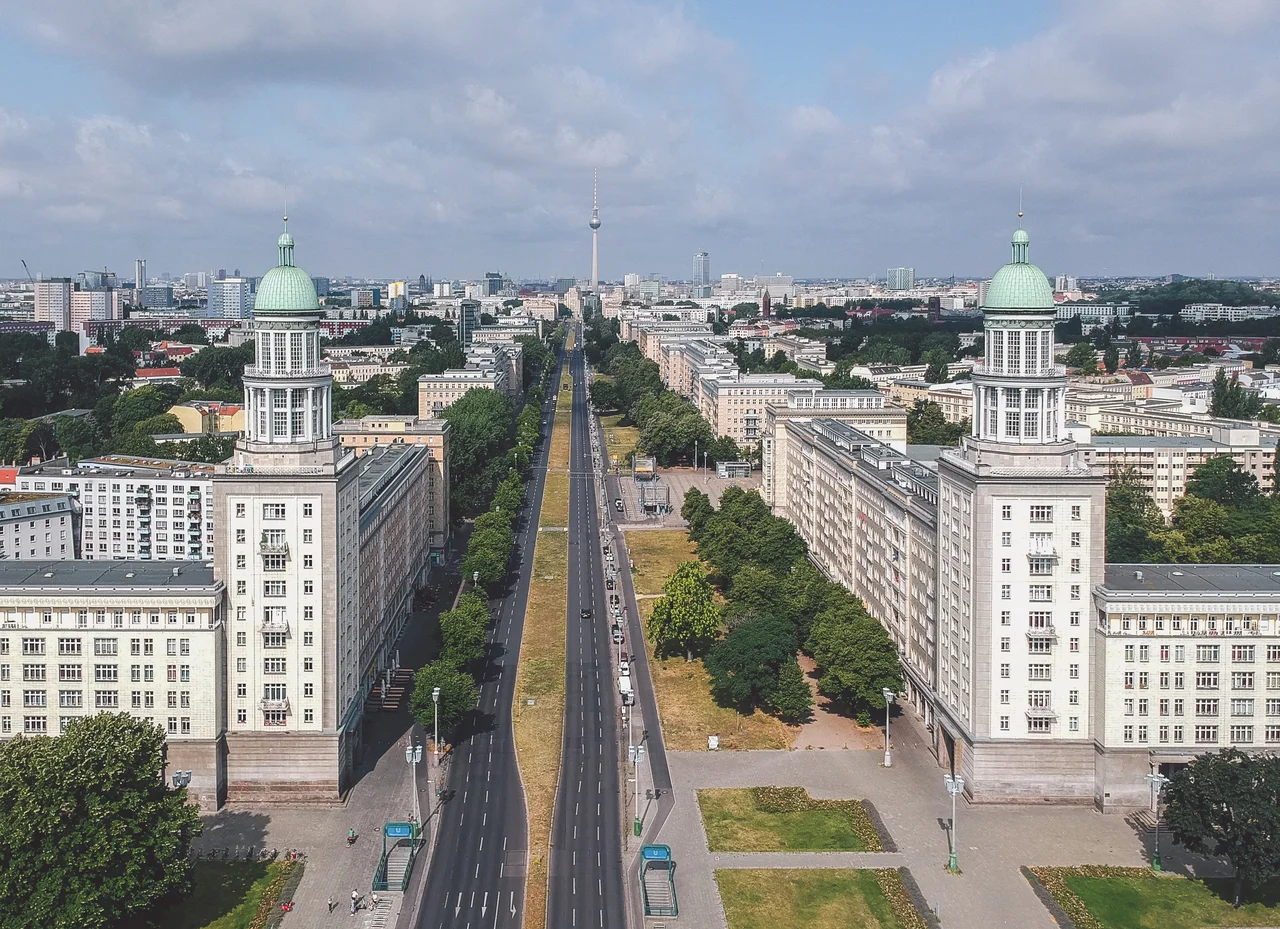

Karl-Marx-Allee
On the morning of 17 June 1953, the construction workers building Stalinallee in East Berlin walked off the scaffolding. The state had quietly raised their work quotas by ten percent — more bricks for the same wage — and the workers said no. They marched down the half-finished boulevard toward the centre of the city, gathering thousands behind them. By that afternoon a workers' rebellion had spread to roughly 700 East German cities and towns. By that evening, Soviet T-34 tanks were rolling east on the very pavement those workers had laid. The boulevard now called Karl-Marx-Allee was East Germany's grandest street, a 2.3-kilometre showcase of socialist urbanism. It was also, very briefly, the place workers tried to take their country back.
What the Wedding-Cake Towers Were For
The boulevard runs east-west between the districts of Friedrichshain and Mitte, 90 metres wide and lined with apartment blocks in the heavy Stalinist style — glazed white tile facades, classical cornices, domed corner towers at Frankfurter Tor and Strausberger Platz. Hermann Henselmann led a team that included Egon Hartmann, Hans Hopp, Kurt Leucht, Richard Paulick, and Josef Souradny. Construction began in 1949 on the bombed-out remains of the old Große Frankfurter Straße. The aim was to house workers in dignity, with wide rooms, balconies, parquet floors, and shops below. Philip Johnson, no socialist, called it "true city planning on the grand scale." Aldo Rossi called it "Europe's last great street." The first residents were sometimes the very people who had built the buildings.
June 17, 1953
The Walter Ulbricht government had been pushing East Germany's recovery hard. By spring 1953 food was scarce, prices were rising, and on May 28 the Politburo announced an increase in production quotas — workers would have to produce ten percent more for the same pay. Resistance built quietly. On 16 June construction workers on Stalinallee laid down their tools and marched. By the next morning the protest had become a strike, the strike had become a march, and the march had become a national uprising for free elections and the end of Communist rule. East German police could not contain it. Soviet tanks moved in on the afternoon of 17 June. At least 55 people were killed in the suppression, with later estimates suggesting more. Hundreds were arrested. Bertolt Brecht, who had stayed in East Berlin, wrote a small bitter poem called Die Lösung ("The Solution"): if the people had lost the government's confidence, would it not be simpler for the government to dissolve the people, and elect another?
From Stalin to Karl Marx
A monumental statue of Stalin had stood on the boulevard since 1951, installed by a Komsomol delegation for the Third World Festival of Youth. After Khrushchev's 1956 secret speech denouncing Stalin, the statue became an embarrassment. East German workers quietly removed it overnight in 1961. The same year, the boulevard was renamed Karl-Marx-Allee — Marx being a safer ideological hero than the recently demoted Soviet leader. Through the 1960s, 70s, and 80s the avenue served as the parade ground for East Germany's elaborate May Day displays: tanks, missile launchers, marching workers in coordinated overalls. The boulevard's wide sightlines were designed for exactly this kind of choreographed power.
Stalin's Bathroom
In February 2009 someone added a line to the German Wikipedia article on Karl-Marx-Allee, claiming the boulevard had been nicknamed "Stalin's bathroom" during the GDR era because of its tiled facades. The claim was repeated by media outlets across Europe. After a Berlin reader wrote to the Berliner Zeitung asking whether the nickname had ever actually been used, journalist Andreas Kopietz published a confession: he had invented the phrase himself and edited it into Wikipedia anonymously to see how far an unsourced fact could travel. It travelled very far. The story became, accidentally, a perfect illustration of the boulevard's reception in reunified Germany — a Stalinist artifact, briefly fashionable as kitsch, more interesting in retrospect than anyone in 1953 could have predicted.
What Walking It Feels Like Now
Walk Karl-Marx-Allee today, eastbound from Strausberger Platz toward Frankfurter Tor, and you pass apartments still occupied by descendants of the original tenants — many of them Berliners who lived through everything. The Kino International, a 1963 modernist cinema with floor-to-ceiling glass overlooking the boulevard, is still showing films. The wide pavements feel oversized for the foot traffic they carry, the way a stage feels oversized when no performance is on. The architecture has been restored at considerable expense; the GDR's monumental aspirations are now a heritage attraction. But underneath the heritage is the older fact. Workers built this. Workers protested here. Tanks came. Workers stayed. The boulevard remembers all of it, even when nobody is reading the plaques.
From the Air
Karl-Marx-Allee runs east-west at approximately 52.52°N, 13.44°E in central Berlin, between Strausberger Platz and Frankfurter Tor. From the air it is one of the city's most distinctive boulevards — exceptionally wide, with characteristic domed Stalinist tower buildings at both ends marking its limits. Berlin Brandenburg (EDDB) lies about 22 km southeast. This is within Berlin's restricted central airspace. The TV Tower at Alexanderplatz, just west of the boulevard, is the dominant visual landmark and a clear navigation reference for finding the avenue.
Nearby Stories
- Battle of the Seelow Heights 24 km away
- Lehnin Abbey 25 km away
- Kingdom of Prussia 43 km away
- Lutherhaus 45 km away
- Lichtenburg Concentration Camp 73 km away
- Szczecin Cathedral 84 km away
- Ludwigslust Palace 121 km away
- Czocha Castle 156 km away