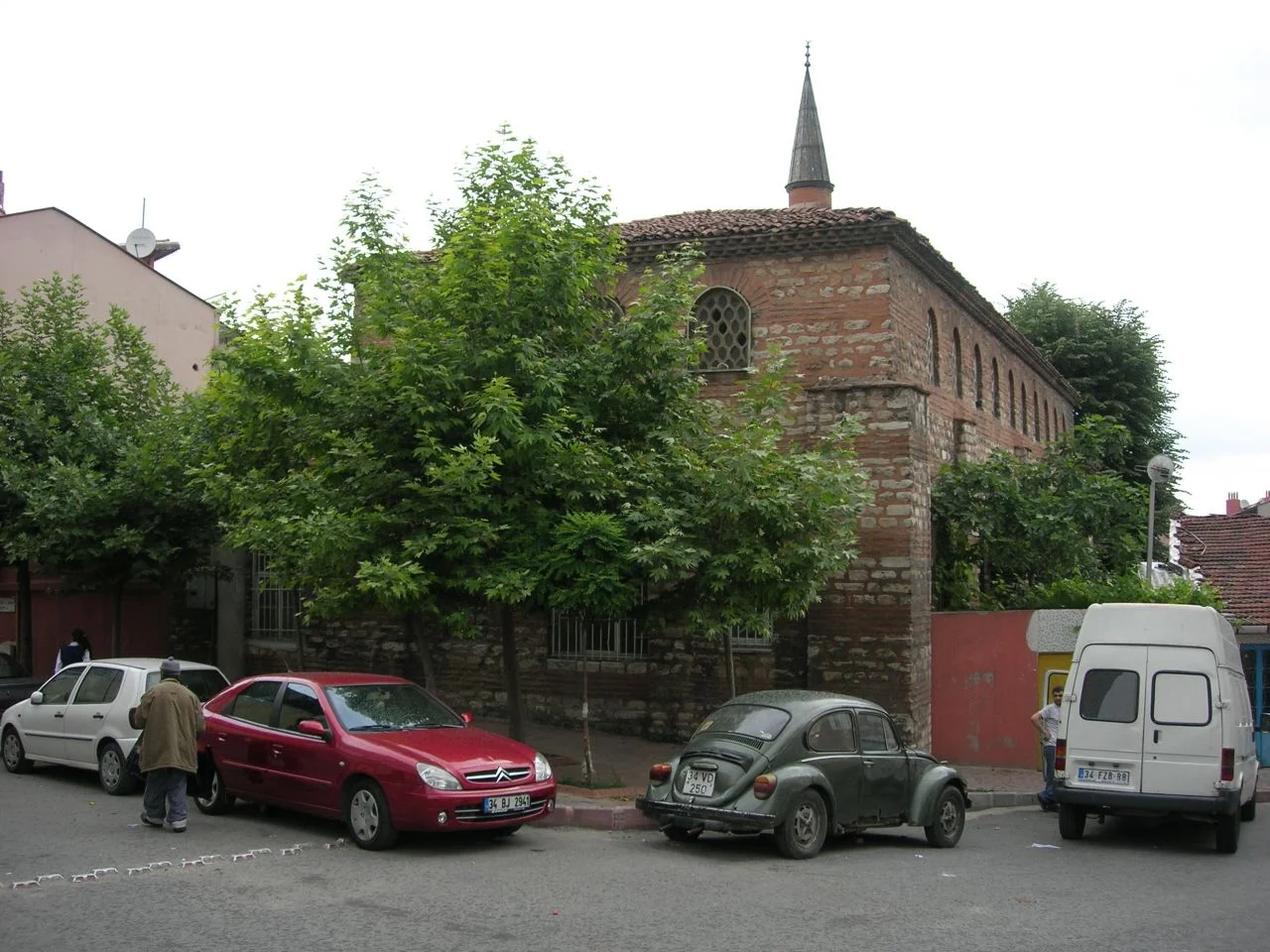

Kefeli Mosque
The name tells you where the people came from, not where the building has been. Kefeli — from Caffa, the Crimean city whose merchants and exiles once worshipped here — is just the latest identity worn by a structure that has belonged to Eastern Orthodoxy, Roman Catholicism, Armenian Christianity, and Islam in turn. The building sits on Kasap Sokak in Istanbul's Fatih district, roughly halfway between the Chora and Fethiye mosques, a quiet stretch of the sixth hill of what was once Constantinople. Most visitors walk past without a second glance. Scholars of Byzantine architecture do not.
A General's Gift to God
Tradition places the origin of this site in the ninth century, when Manuel the Armenian — a general who had fought the Saracens under Emperor Theophilos (r. 829–842) — converted his own house into a monastery near the cistern of Aspar. Manuel was no ordinary soldier. He was the uncle of Empress Theodora, wife of Theophilos, and after his retirement from military life he became one of three counselors who guided Theodora through the regency for her infant son Michael III. A man with those family ties did not build a modest chapel. Whatever he erected here was meant to endure.
The monastery later attracted the attention of Patriarch Photius, who rebuilt it. Romanos I Lekapenos, who seized the Byzantine throne and held it from 920 to 944, restored it again. Emperor Michael VII (r. 1071–1078), after his deposition, retired here — choosing obscurity within familiar walls. These repeated investments by emperors and patriarchs signal how much this site mattered in Constantinople's political and spiritual landscape. Yet scholars now question whether this building is actually the Monastery of Manuel at all. The attribution, long accepted, has been challenged by recent research. The walls keep their secrets.
Four Faiths, One Foundation
What makes the Kefeli Mosque architecturally unusual is not its antiquity but its orientation. Almost every Byzantine church in Constantinople faces east, aligning the altar with the rising sun. This building runs north to south. Nobody knows exactly why. It was dedicated by Catholics to Saint Nicholas and appears to have served Armenian and Catholic congregations simultaneously, with separated altars — an unusual arrangement that speaks to the complexity of religious life in late Byzantine Constantinople, where multiple Christian traditions coexisted uneasily within the same city walls.
After the Ottoman conquest of 1453, the building was converted into a mosque and eventually became associated with the community of Crimean Tatar exiles from Caffa — the Caffariotes, or Kefeliler in Turkish — giving it the name it bears today. The conversion left the structure largely intact, which is why it matters. Inside, you can still read the bones of the original basilica.
The Basilica Reborn
Byzantine architects of the Palaiologan period — roughly the last two centuries of the empire, from the late 13th century onward — rarely built in the old basilica style. That form, with its triple-nave plan and long rectangular nave, belonged to an earlier Christian tradition. The Kefeli Mosque is a rare exception: a deliberate revival of the early Christian basilica during the empire's final, diminished era. Its masonry alternates courses of bricks and stones in a pattern characteristic of the period. The polygonal apse, visible from outside, and the two niches indenting the apse walls point to Palaiologan workmanship.
Of the original three-nave plan, only the western side aisle's end wall survives. The main nave rises through two ranges of windows — the lower ones much larger than the upper, flooding the interior with uneven light. Beneath the western end, a cistern whose roof rests on three columns hints at the building's deeper layers, its foundations reaching down through centuries of accumulated city. The building has never been systematically excavated or studied. What stands above ground is impressive enough.
Between Two Famous Neighbors
The Kefeli Mosque occupies an inconspicuous position between two far more celebrated monuments. To the northwest stands the Chora Church — now Kariye Mosque — famous for its stunning 14th-century mosaics and frescoes, among the finest surviving examples of Byzantine art anywhere in the world. To the southeast lies the Fethiye Mosque, the former Church of the Theotokos Pammakaristos, once the seat of the Ecumenical Patriarchate. Between these well-known landmarks, the Kefeli Mosque is easy to miss.
That obscurity may be part of its appeal. It lacks the crowds, the entrance fees, the tourist infrastructure. In the neighborhood of Salmatomruk, it functions as what it has always been: a working mosque in a residential quarter of the old walled city. The theological transformations of a millennium and a half have not changed the fundamental fact that people still come here to pray. The building was built for devotion. It remains in service.
From the Air
The Kefeli Mosque sits at approximately 41.029°N, 28.942°E on the sixth hill of Istanbul's historic peninsula (Fatih district), about 700 meters north of the Chora Mosque. From the air at 3,000–5,000 feet, the historic peninsula's dense fabric of domes and minarets fills the view below. The nearest airport is Istanbul Airport (LTFM), approximately 35 km to the northwest on the European side. Approach from the Bosphorus and follow the old city walls south; the Fatih district's hillside neighborhoods spread inland from the Golden Horn.
Nearby Stories
- Kocaeli Peninsula 7.6 km away
- Second Battle of Çatalca 11 km away
- Istanbul's Rural Outskirts 14 km away
- MV Struma 20 km away
- HMAS AE2 36 km away
- Bursa 66 km away
- Sangarius Bridge 71 km away
- Januarius MacGahan 101 km away