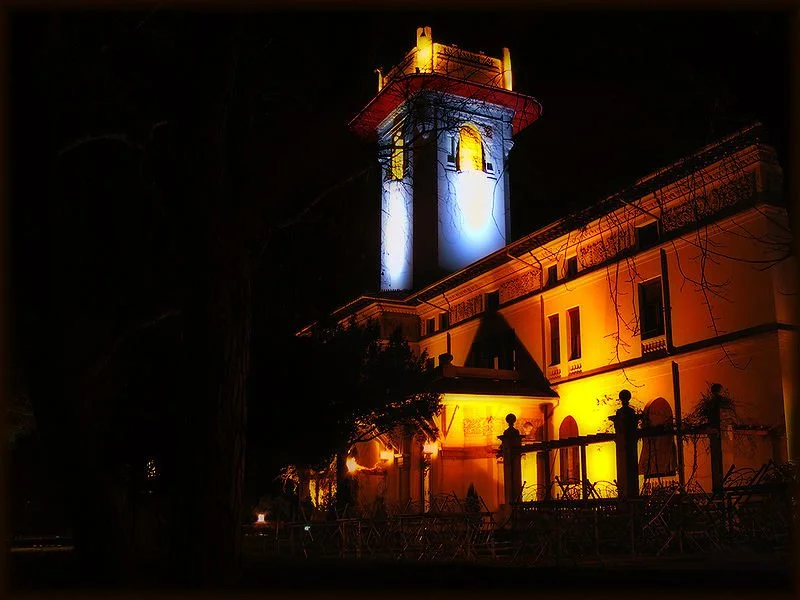

Khedive's Palace
Abbas Hilmi II had just been deposed as Khedive of Egypt when the British found him inconvenient enough to remove in 1914. But in 1907, when the palace above Çubuklu was completed, he was still ruler, still wealthy, and still determined to build something magnificent on a hilltop overlooking the Bosphorus. The result — a three-storey Art Nouveau villa in 270 acres of forest on the Asian shore — is one of Istanbul's stranger stories: an Egyptian ruler's summer retreat, designed in the style of an Italian Renaissance villa, decorated with carved fruit and gilded flowers, set in gardens planned by a Hungarian countess.
A Palace Above the Strait
The Khedive's Palace — known in Turkish as Hıdiv Kasrı, or Çubuklu Palace — stands on a hilltop in the Beykoz district, on the Asian shore of the Bosphorus. At 1,000 square meters, the three-storey building is substantial without being grandiose, its Art Nouveau lines softened by the surrounding woodland. Below, the Bosphorus curves north toward the Black Sea; across the water, the European skyline stretches along the opposite shore.
Completed in 1907, the palace was designed in Art Nouveau style inspired by Italian Renaissance villas, though its architect — Antonio Lasciac, an Austro-Hungarian who worked extensively for the Egyptian ruling family — wove in elements of late Ottoman neoclassicism as well. The ground-floor rooms encircle a central hall. One large hall features a fine fireplace. The upper floor holds two bedrooms. Throughout, walls and ceilings and marble capitals are carved with fruit, flowers, and hunting animals — imagery that reflects European aristocratic taste translated into Istanbul stone.
The Countess Who Designed the Gardens
The interior and gardens owe much to a woman the Ottoman court never officially acknowledged. Abbas Hilmi II's second wife — his unofficial, secret Hungarian wife — was born May Countess Torok von Szendro. In Istanbul she was known as Javidan Hanım, or Lady Djavidan. In her memoir, simply titled "Harem," she described how she oversaw the palace's development from construction through interior decoration, and how she personally designed the garden layout: the arrangement of the trees, the rose garden, the winding paths through the forest.
Stained glass features throughout the palace. The gate is decorated with gilded flowers. The 270-acre grounds — a grove that remains one of the largest intact woodland patches on the Bosphorus — were shaped by her hand. It is an unusual legacy: the gardens of an exiled Egyptian ruler's retreat, designed by a Hungarian aristocrat who could never be publicly named as his wife, now used as a public park by the citizens of Istanbul.
From Private Villa to Public Life
After Abbas Hilmi II was deposed and the palace passed out of Khedival hands, the building fell into disrepair. In the early 1980s, the Turkish Touring and Automobile Club (TTOK) undertook a full restoration under the direction of Çelik Gülersoy, the organization's director general. Two years of work brought the palace back to its 1907 condition, and it opened to the public in 1984.
For a decade the TTOK managed the property: the inner halls as a restaurant, the upper levels as a hotel, the marble hall and gardens as a café. In 1994 the Istanbul Metropolitan Municipality took over. The hotel is now closed, but the palace continues to serve as an event venue — capable of hosting up to 1,000 people in summer and 450 in winter — and the grounds remain open. Every April the property hosts part of the Istanbul Tulip Festival, when the gardens that Javidan Hanım designed more than a century ago fill with color again.
The Forest That Survived
What makes the Khedive's Palace compound genuinely rare in Istanbul is not the architecture but the landscape around it. The 270-acre grove that Abbas Hilmi II preserved as his palace grounds has remained largely intact while the rest of the Bosphorus shoreline urbanized around it. On the Asian side between Beykoz and Çubuklu, where hillside forests gave way to apartment blocks throughout the 20th century, this woodland survived because it was a private estate, then a protected property managed by public institutions.
The trees are old. The paths wind through dappled shade. From the hilltop terrace, the view down to the Bosphorus has not changed in its essentials since 1907 — water and sky and the opposite shore, the same view Abbas and Javidan would have known. Whatever the politics of his reign, whatever the complications of her unofficial status, they chose an extraordinary place to build.
From the Air
The Khedive's Palace sits at approximately 41.105°N, 29.074°E on a wooded hilltop above the Çubuklu neighborhood of the Beykoz district, on the Asian shore of the Bosphorus. It is easily identified from the air by the large forested grove surrounding the hilltop, a conspicuous green patch amid the denser urban development of the Asian Bosphorus shoreline. The nearest airport is Sabiha Gökçen International Airport (LTFJ), approximately 25 km to the southeast. From 3,000–4,000 feet approaching from the south, the Bosphorus narrows visibly near Anadolu Hisarı; the Çubuklu grove sits on the hillside to the north.
Nearby Stories
- Kocaeli Peninsula 7.6 km away
- Second Battle of Çatalca 11 km away
- Istanbul's Rural Outskirts 14 km away
- MV Struma 20 km away
- HMAS AE2 36 km away
- Bursa 66 km away
- Sangarius Bridge 71 km away
- Januarius MacGahan 101 km away