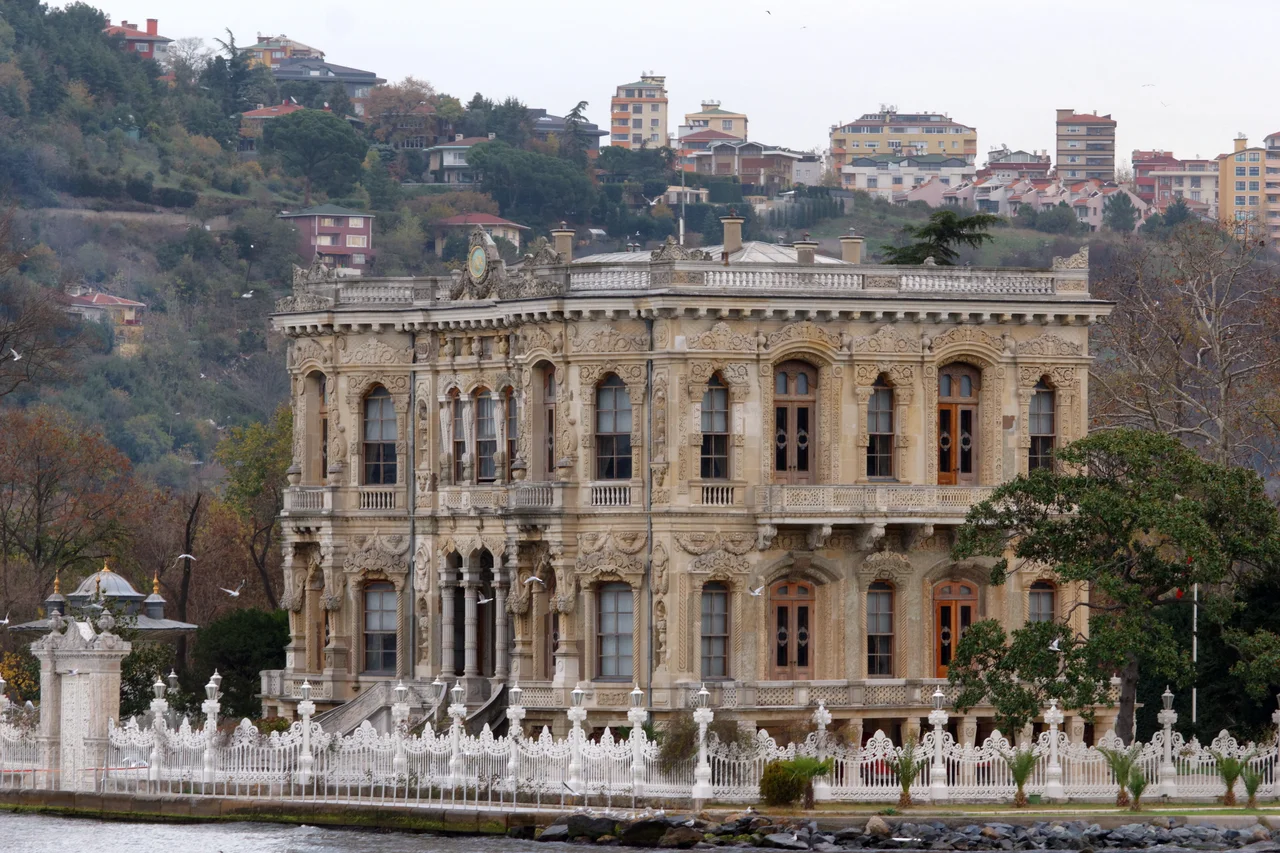

Küçüksu Pavilion
The name means two things at once. Küçüksu — Little Water — refers to the stream that once murmured past its garden gate; Göksu, Sky Water, names the larger stream nearby. The two waters gave this bend of the Bosphorus its character long before any pavilion stood here, and it was that character — cool, wooded, remote from the heat and ceremony of Topkapı — that drew Ottoman sultans to keep a summer lodge on this Asian shore for centuries. What stands today is not the original retreat but its grandest incarnation: a neo-baroque confection completed in 1857 that manages to be simultaneously intimate and extraordinary, a palace small enough to feel like a home and ornate enough to announce imperial power across open water.
A Palace Built for Pleasure
The building that preceded Küçüksu Pavilion was a two-storey timber structure erected during the reign of Mahmud I by his Grand Vizier Divittar Mehmed Pasha. Sultans Selim III and Mahmud II both used it in turn, each finding in this sheltered cove a respite from the capital's demands. When Sultan Abdülmecid I decided to rebuild it in stone and marble, he turned to the Balyan family — specifically Garabet Amira Balyan and his son Nigoğayos — the same Armenian architectural dynasty that was reshaping Ottoman Istanbul building by building. They delivered something remarkable. The footprint is modest, just 15 by 27 meters, but every surface insists on luxury. The façade billows with carved scrollwork and floral reliefs so exuberant they seem almost to move in the afternoon light. Inside, the plan follows the traditional Turkish house form — four corner rooms surrounding a central hall — but dressed in the European taste of the era. Crystal chandeliers from Bohemia hang overhead. The fireplaces are fashioned from colorful Italian marble, two in the Bosphorus-facing rooms, one each elsewhere. Curtains, upholstery, and carpets came from the looms of Hereke. Charles Séchan, who designed sets for the Vienna State Opera, was brought in to oversee the interior decoration. The result is a room that somehow feels both theatrical and restful.
Gardens Open to the Water
Most Ottoman imperial gardens were enclosed by high walls, turning inward, protecting the royal gaze from the outside world. Küçüksu's designers made a different choice. The garden surrounding the pavilion is bounded not by walls but by cast-iron railings, one gate opening at each of the four cardinal points. The Bosphorus lies just beyond. This openness was unusual, even radical, for a royal retreat — it allows the landscape to flow through rather than around the property, and it means that passersby on the strait have always been able to glimpse the marble façade from the water. Pleasure boats and caiques worked these waters for centuries, and the view of the pavilion glowing white against the green hills of the Asian shore would have been familiar to generations of Istanbullus. Sultan Abdülaziz, who reigned after Abdülmecid, added more elaborate ornamentation to the exterior, though some of the original garden outbuildings were lost at the same time. The balance between embellishment and loss has been the pavilion's story ever since.
From Guesthouse to Museum
The Ottoman Empire ended, the Republic began, and Küçüksu Pavilion changed hands along with everything else. In the early republican years the site served as a state guesthouse — official visitors received against a backdrop of imperial splendor, which is a particular kind of diplomatic statement. A thorough restoration in 1944 stabilized the building and opened it to the public as a museum, a status it retains today under the Directorate of National Palaces. The transition from royal hunting lodge to public institution has meant that the pavilion is now seen by people who would never have approached it in the Ottoman era, ferried across the strait on foot rather than arriving by royal caique. What they find is a building in remarkable condition given its age, small enough that a single visit can encompass it entirely, and detailed enough that the same visit rewards close attention.
Captured on Screen
Film crews have long understood what the sultans knew: Küçüksu is immediately convincing as a place of consequence. The James Bond film The World Is Not Enough used the pavilion as the mansion of oil heiress Elektra King, setting it, fictionally, in Baku — the logic being that the building's baroque confidence could plausibly belong to any wealthy and powerful figure anywhere around the Black Sea. The Bollywood production Ek Tha Tiger shot here as well. Neither production lingered long, but both left the pavilion with a second life on screen, recognizable now to audiences far beyond Istanbul. It is a strange kind of afterlife for a building that was always meant to be a private retreat: seen by millions in a medium its architects could not have imagined, playing a role in stories its patrons could not have anticipated.
Approaching from the Water
Standing at the pavilion's iron railing, you look directly out at the Bosphorus and at the world of movement it has always contained. The Fatih Sultan Mehmet Bridge hangs in the middle distance to the north; the ruins of Anadoluhisarı, the Anatolian fortress, anchor the near shore just south. This is the narrowing point where the strait pinches before widening again, and the currents here are noticeably stronger than elsewhere. On clear days the European hills are visible across the water. It is easy, standing here, to understand why the sultans returned season after season — not only for the hunting that gave the pavilion its purpose, but for the quality of this particular light on this particular reach of water, which changes hour by hour and is never quite the same twice.
From the Air
Küçüksu Pavilion sits at 41.0783°N, 29.0647°E on the Asian shore of the Bosphorus, tucked between Anadoluhisarı to the south and the Fatih Sultan Mehmet Bridge to the north. At 1,500–2,000 feet on a clear day the white neo-baroque facade is visible against the green hillside directly on the water's edge. The nearest airport is LTFJ (Sabiha Gökçen International), approximately 25 km to the southeast. The Bosphorus itself is the primary navigation corridor; the bridge spans at roughly 41.09°N provide useful orientation markers. Best viewing is from a heading of roughly 270° (westbound), approaching from the Asian interior, which presents the building and its open garden against the open strait.
Nearby Stories
- Kocaeli Peninsula 7.6 km away
- Second Battle of Çatalca 11 km away
- Istanbul's Rural Outskirts 14 km away
- MV Struma 20 km away
- HMAS AE2 36 km away
- Bursa 66 km away
- Sangarius Bridge 71 km away
- Januarius MacGahan 101 km away