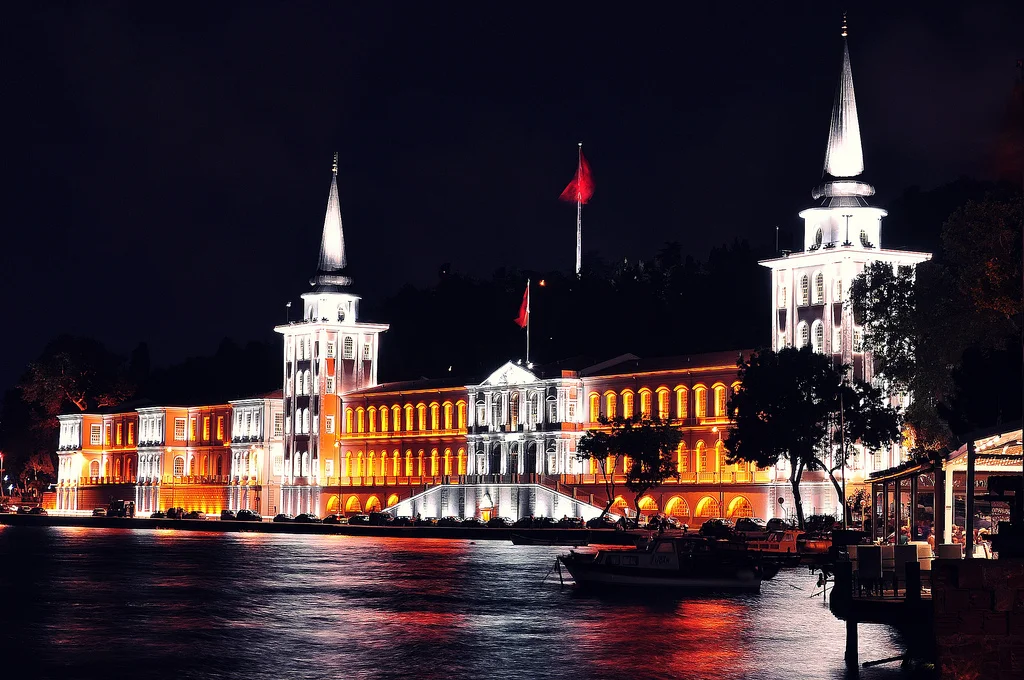

Kuleli Military High School
Every ship passing through the Bosphorus for the past century and a half has sailed past those twin towers. They rise from a long, white neoclassical building set directly at the water's edge in Çengelköy, so close to the strait that the stone seems to grow from the shoreline itself. Generations of cadets looked out from those towers at one of the world's great waterways; generations of sailors looked up at the building and knew, without asking, that they were passing something that mattered. Kuleli Military High School was Turkey's oldest military high school, founded in 1845 and finally closed in 2016 — 171 years of forming officers, surviving wars, changing governments, and enduring the full turbulent arc of Ottoman decline and Republican rise.
Built Before Its Purpose Arrived
The building now known as Kuleli was originally constructed as cavalry barracks. Ottoman Armenian architect Garabet Balyan — the same family name that appears on some of Istanbul's most celebrated buildings — completed the structure in 1843. It was an imposing commission even before any school occupied it: a long central block flanked by the cylindrical towers that would become the building's signature, set hard against the Bosphorus at Çengelköy on the Asian shore. The school that would eventually take possession of it began its life elsewhere. Established on 21 September 1845 under the name Mekteb-i Fünun-ı İdadiye — roughly, the School of Preparatory Sciences — it first occupied the Maçka Barracks, now part of Istanbul Technical University. Its second year opened with a formal ceremony in the presence of Sultan Abdülmecid I. The school moved through several locations before finally settling at the Kuleli Barracks in 1872, by which point it had become known simply as Kuleli Military High School, the name it would carry for the rest of its existence.
A School That Kept Becoming a Hospital
What strikes a reader working through Kuleli's history is how many times the building was commandeered, evacuated, and returned. During the Russo-Turkish War of 1877–78, students and staff relocated to the Military Academy in Pangaltı while Kuleli became a hospital. Back they came in 1879. During the Balkan Wars of 1912–13, the barracks converted to hospital use again; students scattered to Kandilli and Beylerbeyi. In World War I, the school spent time at the Prinkipo Greek Orthodox Orphanage on Büyükada island. Then, in 1918, the Armistice of Mudros gave the British occupying forces authority over Istanbul, and the Kuleli building was repurposed as a dormitory for Armenian orphans and refugees displaced during the war — people who had survived enormous loss and needed shelter. The school moved to tents near Kağıthane and then to a police station in Maçka. Britain evacuated Kuleli on 6 October 1923, following the Treaty of Lausanne, returning it to a Turkish army that had just won a war to reconstitute itself as a republic.
The Names in the Roster
Kuleli's alumni list reads like a compressed history of modern Turkey. Two presidents graduated from its classrooms: Cemal Gürsel, the fourth President, and Cevdet Sunay, the fifth. Multiple Chiefs of the General Staff passed through, among them İlker Başbuğ and Yaşar Büyükanıt. Cemal Paşa — officer and for a time mayor of Istanbul — attended, as did Field Marshal Fevzi Çakmak, who commanded Turkish forces through the War of Independence. The list extends into arts and letters: the poet Fazıl Hüsnü Dağlarca, writer and satirist Aziz Nesin, and Ömer Seyfettin, whose short stories remain central to Turkish literature. Fighter pilots, wrestlers, diplomats, and dermatologists — Hulusi Behçet, who identified the disease that now bears his name, was an alumnus. The building shaped them all, though what exactly a decade of discipline on the Bosphorus contributed to each life is impossible to measure.
Closure and Aftermath
The 2016 coup attempt in Turkey ended Kuleli's run as a military school with finality. On 31 July 2016, a government decree closed all military high schools in Turkey. Kuleli, along with its counterparts elsewhere, ceased operations. The building initially became a museum, then transitioned into a language school where military personnel learned foreign languages — a quieter purpose for walls that had once produced generals and presidents. The famous towers still stand. Ships still pass. The building remains one of the most recognizable landmarks on the entire Bosphorus, its long white facade reflecting off the water at dawn in a way that has not changed since Garabet Balyan set the stones in the 1840s. What has changed is the silence where the cadets used to be.
A Landmark on the Strait
There is something particular about institutions that occupy buildings of great architectural consequence — the building outlasts any single purpose assigned to it. Kuleli was barracks, then school, then hospital (several times over), then school again, then museum, then language academy. Through all of it the twin towers stood sentinel over a stretch of water that connects continents. The Asian shore here is narrower and quieter than the European side; Çengelköy retains a village feel that the opposite bank lost long ago. In that context the scale of the Kuleli building remains surprising — a grand neoclassical mass in a neighborhood of wooden houses and tea gardens, its presence a reminder that the Bosphorus has always attracted power as well as beauty.
From the Air
Kuleli Military High School sits at 41.0586°N, 29.0547°E on the Asian Bosphorus shore at Çengelköy, directly on the waterline south of the Fatih Sultan Mehmet Bridge. The building's twin towers make it unmistakable from the water and from the air; at 1,500–2,500 feet the long white facade is visible against the green Asian hillside. Nearest airport is LTFJ (Sabiha Gökçen International), approximately 27 km to the southeast. The Bosphorus strait provides the primary navigation reference; the Kuleli building lies on the Asian (eastern) bank, roughly halfway between the Fatih Sultan Mehmet Bridge to the north and the Bosphorus Bridge (15 Temmuz Şehitler Köprüsü) to the south.
Nearby Stories
- Kocaeli Peninsula 7.6 km away
- Second Battle of Çatalca 11 km away
- Istanbul's Rural Outskirts 14 km away
- MV Struma 20 km away
- HMAS AE2 36 km away
- Bursa 66 km away
- Sangarius Bridge 71 km away
- Januarius MacGahan 101 km away