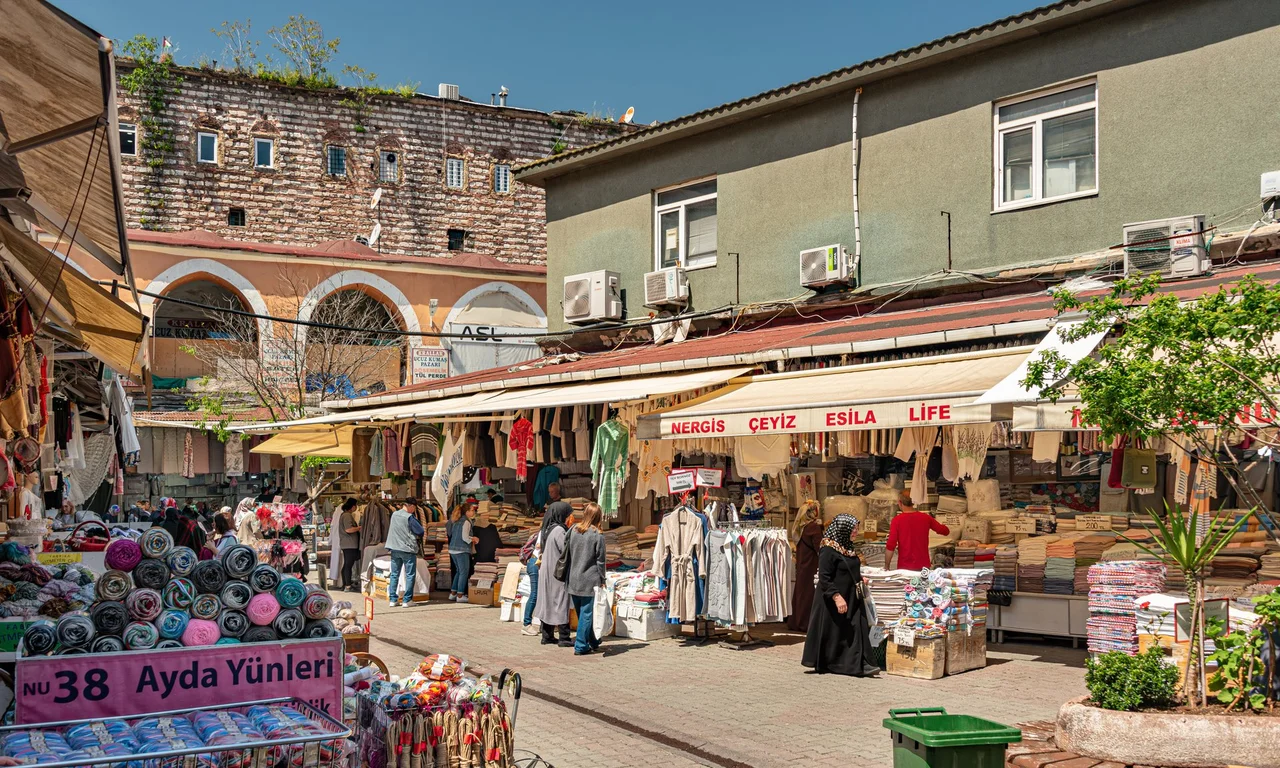

Kürkçü Han
When Mehmet II took Constantinople in 1453, he inherited a shattered city. Centuries of Byzantine decline had left the population drastically reduced and vast stretches of the urban fabric in disrepair. What followed was one of the most deliberate acts of urban reconstruction in medieval history: the systematic creation of a new commercial capital, quarter by quarter, institution by institution. The Grand Bazaar was its beating heart, and the Kürkçü Han — the furriers' caravanserai — was one of the first buildings raised to serve it. Commissioned by Mahmud Pasha, Mehmet's grand vizier, and completed in 1467, it is the oldest surviving caravanserai in Istanbul. More than five and a half centuries have passed since those stones were laid. The han is still standing.
The Man Who Built It
Mahmud Pasha Angelović was not a man of simple origins. Born into a Serbian noble family with Byzantine connections, he had entered Ottoman service and risen to become Mehmet II's most trusted administrator and military commander — twice grand vizier, repeatedly entrusted with the most sensitive campaigns of the empire's expansion. He was also a prolific builder. The han that bears the kürkçü designation — the furriers — was part of a larger complex that included a bathhouse, the Mahmut Pasha Hamam, located about a block to the south. That hamam survives as well, making Mahmud Pasha's contribution to the commercial district doubly legible today. The han itself served the fur trade specifically: kürkçü means furrier in Turkish, and the merchants who dealt in pelts — an expensive and globally traded commodity in the fifteenth and sixteenth centuries — made this courtyard their base. Where exactly the furs came from, the routes they traveled, the prices they commanded: all of that commerce passed through these gates.
What a Han Was For
The han as a building type deserves a moment of explanation, because understanding it changes how you see the structure. A han was not simply a warehouse, not simply a hotel, not simply an office building — it was all three at once, built around a courtyard that served as its organizing principle. Foreign merchants arrived with goods and needed somewhere to store them securely, somewhere to sleep, and somewhere from which to conduct negotiations. The han provided all of this. Workshops occupied the ground floor; sleeping rooms, offices, and storage occupied the upper floor. The courtyard in between was the place of encounter, where deals were struck and relationships formed. The Kürkçü Han had two such courtyards — a south courtyard with roughly 45 rooms on each of its two stories, and a north courtyard with about 30 rooms per story, totaling approximately 150 rooms in all. This was a substantial commercial facility by any standard, capable of accommodating many merchants and their goods simultaneously. The entrance gate today stands on the eastern side.
Five Centuries of Use and Modification
No building survives 550 years without change, and the Kürkçü Han is no exception. It has been modified, partly ruined at various points, and renovated — a cycle typical of Istanbul's historic commercial fabric, which has been burned, rebuilt, subdivided, and repurposed continuously across the centuries. The Grand Bazaar itself experienced catastrophic fires and wholesale rebuilding; the hans surrounding it were similarly vulnerable. What is remarkable is not that the Kürkçü Han shows its age, but that it survives at all, and in sufficient condition to remain recognizable as the structure Mahmud Pasha commissioned in the 1460s. The stone construction — typical of Ottoman hans of this period, in contrast to the lighter timber construction often used elsewhere — contributed to its durability. Stone burns less readily than wood, holds its shape through more insults, and forgives more of the structural damage that accumulates across centuries.
At the Edge of the Grand Bazaar
The location of the Kürkçü Han within Istanbul's commercial geography matters. It sits in the historic market district that runs from the Grand Bazaar — founded by Mehmet II between 1456 and 1461 — northward toward the Eminönü neighborhood on the Golden Horn shore. This district was built as a machine for trade, each building type fitting into a functional hierarchy: the covered bazaars at the center, the hans around the perimeter providing lodging and storage, the street markets extending outward in all directions. The han was not incidental to the bazaar but integral to it, the place where merchants came to rest and regroup between the transactions that took place in the covered halls a short walk away. Walking from the Grand Bazaar to the Kürkçü Han today takes only a few minutes and crosses some of the most commercially dense streets in Istanbul — streets where the same mixture of goods, noise, and bargaining pressure that existed in Mahmud Pasha's time continues, updated in its specific inventory but not in its essential character.
Oldest Is Not Always Most Famous
The Kürkçü Han does not attract the same crowds as the Grand Bazaar, which lies just minutes away and which draws millions of visitors annually. It is quieter, less curated, and requires some navigational intention to find — the main entrance on the eastern side is not prominently signed for tourists. This relative obscurity is part of its interest. To stand in the courtyard of the oldest surviving caravanserai in Istanbul is to encounter a building that has remained in use across a span of time that encompasses the entire history of the Ottoman Empire and a century of the Turkish Republic besides. Whatever happens inside its walls now, the structure itself is a fact about what this city has been and what it has managed to preserve.
From the Air
The Kürkçü Han sits at 41.0131°N, 28.9701°E in the historic commercial core of European Istanbul, within the Eminönü-Grand Bazaar district. From the air at 2,000–3,000 feet the Golden Horn is visible to the north and the Marmara Sea to the south; the dense market district is identifiable by its characteristic urban texture between the two. The nearest major airport is LTFM (Istanbul Airport), approximately 33 km to the northwest on the European side. The Grand Bazaar itself, one of the largest covered markets in the world, lies just to the southwest and serves as the most prominent aerial reference in this part of the city.
Nearby Stories
- Kocaeli Peninsula 7.6 km away
- Second Battle of Çatalca 11 km away
- Istanbul's Rural Outskirts 14 km away
- MV Struma 20 km away
- HMAS AE2 36 km away
- Bursa 66 km away
- Sangarius Bridge 71 km away
- Januarius MacGahan 101 km away