
Kuzguncuk
A tombstone in Kuzguncuk's old cemetery carries a date: 1562. It marks the earliest confirmed evidence of Jewish presence in this small Bosphorus neighborhood — which means that by the time the stone was carved, the Sephardic families expelled from Spain in 1492 and Portugal in 1497 had already been living here for at least two generations, long enough to have buried their dead and begun to think of this valley as home. Kuzguncuk — the name means, depending on the etymology you favor, either "little raven" or possibly a distortion of an older Slavic or Byzantine place name — had already been called many things before the Jews arrived. It would accumulate more communities still, each adding its own layer to a neighborhood that became, almost inadvertently, one of Istanbul's great experiments in coexistence.
Before Living Memory: Gilded Tiles and a General's Church
Byzantine sources suggest this valley on the Asian Bosphorus shore was once called Khrysokeramos — Golden Tile — after a church here with a gilded roof that caught the light for anyone passing on the water. The name Kuzguncuk itself may descend from a holy figure called Kuzgun Baba, said to have lived here during the reign of Sultan Mehmet II, or from an older toponym, Kozinitza, worn smooth by centuries of Turkish pronunciation. Around the year 553, the Byzantine general Narses — who had recently defeated the Ostrogoths in Italy and was in a position to be generous with his wealth — had a church built here dedicated to the Virgin Mary. That church is long gone. The gilded roof is gone. But the impulse that placed a sacred building in this particular valley, sheltered from the Bosphorus winds, opening toward the water, has never entirely left. Sacred buildings have stood in Kuzguncuk ever since.
The Arriving Communities
The Jews who came to Kuzguncuk in the late fifteenth and early sixteenth centuries were among the beneficiaries of one of Ottoman history's more consequential decisions: Sultan Bayezid II's acceptance of the Sephardic exiles after their expulsion from Spain and Portugal. As voluntary immigrants rather than conquered subjects, these families had some freedom to choose their place of settlement, and many moved beyond the established Jewish neighborhoods of the old city — places like Balat on the Golden Horn — to the Bosphorus villages. Kuzguncuk was one such village, small enough that newcomers could build community from the ground up. The 1562 tombstone tells us they were established here within decades. Armenians followed in the eighteenth century and had grown into a substantial community by the nineteenth; Ottoman records from 1834 document a petition from Armenian residents asking that their nighttime religious services be allowed to continue without interference. Their first church went up in 1835. Greeks were also present, worshipping at their own churches. Alongside all of this, a mosque served the Muslim residents, and the neighborhood that resulted was unusual in Istanbul and unusual by any standard: several faith communities living in close physical proximity, their institutions — two synagogues, multiple churches, a mosque — within a few minutes' walk of one another.
The Fractures of the Twentieth Century
The coexistence that Kuzguncuk embodied was real, but it was not immune to the political pressures that reshaped Istanbul's minority communities across the twentieth century. The establishment of Israel in 1948 drew many of Kuzguncuk's Jewish residents away, as it did from Jewish communities throughout Istanbul and across the diaspora. More damaging still was the Istanbul Pogrom of September 1955, in which organized violence — primarily targeting Greek, Armenian, and Jewish businesses and homes across the city — sent shockwaves through every minority community in Istanbul. Kuzguncuk's Greek and Armenian families emigrated in significant numbers in the pogrom's aftermath. The people who left were not abstractions: they were families with roots in the neighborhood going back generations, who had worshipped in those churches and been buried in those cemeteries, and who now found themselves making the calculation that their lives were safer elsewhere. The housing they vacated was filled by migrants from Anatolia — predominantly from the Black Sea region — who came in the decades that followed, so that by the end of the twentieth century the neighborhood's population was majority Muslim and largely of Black Sea origin, with sizable contingents from İnebolu, Rize, Trabzon, Tokat, Kars, and Sivas.
What Remains
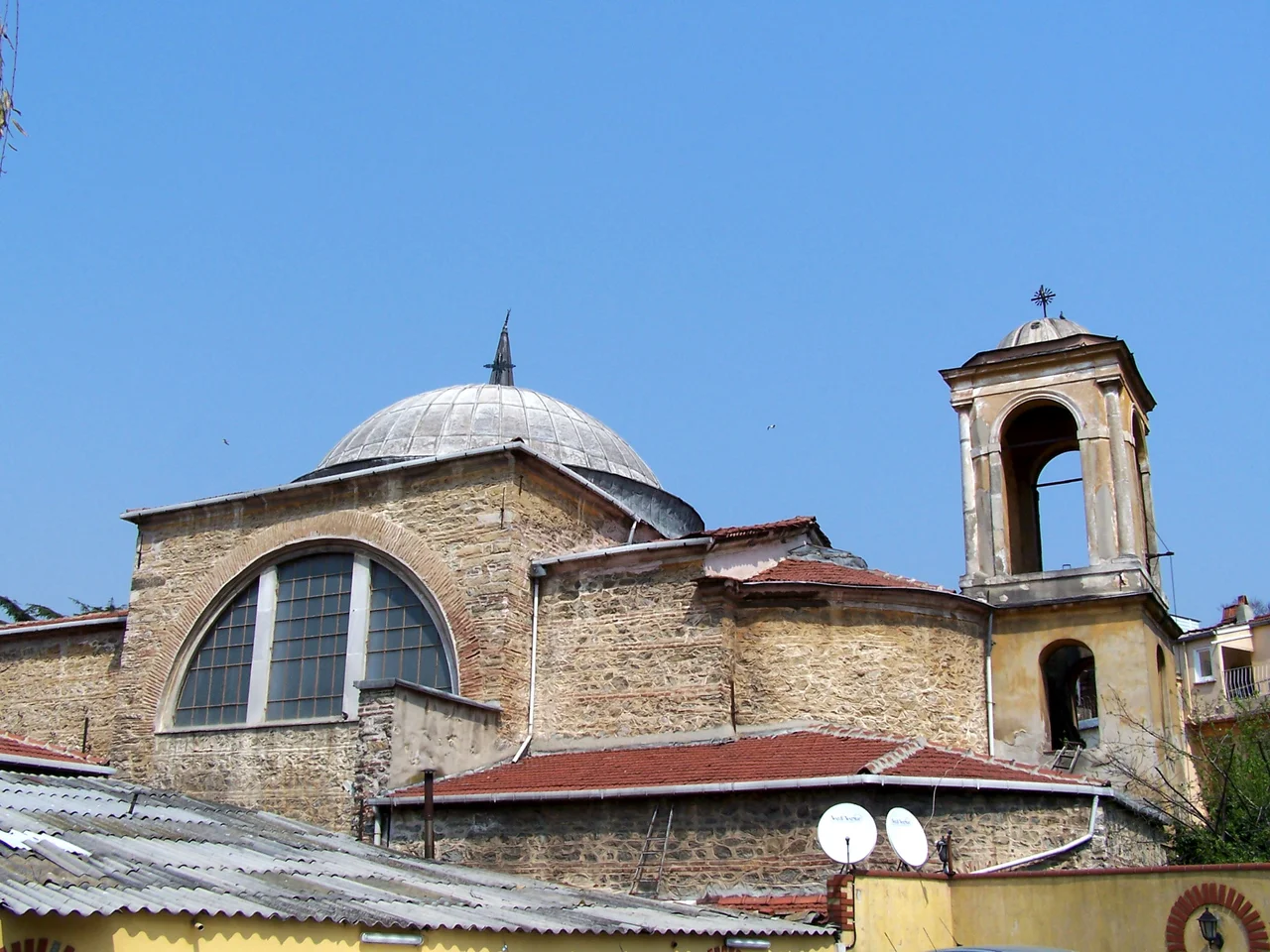
Two synagogues still stand in Kuzguncuk: the Bet Yaakov, built 1878, and the Bet Nissim, dating to the 1840s. The Surp Krikor Lusavoriç Armenian Church — named for Saint Gregory the Illuminator — was first built in 1835 and rebuilt in 1861; it still stands. So do two Greek Orthodox churches, Ayios Yeorgios and Ayios Panteleimon, and a Greek Orthodox sanctuary, Ayios Ioannis, which houses a holy spring. The Üryanizade Mosque on the northern shore edge was built as a small mosque in 1860. Walking through Kuzguncuk today you encounter these buildings in close succession, on a street scale that permits you to see multiple houses of worship from a single vantage point. Whether this proximity feels remarkable or ordinary depends on what you're used to; for people accustomed to cities where different faiths occupy separate zones, it is striking. The Nakkaştepe Jewish Cemetery is also here. The dead of multiple communities rest in this valley.
Quiet Streets, Wooden Houses, Plane Trees
Beyond its history of faith and community, Kuzguncuk is simply a pleasant place to be. The neighborhood's population of 4,151 (2022) makes it small by Istanbul standards, and its physical geography — tucked into a valley, surrounded on three sides by nature preserves, cemeteries, and a military installation — gives it an isolation unusual for a city of its size. The streets are lined with Ottoman wooden houses in various states of preservation and repair. Plane trees shade the main street. Vegetable gardens, locally called bostans, still operate in some of the valley spaces. This combination of visual charm, architectural authenticity, and human scale has made Kuzguncuk a favorite location for Turkish film and television production since the popular comedy series Perihan Abla shot here in the late 1980s (1986–1988). The residents find the constant production activity more disruptive than flattering, which is understandable — it is, after all, their neighborhood, not a set.
From the Air
Kuzguncuk sits at 41.0367°N, 29.0297°E on the Asian shore of the Bosphorus, in the district of Üsküdar, south of Beylerbeyi and north of İcadiye. The neighborhood occupies a valley opening directly onto the strait; from the air at 1,500–2,500 feet the wooded hillsides enclosing the valley are clearly visible, with the built-up area concentrated along the Bosphorus waterfront. The nearest airport is LTFJ (Sabiha Gökçen International), approximately 22 km to the southeast. The Bosphorus Bridge (15 Temmuz Şehitler Köprüsü) spans roughly 1.5 km to the south at 41.025°N, providing a clear aerial reference; Beylerbeyi Palace is visible on the waterfront immediately to the north.
Nearby Stories
- Kocaeli Peninsula 7.6 km away
- Second Battle of Çatalca 11 km away
- Istanbul's Rural Outskirts 14 km away
- MV Struma 20 km away
- HMAS AE2 36 km away
- Bursa 66 km away
- Sangarius Bridge 71 km away
- Januarius MacGahan 101 km away