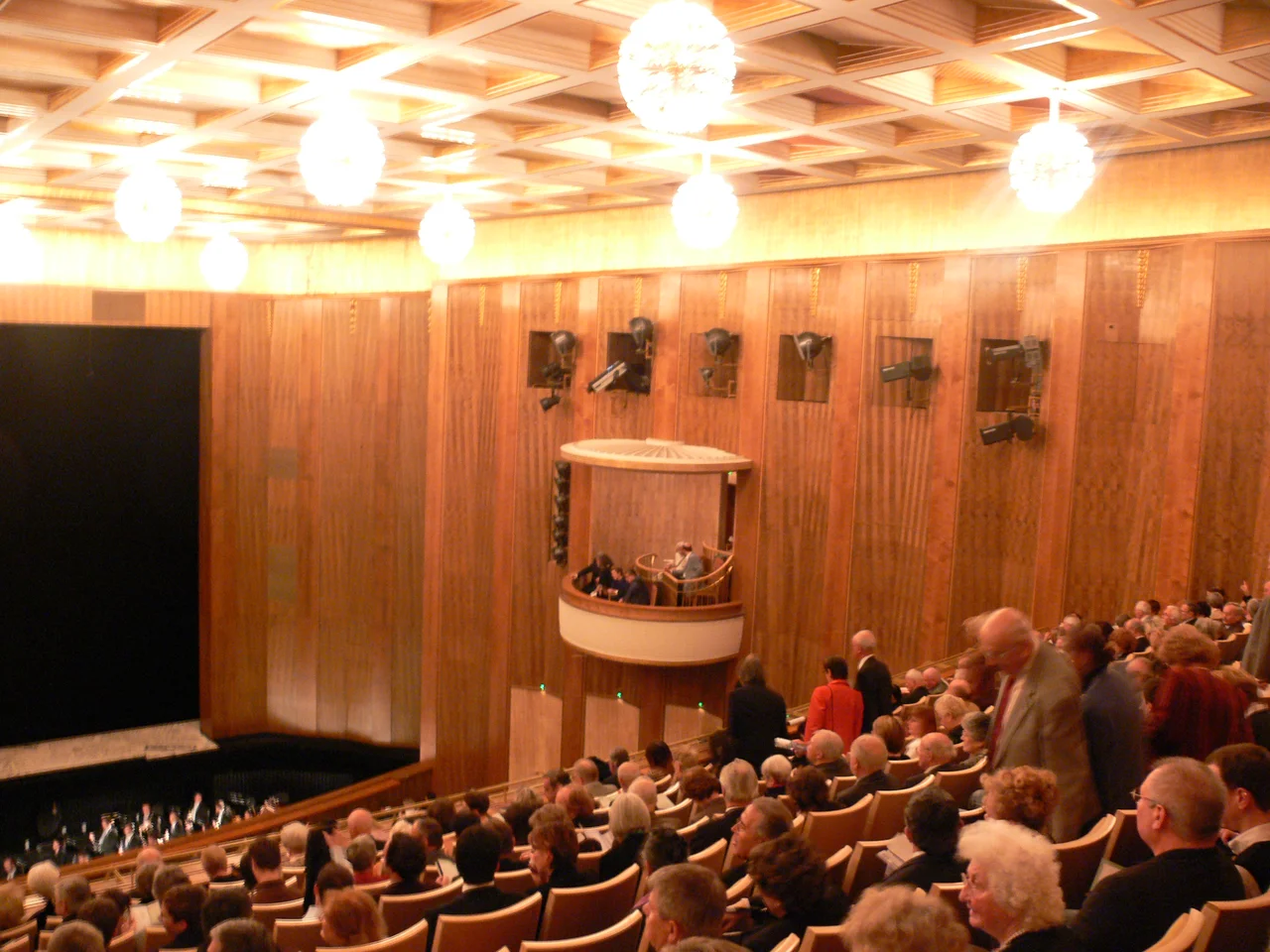

Leipzig Opera
Three buildings have housed the Oper Leipzig over its 332-year history. The first was the Oper am Bruhl, opened in 1693 with Telemann eventually directing it - making Leipzig the third city in Europe, after Venice and Hamburg, with a permanent opera house. The second was the Neues Theater, inaugurated in January 1868, where the young Gustav Mahler conducted under Arthur Nikisch from 1886 to 1888 and where he completed his First Symphony. Both buildings are gone. The Neues Theater burned to the ground during the RAF firebombing on the night of 3 December 1943, along with every other theater in Leipzig. The third building - the one that stands today on the Augustusplatz - was opened on 8 October 1960 with Wagner's Die Meistersinger von Nurnberg, and it is the rare opera house that says, in its very stones, both 'we are the heirs of Mahler' and 'we were rebuilt by the GDR.' The architecture is unapologetic socialist classicism. The repertoire is unapologetically world-class.
Telemann's Beginning
Singspiel performances are documented in Leipzig from 1693, and within a decade the city had a dedicated opera house. Georg Philipp Telemann directed the Oper am Bruhl from 1703 to 1705, composing many of the works he conducted - he would do the same later in Hamburg. The Leipzig house had a peculiar institutional character from the start: it was a merchant city's opera, supported by trade-fair money rather than by a court, and that gave it both a fragility (when the merchants pulled funding, it closed) and a freedom (it could program what audiences wanted, not what a duke's mistress preferred). The house went through several closures and reopenings across the eighteenth century before settling into a more permanent existence in the nineteenth. Throughout it shared an orchestra with the city's concerts: from 1766 the Gewandhaus Orchestra, founded in 1743, has played in the opera pit - a relationship that still defines both institutions.
Mahler in the Pit
The Neues Theater of 1868 was where Leipzig opera came of age internationally. Gustav Mahler arrived in 1886 as second conductor, working under Arthur Nikisch, and stayed for two years that proved decisive for his career. He completed Carl Maria von Weber's unfinished opera Die Drei Pintos here, conducting its premiere in January 1888 to international acclaim - it was Mahler's first major public success. He also finished his own Symphony No. 1 in Leipzig. The same theater hosted a roll call of premieres that defined twentieth-century musical theater: Marschner's Der Vampyr in 1828, Lortzing's Zar und Zimmermann in 1837, Schumann's Genoveva in 1850. Later it would premiere Ethel Smyth's The Wreckers in 1906, Krenek's jazz-influenced scandal Jonny spielt auf in 1927, and - most famously - Kurt Weill and Bertolt Brecht's Aufstieg und Fall der Stadt Mahagonny in 1930, an opera so politically provocative that the Nazis would later make a point of banning it.
Firebombed
On the night of 3 December 1943, RAF Bomber Command launched a major raid on Leipzig with high-explosive ordnance. The Neues Theater took direct hits and burned through the night. By morning every theater in the city was either destroyed or unusable. Leipzig had been a city of music since the medieval trade fairs - Bach's St. Thomas, Mendelssohn's conservatory, Wagner's birthplace, the Gewandhaus - and now its largest stage was gone. For seventeen years the company performed where it could: in the surviving Schauspielhaus, in the Gewandhaus, in temporary venues. Construction of a replacement began in 1956, in a city now firmly inside the German Democratic Republic. The new opera house, a massive sandstone-and-glass cube on the Augustusplatz, was designed in the official style of the socialist 1950s but engineered for a serious modern repertoire. The October 1960 opening with Die Meistersinger was a deliberate statement: Wagner, in Wagner's birth city, in the GDR's flagship opera house.
The Modern House
Music directors since reunification have included Lothar Zagrosek, Riccardo Chailly (2005-2008), and Ulf Schirmer (2009-2022, also serving as Intendant from 2011). Tobias Wolff became Intendant in 2022. The Gewandhaus Orchestra still plays the pit - a continuous relationship now stretching from 1766. World premieres continue: Stockhausen's Dienstag aus Licht in 1993 and Freitag aus Licht in 1996, Hersant's Der schwarze Monch in 2006, Gordon Getty's The Canterville Ghost in 2015. The opera also runs an unusually serious children's choir program, with regular productions written specifically for young voices. Walking up to the building from the Augustusplatz, the GDR-era facade reads as authoritarian, but inside the auditorium the curve of the boxes and the warmth of the wood are pure opera-house DNA - the descendant, through three buildings and 332 years, of the merchants who decided in 1693 that Leipzig deserved its own stage.
From the Air
Located at 51.34 degrees N, 12.38 degrees E on Augustusplatz at the eastern edge of Leipzig's inner ring, immediately across the square from the Gewandhaus concert hall. The flat-roofed sandstone building is a recognizable rectangular volume in the dense city center. Nearest major airport: EDDP (Leipzig/Halle) about 18 km northwest; EDDB (Berlin Brandenburg) about 165 km north-northeast. Best photographed at dusk when the auditorium windows light up the facade.
Nearby Stories
- Colditz Castle 23 km away
- Lutherhaus 24 km away
- Naumburg Cathedral 31 km away
- Battle of Jena-Auerstedt 35 km away
- Kingdom of Saxony 52 km away
- Moritzburg Castle 54 km away
- Einstein Tower 78 km away
- Gardelegen Massacre 102 km away