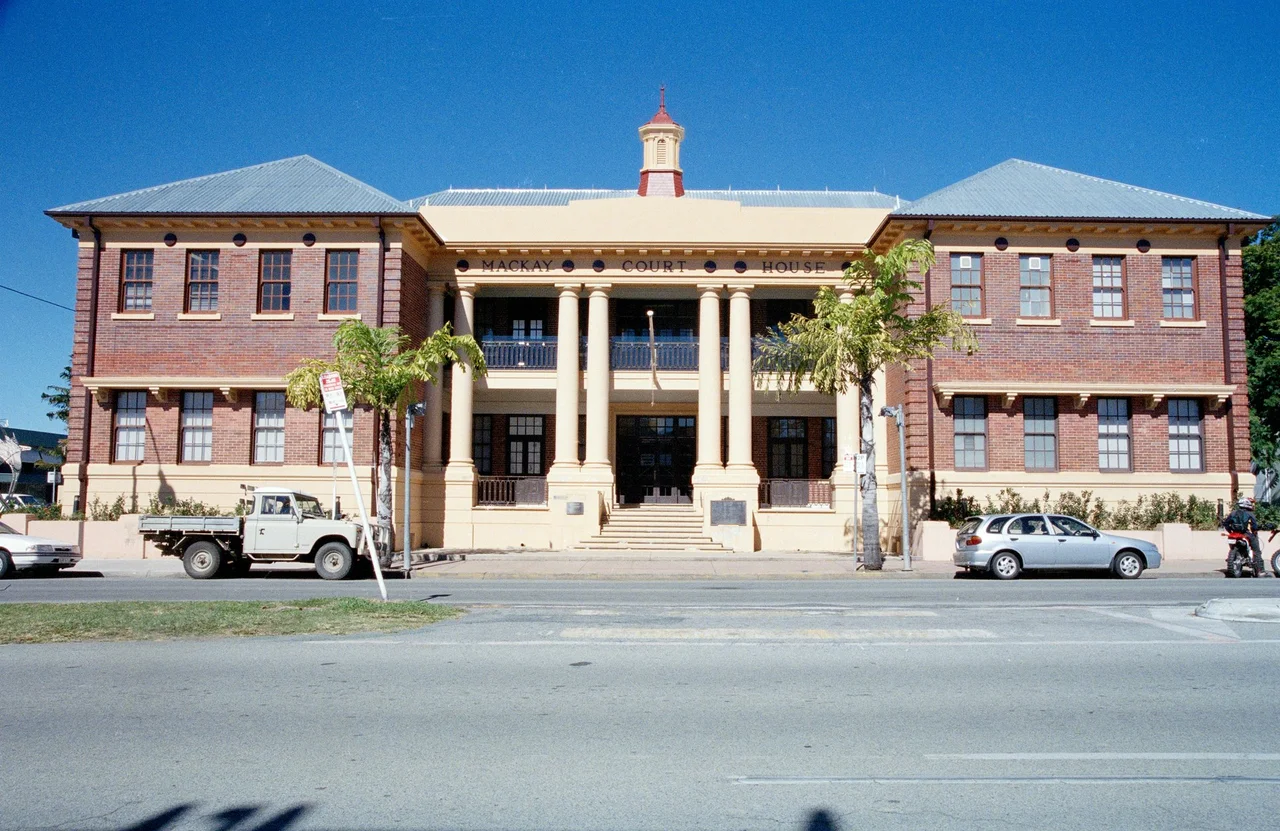
Mackay Court House and Police Station
When Mackay tried to demolish its old police station in 1989, the town pushed back hard enough to stop it. That instinct - to keep the building rather than clear the lot - tells you something about what stands on the corner of Victoria and Brisbane Streets. Here, on one city block, two courthouses face the world from opposite eras: a stern classical hall from the 1880s sugar boom, and a grand Georgian-revival pile raised by Depression labour in the 1930s. Between them they trace, in brick and rendered stone, the entire arc of how the law planted itself in this corner of Queensland.
Law on Horseback
Justice came to Mackay before the courthouses did. By late 1863 the township had two police constables; in 1865 a watch house went up and a Police Magistrate arrived to ride the district. The young colony faced a brutal arithmetic - a vast territory, a scattered population, almost no roads, and very little money. The solution was to bundle everything onto one site: court, lock-up, barracks, and a paddock for the horses that carried the law from town to town. A timber courthouse appeared in 1872, was found wanting almost immediately, and was replaced the next year. The pace of rebuilding mirrored the speed at which money, cane, and people were pouring into the Pioneer Valley.
The Architect's Power of Stone
By the mid-1880s the sugar industry was booming and Mackay demanded a courthouse to match its ambitions. The commission went to John James Clark, the Queensland Colonial Architect - a Liverpool-trained prodigy who had won competitions across Melbourne and designed that city's Treasury before moving north. Clark built Mackay's courthouse in the classical revival style he used for Charters Towers, Rockhampton, and Warwick, a language chosen deliberately to make the law feel permanent and unanswerable. Rendered brick was scored to imitate cut stone. A Tuscan portico rose two storeys to a triangular pediment. The building opened on 27 May 1886, and on 15 June the Supreme Court sat in Mackay for the first time. The message in every column was the same: this authority is here to stay.
Built by the Unemployed
The town that suffered a devastating cyclone in 1918 became, improbably, the fastest-growing in Queensland between the wars - its population doubling from 1920 to 1940 once the railway reached it in 1924. When the Depression threw thousands out of work, the Labor government answered with public building programs, and Mackay's justice precinct was rebuilt on the backs of those projects. Brick police residences went up in 1936 and 1937, finer than anything comparable elsewhere in regional Queensland. Then came the centrepiece: a grand two-storey courthouse by Government Architect Andrew Baxter Leven, its Georgian-revival facade fronted by paired Tuscan columns and a wrought-iron balustrade. Premier William Forgan Smith laid the foundation stone on 31 March 1938. Inside, the halls were panelled in polished silky oak and floored with coloured terrazzo - public grandeur paid for by men who badly needed the wages.
A Reversal of Roles
When the new courthouse opened, the buildings quietly swapped jobs. The 1886 hall - too small for decades - became the police station, reworked in 1940 and 1941 with a new upper level and a recreation room. A starkly modern watch house, all face brick and patterned concrete blocks in the International style, joined the complex in 1962 and 1963. Walk the block today and you read the whole sequence at a glance: Clark's scored-stone classicism, Leven's confident Georgian colonnade, the bungalow residences echoing the pediment of the building they served, and the austere mid-century cell block behind. After the people of Mackay saved the old station in 1989, it and the 1938 courthouse were refurbished in 1990 and 1991. The lawn-set ensemble survives as one of Queensland's most complete records of how a colonial town built, and rebuilt, the architecture of its own authority.
From the Air
The complex stands at 21.142°S, 149.188°E in central Mackay, on the corner of Victoria and Brisbane Streets, a block back from the Pioneer River. The grand courthouses are low-rise but distinctive against the surrounding CBD grid. Nearest airport is Mackay (YBMK / MKY), about 3 km south; Hamilton Island (YBHM / HTI) and Proserpine / Whitsunday Coast (YBPN / PPP) lie to the north. Best viewed in clear morning light when the rendered facades catch the sun; the city sits in a humid subtropical zone where afternoon wet-season storms can cut visibility.
Nearby Stories
- Eungella National Park 7.9 km away
- Brampton Island 13 km away
- Pine Islet Light 52 km away
- Brigalow Belt 86 km away
- Proserpine 88 km away
- Canal Creek Air Crash 213 km away
- Coral Sea Islands 235 km away
- Great Keppel Island 262 km away